How to Choose Kitchen Cabinets for Your Oahu Kitchen
Key takeaway
Choosing kitchen cabinets comes down to four decisions, in this order: box construction (plywood vs. particleboard), door style and finish, layout and storage needs, and hardware. Get those four right and the cabinets will hold up to daily use and, on Oahu, to humidity and salt air. Everything else — color trends, brand names — is secondary to those four structural choices.
Key takeaways
- Choose plywood boxes over particleboard if the kitchen sees regular moisture or heavy daily use; plywood resists swelling better over time.
- Map your storage needs (pots, trash, recycling, pantry goods) before picking a door style — layout drives cabinet count, not the reverse.
- On Oahu, confirm humidity-rated materials and, for condos, AOAO paperwork requirements before you order, since both affect what can actually be installed.
Start with box construction, not door style
The cabinet "box" (the carcass behind the door) is what determines how long the cabinet lasts, and most buyers skip straight to door color without checking it. Boxes are typically built from one of two materials:
- Plywood — layered wood veneers glued under pressure. More resistant to swelling from humidity and more capable of holding screws over repeated opening and closing.
- Particleboard or MDF — wood fibers bonded with resin. Lighter and often less expensive to produce, but more prone to swelling if it gets wet and screws can strip out faster with heavy use.
Composite wood products sold in the U.S., including particleboard and MDF cabinet components, are subject to formaldehyde emission limits under the EPA's TSCA Title VI rule, which is worth asking about if anyone in the home has respiratory sensitivities. Ask any cabinet maker directly whether boxes are plywood, particleboard, or a mix — drawer boxes and cabinet backs are common places where cheaper material gets substituted even on an otherwise solid product.
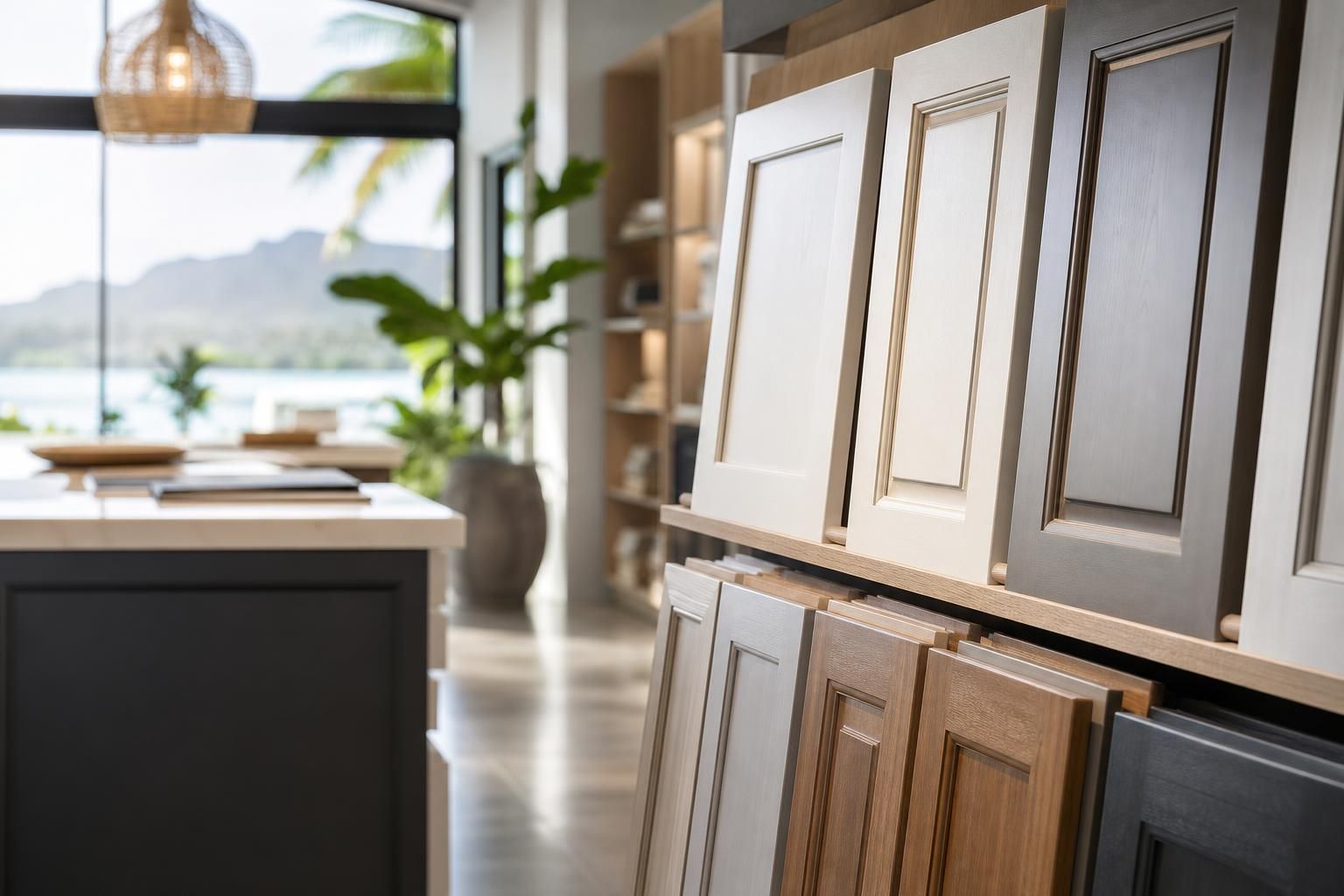
Pick a door style and finish that matches how the kitchen gets used
Door style is mostly aesthetic, but finish type affects maintenance:
- Slab/flat-panel — simple, modern, easiest to wipe clean since there are no grooves to catch grease.
- Shaker — a recessed center panel with a flat frame; the most common style because it reads as both traditional and modern.
- Raised panel — more ornate, with more surface detail that can collect dust and grease in the grooves.
For finish, painted and thermofoil doors show fingerprints differently than stained wood grain, and painted MDF doors can chip at corners over years of use in a way that solid wood touches up more easily. If you're weighing finish against hardware together, this guide to cabinet hardware finishes covers which finishes hold their look longest under daily hand contact.
Plan storage and layout before locking in a style
Cabinet selection is really a storage planning exercise. Walk through what actually needs a home: trash and recycling pull-outs, a pantry column, corner cabinet access (lazy susan or a pull-out blind corner unit), and drawer stacks for pots instead of lower cabinets with shelves. The National Kitchen & Bath Association publishes planning guidelines that recommend at least 42 inches of clearance in a walkway with cabinets on one side, and more where two people work at once — a number worth measuring against your own kitchen footprint before finalizing cabinet widths.
If your kitchen includes an island, the clearance on both sides needs to accommodate open dishwasher and oven doors, not just walking room — see how much space to leave between cabinets and an island for the specific measurements to check. And if the kitchen itself is small, cabinet depth and height choices change the math entirely; what size cabinets fit a small kitchen walks through scaling cabinet runs to a tight footprint without losing storage.
Choose hardware built for humidity and salt air
Hardware is a small line item that gets ignored until it corrodes. In coastal and humid environments, cheaper plated finishes can pit or discolor faster than a solid finish like stainless steel or a powder-coated matte black. The National Institute of Standards and Technology has documented how salt-laden coastal air accelerates corrosion on unprotected metals — a mechanism that applies to cabinet hinges and pulls just as much as it does to outdoor railings, especially in homes within a mile or two of the shoreline. Soft-close hinges are now standard on most mid-range and above cabinet lines and are worth requesting even if they add a small amount to the order, since they reduce wear on the box itself over years of daily use.
Measure and plan around Oahu-specific conditions
A cabinet order that looks right on paper can run into real problems during installation if a few local conditions aren't checked first:
- Subfloor and wall irregularities — older Oahu homes often have settled floors or out-of-square walls, which means cabinet runs need scribe strips or filler panels to sit flush; a cabinet maker who's measured in older local homes before will flag this at the walkthrough.
- Elevator and loading-dock access — for condo and high-rise kitchens, cabinet boxes have to physically fit through the building's elevator and service entrance, which can mean boxes are assembled on-site instead of delivered whole.
- AOAO board approval — many Oahu condo associations require material specs and sometimes sound-rating documentation before a kitchen renovation is approved, and getting that paperwork wrong is one of the most common delays condo owners run into.
- Freight lead time on special orders — any cabinet line, finish, or hardware not stocked locally ships from off-island, which extends lead time beyond what a mainland buyer would expect.
If you're starting from scratch, the right order of steps for a kitchen remodel lays out when cabinet selection should happen relative to flooring, countertops, and electrical work — getting that sequence wrong is a common cause of rework. And whether you're in Honolulu, Kapolei, or elsewhere on the island, working with a cabinet maker who understands local conditions up front avoids most of the surprises above.
Decide between stock, semi-custom, and custom
These three tiers determine how much flexibility you have:
- Stock cabinets — pre-built in standard sizes, fastest to get, limited to a fixed set of widths and finishes.
- Semi-custom cabinets — standard boxes with more size, finish, and storage-insert options; the most common choice for kitchens that aren't a perfectly standard shape.
- Custom cabinets — built to the kitchen's exact dimensions, including non-standard widths, ceiling heights, and built-in features like appliance garages or furniture-style end panels.
Custom is usually the right call for irregular kitchen layouts, oddly shaped condo galleys, or anyone trying to use every inch of a small footprint. Oahu Flooring Quote connects homeowners with cabinet makers who work in all three tiers and can advise which one fits a given kitchen's shape and timeline. Touching actual door and finish samples in person — rather than judging from a photo — also changes people's decisions more often than you'd expect, since finish sheen and wood grain read very differently under kitchen lighting than on a screen.
Frequently Asked Questions
Q: What's the real difference between stock and custom cabinets?
Stock cabinets come in fixed standard sizes and ship fastest; custom cabinets are built to a kitchen's exact dimensions and can include non-standard widths, heights, and storage features. Semi-custom sits in between, offering more size and finish options on a standard box structure.
Q: Should I choose plywood or particleboard cabinet boxes?
Plywood boxes resist moisture swelling and hold screws better over years of daily use, which matters in humid Oahu kitchens. Particleboard and MDF are common in lower-cost lines but are more prone to swelling if exposed to water and can strip screws faster under heavy use.
Q: How much clearance do I need around a kitchen island?
Industry planning guidelines generally call for at least 42 inches of clearance in a one-cook walkway, with more where appliance doors need to open or two people work at once. Exact clearance depends on cabinet depth, appliance placement, and island size, so it's worth measuring your specific layout.
Q: Do Oahu condo kitchens need special cabinet approval?
Many Oahu condo associations (AOAOs) require material specifications, and sometimes sound-rating documentation, before approving a kitchen renovation. Getting that paperwork prepared correctly before submission is one of the most common points where condo projects get delayed.
Q: What cabinet hardware finish holds up best in a coastal climate?
Solid finishes like stainless steel or powder-coated matte black generally resist pitting and discoloration better than thin plated finishes in humid, salt-air environments. Soft-close hinges are also worth requesting regardless of finish, since they reduce wear on the cabinet box over time.