Melamine vs Wood Cabinets: Which Holds Up on Oahu?
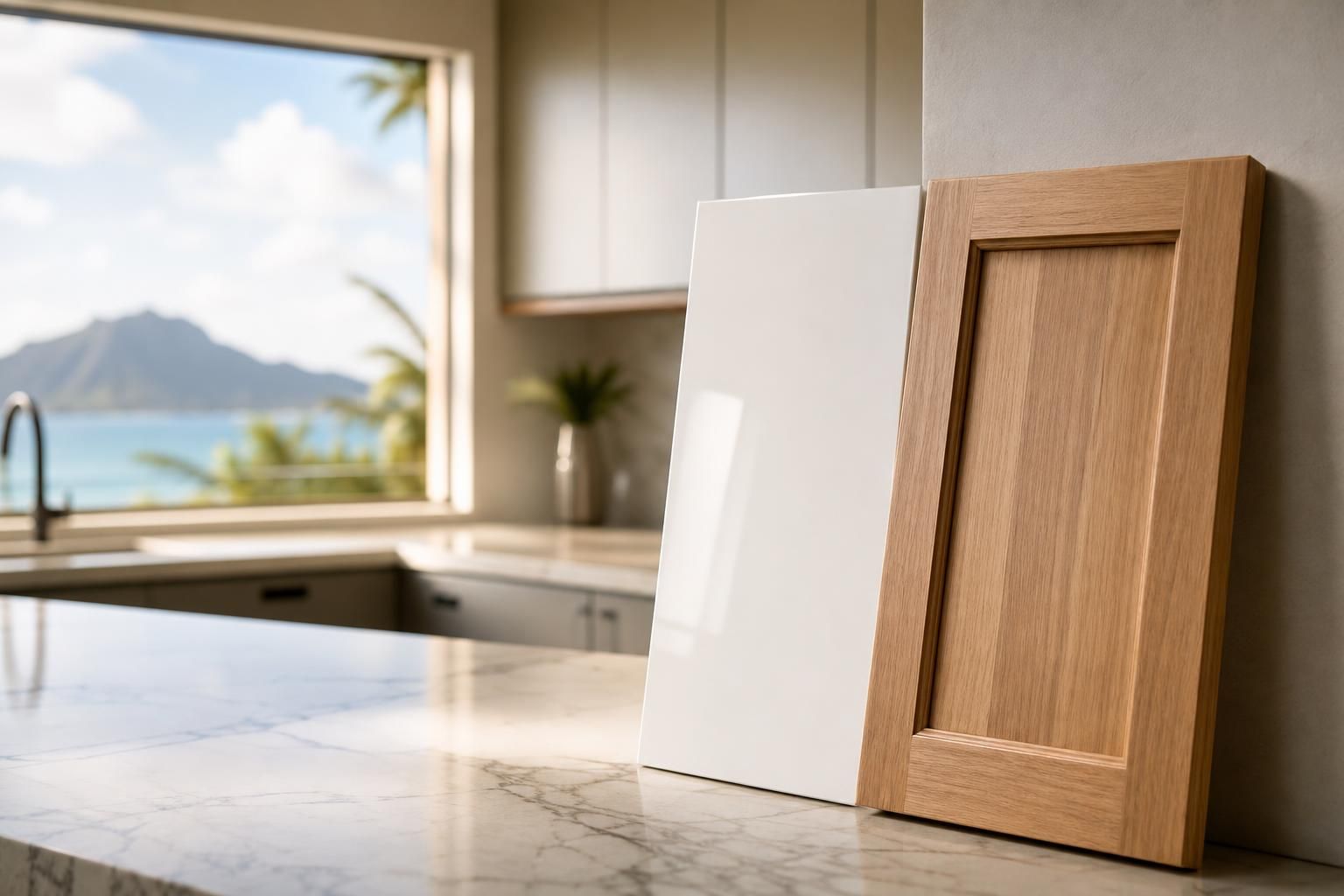
Key takeaway
Melamine cabinets are a flat, moisture-resistant panel (particleboard or MDF core with a plastic laminate face) that resists humidity and swelling better than solid wood, while wood cabinets offer real grain, refinishing ability, and a traditional look but need better climate control to avoid warping in Hawaii's humidity. For most Oahu kitchens and condos, melamine construction with a hardwood or plywood box is the more durable everyday choice; solid wood face frames and doors still make sense where budget allows for ongoing care and the owner wants a specific wood species.
Key takeaways
- Melamine resists humidity swelling better than solid wood veneer or slab doors, which matters year-round in Oahu's trade-wind climate.
- Box construction (plywood vs. particleboard) often affects long-term durability more than whether the door face is melamine or wood.
- The only way to know what a cabinet package costs for your kitchen's layout and finish level is a quote against your actual measurements.
What "Melamine" and "Wood" Actually Mean in a Cabinet Quote
Cabinet suppliers use "melamine" to describe a thermally fused laminate on top of particleboard or medium-density fiberboard (MDF). It's not a cheap sticker — it's heat-pressed under pressure so the surface resists scratching, staining, and moisture penetration better than raw wood or many painted finishes. "Wood" cabinets usually mean either solid wood doors and face frames over a plywood box, or a wood veneer glued to a substrate. The box (the cabinet's internal structure) is a separate decision from the door face, and on Oahu that box material matters as much as what you see from the front.
A kitchen can mix both: melamine interiors and shelving (because they wipe clean and don't absorb moisture) paired with wood or wood-look doors for the look buyers want. That's a common configuration local suppliers quote, and it's worth asking about specifically rather than assuming "wood cabinets" means solid wood everywhere.
How Oahu's Climate Changes the Calculation
Honolulu sits in a consistently humid, salt-air environment, and that affects wood differently than it affects engineered panels. Solid wood expands and contracts with humidity swings, which over years can loosen joints, warp doors, or create gaps at drawer fronts — especially in homes without reliable air conditioning or in units near the shoreline. Average relative humidity in Honolulu typically runs high year-round according to NOAA's climate records, which is the kind of steady moisture load that stresses solid wood more than it stresses a sealed laminate surface.
Melamine's plastic face doesn't absorb ambient moisture the way raw or veneered wood can, so it's less prone to the swelling and finish failure that shows up over time in older Oahu homes with minimal climate control. That's one reason it's a frequent choice for rental units, condos, and homes without central air — not because it looks cheaper, but because it tolerates the environment with less long-term maintenance.
Durability, Maintenance, and Repair Differences
The two materials fail differently, and that matters for homeowners planning to stay put for years versus those renovating a rental.
| Factor | Melamine | Solid Wood / Veneer |
|---|---|---|
| Moisture resistance | High — sealed laminate face resists swelling | Lower — absorbs humidity, can warp or swell |
| Scratch/stain resistance | High on the face; edges can chip if impacted | Moderate; shows wear but can be sanded |
| Refinishing | Not refinishable — damaged panels are replaced | Can be sanded, restained, or repainted |
| Look and feel | Flat, consistent color/woodgrain print | Natural grain variation, authentic texture |
| Edge/impact damage | Chips at corners and edges over time | Dents but rarely chips at the surface |
| Long-term in condo units | Performs well with AC cycling and AOAO humidity limits | Needs more consistent indoor climate control |
Melamine's weak point is edge damage — a hard impact can chip the laminate at a corner in a way that's visible and not repairable like a wood scratch. Wood's weak point is the opposite: it rarely chips, but humidity and UV exposure change its color and can loosen joinery over years, which eventually means refinishing or replacement rather than a quick touch-up.
Box Construction Matters as Much as the Door Face
Whether the door is melamine or wood, ask what the box itself is made from. Plywood boxes resist moisture and hold screws better over repeated drawer and door use; particleboard boxes are more vulnerable to swelling if they get wet from a sink leak or a humid laundry closet. The Kitchen Cabinet Manufacturers Association publishes a performance and construction standard (ANSI/KCMA A161.1) that many manufacturers test against, covering things like drawer slide cycles, structural load, and finish durability — it's a useful reference point when comparing quotes that otherwise look similar on paper.
If you're weighing cabinet styles for a full kitchen, the breakdown in how to choose kitchen cabinets for your Oahu kitchen covers door styles and layout decisions that pair with this material choice.
Indoor Air Quality Considerations
Particleboard and MDF cores are bonded with adhesives that can off-gas formaldehyde, and this has been a long-standing concern in composite wood products. Under the Toxic Substances Control Act, the EPA regulates formaldehyde emission standards for hardwood plywood, particleboard, and MDF sold in the U.S., which applies to both melamine-faced panels and wood veneer products built on composite cores. Asking a supplier whether their panels meet current emission standards is a reasonable question regardless of which door style you choose — it's about the core material, not the surface finish.
Condo and AOAO Considerations
Condo renovations add a wrinkle that single-family homes don't deal with: board approval. Some AOAO guidelines care more about sound transmission from flooring than cabinet material, but cabinet specs can still be part of the paperwork package, especially for kitchen layout changes or plumbing relocations. If you're coordinating a condo kitchen alongside new cabinets, see custom cabinets in Kailua for what to have ready before you place an order, and factor in the sequencing question covered in installing cabinets before flooring if your project includes both.
What Actually Drives the Cost Difference
Material type is only one factor in a cabinet quote. The bigger cost drivers are usually box construction quality, door style and finish complexity, hardware, the number of linear feet and specialty cabinets (corner units, pull-outs, tall pantry cabinets), and whether cabinets are stock, semi-custom, or fully custom to a layout. Freight on special-order finishes to Oahu and any need to match existing cabinetry in a partial remodel also factor in. For a broader look at what moves renovation costs across a project, home renovation cost drivers in Hawaii walks through the mechanisms rather than a flat number, because every kitchen's layout and finish level changes the math. The only accurate number for your kitchen comes from a free quote against your actual square footage and cabinet count.
Frequently Asked Questions
Q: Is melamine cheaper than wood cabinets?
Melamine is typically less expensive than solid wood doors because the material and manufacturing process cost less, but the final price depends on box construction, hardware, and layout complexity, not just the door material.
Q: Does melamine look fake compared to wood?
Modern melamine finishes include detailed woodgrain prints and matte or textured surfaces that are harder to distinguish from real wood at a glance, though close inspection and edge detailing still reveal the difference.
Q: Can melamine cabinets handle Oahu's humidity better than wood?
Yes — melamine's sealed laminate face resists moisture absorption better than raw or veneered wood, which makes it a common choice for condos and homes without consistent air conditioning.
Q: Can you repair chipped melamine the way you'd sand out a scratch in wood?
Not easily. Chipped melamine usually means replacing the damaged panel or door, while solid wood can often be sanded and refinished to remove surface damage.
Q: Do melamine cabinets off-gas more than wood cabinets?
It depends on the core material, not the surface — both melamine-faced and veneered wood cabinets are often built on particleboard or MDF cores, and formaldehyde emissions from those cores are regulated under EPA standards regardless of the door finish.