Plywood vs MDF Cabinets: Which Holds Up on Oahu?
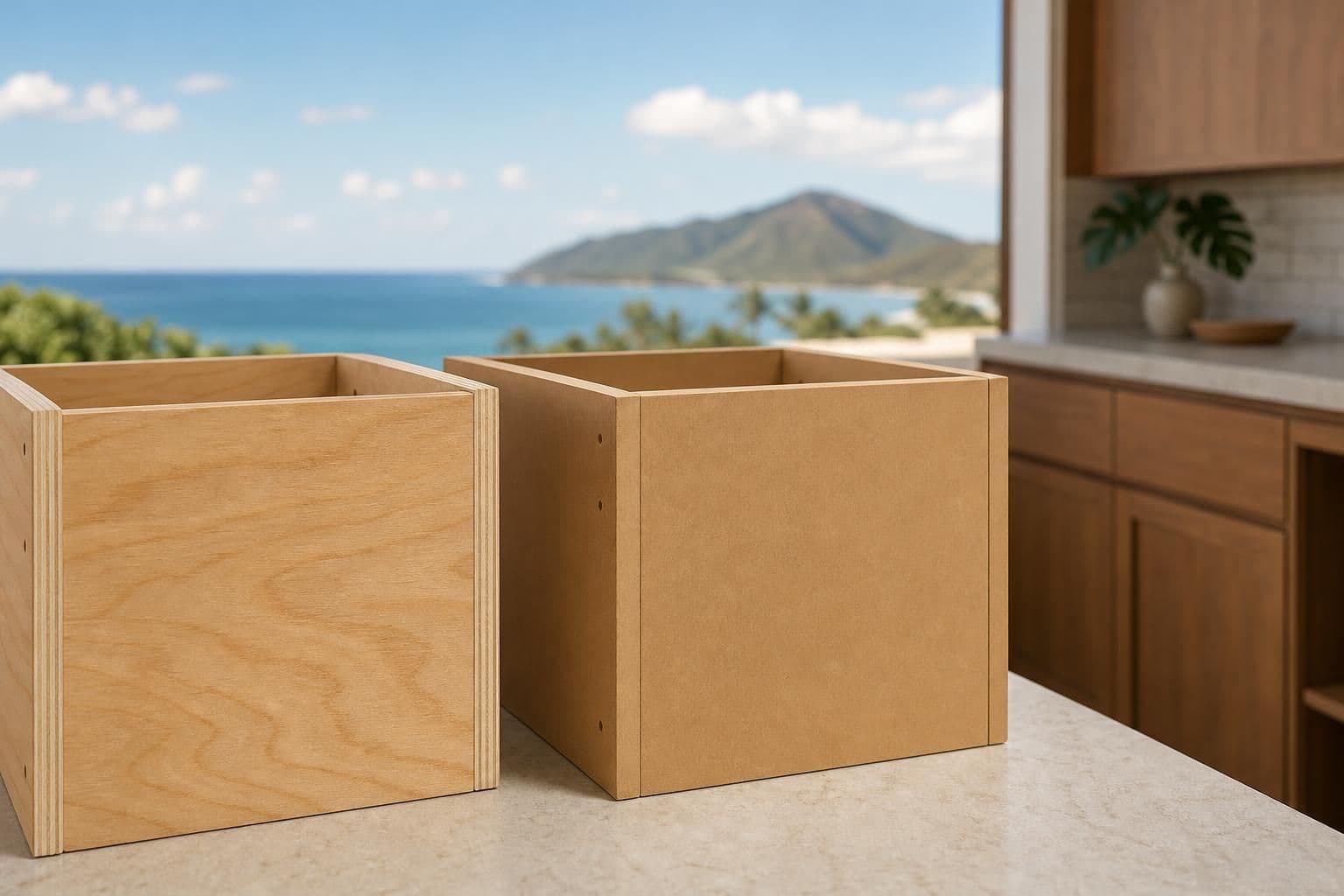
Key takeaway
Plywood holds up better than MDF in cabinet boxes exposed to Hawaii's humidity because its layered wood grain resists swelling and delamination, while MDF (medium-density fiberboard) offers a smoother, more affordable surface that's better suited to painted doors and drier, climate-controlled spaces. Neither material is wrong — the right choice depends on where the cabinet sits in your home, how close it is to moisture, and whether it's a box, a door, or a drawer.
Key takeaways
- Plywood boxes resist moisture swelling better, which matters most under sinks, near lanai doors, and in island kitchens with trade-wind airflow.
- MDF takes paint and routed profiles more evenly, so it's common for cabinet doors and face frames even when the box is plywood.
- The material question matters less than moisture control at the install — sealed edges, proper AC, and kitchen ventilation protect either material.
What Plywood and MDF Actually Are
Plywood is made from thin layers of real wood veneer glued together with the grain alternating direction in each layer, which is what gives it strength and resistance to warping. MDF is made from wood fibers bonded with resin under heat and pressure into a dense, uniform panel with no visible grain. The Composite Panel Association sets the industry standards both materials are typically graded against for density and formaldehyde emissions.
Because plywood's layers run in opposing directions, it holds screws and hinges more securely over time and shrugs off minor water exposure better than MDF, which can swell at the edges and never fully return to its original shape once saturated.
How They Perform in Oahu's Climate
Humidity and salt air are the two conditions that separate mainland cabinet advice from what actually works here. Oahu's average relative humidity runs high year-round, and condos near the shoreline deal with airborne salt that accelerates wear on anything with exposed raw edges or untreated fasteners.
- Under-sink and laundry cabinets see the most moisture exposure in a typical home — plywood is the safer box material here.
- Kitchen islands near sliding lanai doors get humidity swings every time the door opens — sealed plywood boxes outlast MDF in this spot.
- Bathroom vanities combine standing water risk with steam — plywood with a marine-grade sealant is the more forgiving choice.
- Bedroom closets and office built-ins stay dry and climate-controlled — MDF performs fine and costs less to produce.
If you're also weighing flooring material for the same humid conditions, the same logic applies — see our guide on humidity and salt air flooring choices for how material selection changes near the coast.
Where MDF Is the Better Choice
MDF isn't a downgrade — it's a different tool. Its dense, consistent surface machines cleanly for routed panel doors, shaker profiles, and anything getting painted rather than stained, because there's no wood grain telegraphing through the finish. Many cabinet lines use MDF doors on plywood boxes specifically to get this smooth painted look without the grain texture plywood veneer would show.
MDF is also heavier per square foot than plywood, which matters for tall pantry doors or large island panels where hinge load and sag over time become real concerns.
Plywood vs MDF at a Glance
| Factor | Plywood | MDF |
|---|---|---|
| Moisture resistance | Better — layered grain resists swelling | Weaker — edges swell if saturated |
| Paint/finish surface | Shows grain through paint | Smooth, ideal for painted doors |
| Weight | Lighter per sheet | Heavier, can sag on long spans |
| Screw/hinge holding | Holds fasteners more securely over time | Can strip with repeated hardware removal |
| Best use in a kitchen | Cabinet boxes, under-sink, near lanai doors | Doors, face frames, dry interior rooms |
What Actually Drives the Decision
Most cabinet lines mix both materials — plywood boxes with MDF doors is a common, sensible combination rather than an either/or choice. What actually moves the decision on an Oahu project is less about plywood versus MDF in the abstract and more about:
- Proximity to water sources — sinks, dishwashers, washing machines, and exterior doors all raise the moisture risk for whatever material sits nearby.
- Condo versus single-family exposure — a high-rise unit with central AC sees less humidity swing than a ground-floor Kailua home with louvered windows.
- Finish type — painted doors favor MDF's smooth surface; stained or natural-wood looks favor plywood veneer.
- AOAO board requirements — some condo associations specify moisture-resistant materials for kitchen and bath renovations as part of their approval paperwork, which is worth checking before you finalize a cabinet order. Our rundown on Honolulu condo AOAO flooring rules covers how boards evaluate renovation specs, and cabinet material questions often come up the same way.
Sealant quality and edge-banding matter as much as the base material itself — an unsealed MDF edge near a sink fails faster than a well-sealed one, and the same is true in reverse for plywood with a poor glue line. The U.S. Environmental Protection Agency also publishes guidance on formaldehyde emission limits for composite wood products, which is worth knowing if indoor air quality is a concern in a tightly sealed condo unit.
Cabinet Height and Layout Still Matter
Material choice doesn't change the basic dimensions a kitchen needs to work. If you're planning a new layout alongside a box-material decision, it helps to nail down standard cabinet heights first, since that affects how much material you're ordering and where moisture-prone zones (under the sink, toe-kick areas) actually fall in the design.
Getting a Straight Answer for Your Project
The only way to know which material makes sense for a specific kitchen, laundry, or condo renovation is to look at the actual layout, moisture exposure, and finish goals — a general rule can point you in the right direction, but it can't account for where your sink sits or how much airflow your unit gets. A free quote based on your real square footage and layout is the fastest way to get a straight answer instead of a guess.
Frequently Asked Questions
Q: Is plywood always better than MDF for kitchen cabinets?
Not always — plywood resists moisture better, which matters most for boxes near sinks and exterior doors, but MDF often produces a smoother painted finish and costs less to manufacture for doors and face frames.
Q: Can MDF cabinets handle Hawaii's humidity at all?
MDF can hold up fine in climate-controlled interior rooms with stable humidity, but it swells faster than plywood if edges aren't sealed or if it sits near a consistent moisture source like a sink or laundry area.
Q: Do cabinet makers ever combine plywood and MDF in the same cabinet?
Yes — using a plywood box with MDF doors is a common combination that balances moisture resistance in the structure with a smooth paintable surface on the visible panels.
Q: Does cabinet material affect AOAO condo board approval?
Some condo associations specify moisture-resistant material requirements for kitchen and bath renovations as part of their approval process, so it's worth confirming your board's rules before finalizing an order.
Q: How do I know which material is right for my specific kitchen?
The right call depends on your layout, moisture exposure near sinks and exterior doors, and finish preference — a project-specific quote against your actual square footage is the only reliable way to settle it.