How to Choose the Right Cabinet Makers in Honolulu
Key takeaway
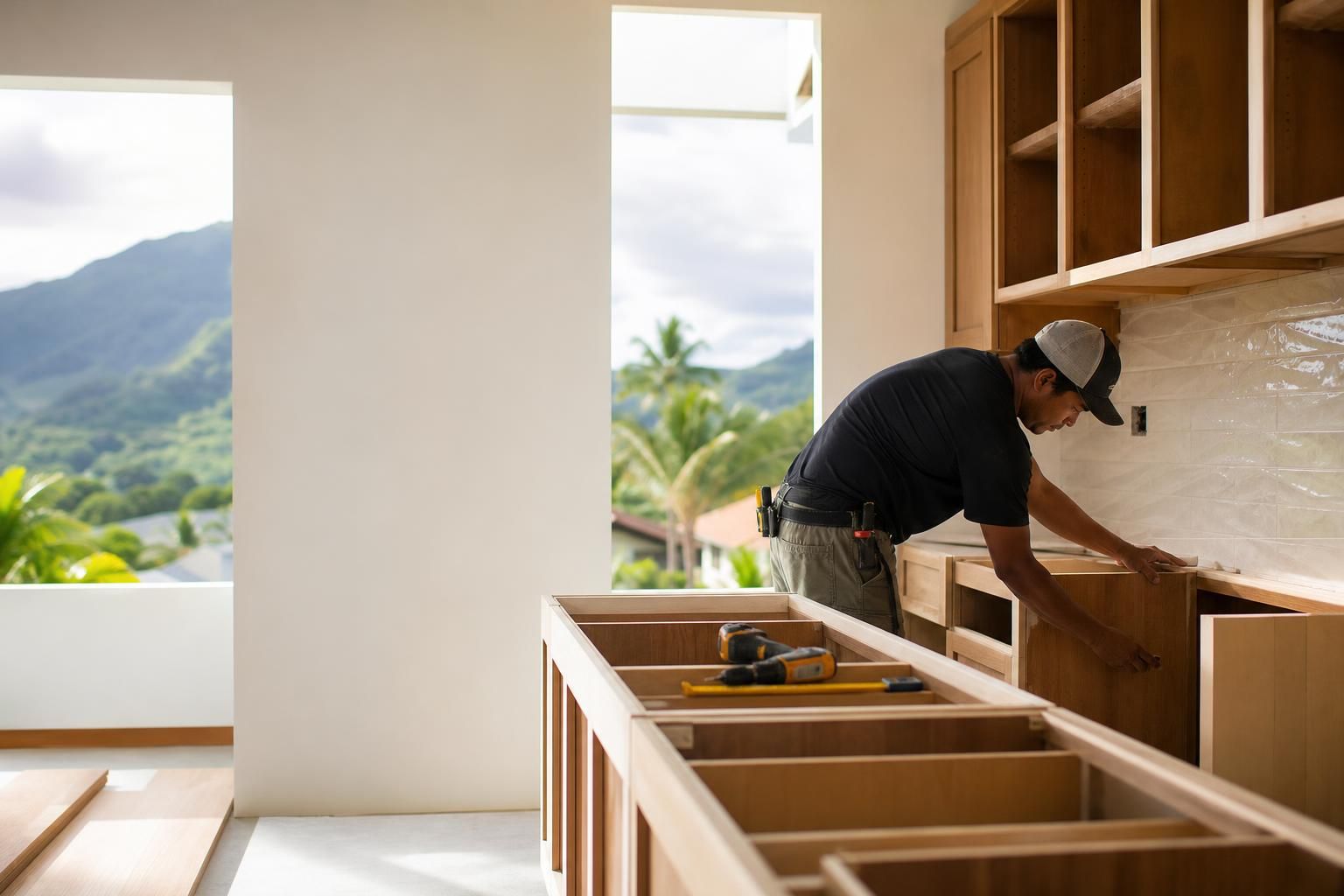
The cabinet makers worth hiring in Honolulu are licensed contractors (or work under one), use moisture-resistant box construction suited to island humidity, and give you a single point of contact from design through installation. Ask to see or touch a finished sample before you commit, confirm who pulls the building permit if your project needs one, and get the quote in writing against your actual kitchen or bathroom measurements rather than a rough estimate.
Key takeaways
- Verify the cabinet maker or their installer holds a current Hawaii contractor license before signing anything.
- Favor moisture-resistant box materials (marine-grade plywood or sealed MDF) over standard particleboard in any Oahu kitchen, bath, or laundry install.
- Get a written quote tied to your project's actual square footage and layout, not a generic per-box estimate.
Check Licensing Before You Check Style
Cabinet installation that involves electrical work, structural changes, or plumbing relocation legally requires a licensed contractor in Hawaii. You can look up any contractor's license status directly through the Hawaii Department of Commerce and Consumer Affairs, which maintains the state's contractor license database. A reputable cabinet shop will tell you upfront whether they hold the license themselves or route installation through a licensed partner — if they dodge the question, that's a signal to walk.
This matters more in condos than in single-family homes. High-rise buildings often require proof of licensed, insured labor before granting building access, separate from any AOAO design approval for the cabinets themselves.
Custom, Semi-Custom, or Stock — What the Terms Actually Mean
"Cabinet maker" covers three very different business models, and the price and timeline differ sharply between them:
- Stock cabinets come in fixed sizes from a catalog, ready in days, with limited finish choices.
- Semi-custom cabinets use standard box sizes but allow changes to finish, hardware, and some dimensions.
- Full custom cabinets are built to your exact measurements and layout, including irregular walls or ceiling heights common in older Oahu homes.
A shop that only offers one tier isn't necessarily worse, but it should say so clearly instead of letting "custom cabinets" mean something different in the contract than it did in the sales pitch. If your kitchen has an awkward galley layout or a non-standard ceiling drop, read through a guide on choosing a cabinet layout for a galley kitchen before you start comparing shops, so you know what to ask for.
Material Choice Matters More in Honolulu Than on the Mainland
Salt air and interior humidity swings are harder on cabinet boxes here than in most mainland climates. The U.S. Environmental Protection Agency notes that composite wood products — including particleboard and MDF used in many cabinet boxes — can off-gas formaldehyde, with higher temperatures and humidity increasing emission rates. That's a practical reason to ask what core material a cabinet maker uses and whether it meets low-emission formaldehyde standards, not just how the door front looks.
Ask specifically about:
- Box material (plywood vs. particleboard vs. MDF)
- Moisture sealing on exposed edges, especially near sinks and laundry hookups
- Hinge and drawer slide hardware rated for frequent humidity exposure
If you're deciding on hardware finish at the same time, this guide to cabinet hardware that lasts covers which finishes hold up against salt air corrosion.
Condo Projects Need Paperwork, Not Just a Good Design
Most Honolulu condo associations require cabinet and flooring changes to go through an AOAO architectural review before work begins. That typically means submitting specs — materials, dimensions, sometimes sound or fire-rating documentation — for board approval before an installer ever shows up. A cabinet maker who's done condo work on Oahu before should be able to hand you those specs in a format the board recognizes, rather than making you translate a generic invoice into AOAO language yourself. Oahu Flooring Quote writes specs in that format as part of its process, which is worth asking any shop you're considering whether they do as well.
What to Ask Before You Sign
A short list of questions separates a straightforward quote from one with surprises buried in it:
- Is the quote based on my actual measured square footage, or a rough average?
- Who is my point of contact if something changes mid-project — design, materials, or installer?
- What happens if special-order material is delayed on the next barge shipment?
- Is tear-out and disposal of my old cabinets included, or billed separately?
- Can I see or touch a finished sample of the exact door style and finish I'm choosing?
Touchable samples matter more than photos for cabinets, since color and sheen shift under the yellow-leaning light common in Hawaii kitchens. Two Honolulu showrooms let you compare finishes in person before ordering, which is worth doing even if you're leaning toward a shop that only shows renderings.
Matching Cabinets to the Rest of the Room
Cabinet color decisions don't happen in isolation — they interact with your flooring, countertop, and wall color, and a maker who only focuses on the cabinet itself can leave you with a mismatched kitchen. If you're still deciding on finish direction, a guide to matching cabinet color to flooring is worth reading before you lock in a door sample. The same logic applies to secondary spaces: a laundry room cabinet guide for Oahu homes covers moisture and ventilation considerations that a kitchen-focused cabinet maker might not bring up unprompted.
Timeline Expectations
Custom cabinet orders routed through Oahu suppliers typically involve a design and measurement phase, a manufacturing lead time, and then installation — and any step can be extended by special-order material needing to arrive by freight rather than being held in local stock. Ask for a realistic range up front and confirm whether the quoted timeline assumes in-stock materials or a special order, since the two can differ by weeks.
The only number worth trusting for your project is one tied to your actual square footage, layout, and material choice — not a flat estimate copied from a catalog. A free quote built around your measurements, with answers back within 24 hours, is a faster way to get an accurate figure than comparing advertised starting prices between shops.
Frequently Asked Questions
Q: Do I need a licensed contractor for cabinet installation in Honolulu?
If the work involves electrical, plumbing, or structural changes, yes — Hawaii law requires a licensed contractor for that scope. For straightforward cabinet swaps with no electrical or plumbing changes, licensing requirements are lighter, but using a licensed installer still protects you if something goes wrong.
Q: What's the difference between custom and semi-custom cabinets?
Semi-custom cabinets use standard box sizes with customizable finishes and hardware, while full custom cabinets are built to your exact room measurements, including non-standard wall or ceiling conditions. Custom typically costs more and takes longer, but it solves layout problems stock sizes can't.
Q: Do condo cabinet projects need board approval in Honolulu?
Most Honolulu AOAOs require architectural review before cabinet or flooring work begins, which usually means submitting material specs and sometimes sound-rating documentation to the board. Ask your cabinet maker whether they prepare these specs as part of their process, since not all shops do.
Q: How long does a custom cabinet order take?
Timelines vary based on design complexity and whether materials are in local stock or special-ordered through freight. Special orders typically add the most time, so ask upfront whether your quoted timeline assumes in-stock material.
Q: What cabinet material holds up best in Hawaii's climate?
Marine-grade plywood or sealed MDF generally outperforms standard particleboard in humid, salt-air environments, particularly for boxes near kitchens, laundry rooms, and bathrooms. Ask any cabinet maker directly what core material they use before comparing finish options.