Countertop Installers in Honolulu: How to Choose One
Key takeaway
Countertop installers in Honolulu should be licensed through the Hawaii Department of Commerce and Consumer Affairs, able to do an on-site template measurement before fabrication, and willing to put lead times and scope in writing. For condo projects, they also need to understand AOAO paperwork, freight elevator booking, and building sound or weight rules before work starts. The fastest way to compare installers fairly is to request quotes based on your actual square footage rather than a generic estimate.
Key takeaways
- Confirm the installer is licensed with Hawaii's Contractors License Board before signing anything.
- Templating happens after demo, not before — that's when exact measurements lock in fabrication.
- Condo jobs need extra lead time for AOAO approval, elevator booking, and loading-dock scheduling.
What Licensing Actually Means Here
In Hawaii, contractors who install countertops as part of a kitchen or bath remodel typically need to hold a license issued by the state's Department of Commerce and Consumer Affairs, Contractor License Board. A valid license number should be something the installer gives you without hesitation, and you can look it up yourself rather than taking their word for it. This matters more on Oahu than it might elsewhere, because a large share of countertop work here is tied to condo renovations that require documentation for building management — an unlicensed installer can stall or kill that approval entirely.
Licensing also affects liability if something goes wrong mid-install — a cracked slab, a damaged cabinet box, a water line nicked during sink cutout. A licensed, insured installer carries coverage for that. A handyman working off a text thread usually doesn't.
Why Templating Happens After Demo, Not Before
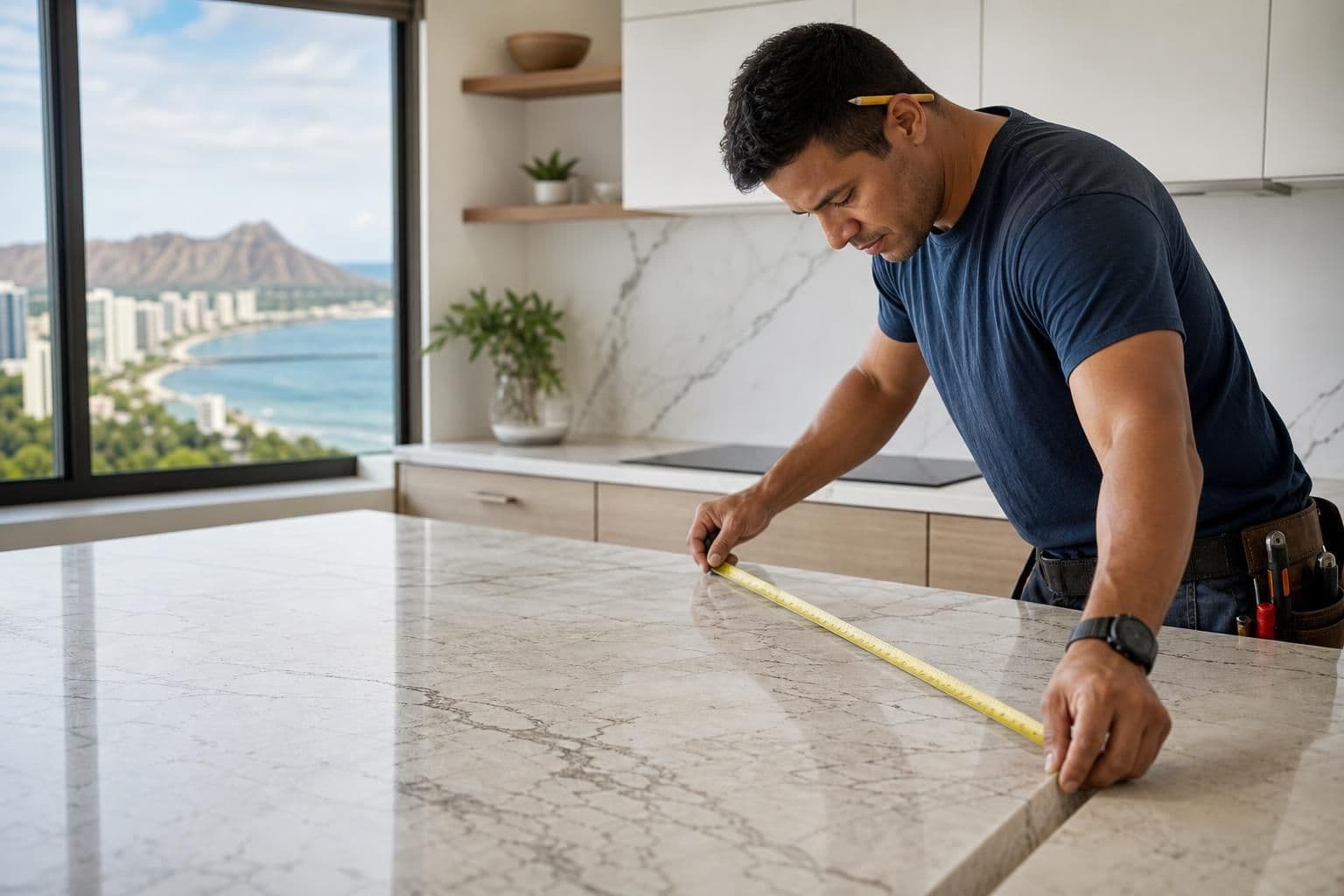
A common point of confusion is when measuring actually happens. Countertop fabrication isn't done from a tape measure and a sketch — it's done from a physical template taken after old countertops and backsplash are removed, but before new material is cut. This is the step that catches out-of-square walls, old cabinet boxes that have shifted over decades, and uneven support ledges that are common in older Oahu homes.
Skipping this step, or quoting a price before it happens, is how installers end up with slabs that don't fit and homeowners end up with delays. A legitimate installer will tell you upfront that your final number depends on the post-demo template, not a phone estimate. That's also why a quote based on your actual project is worth more than a number pulled from a general price list — it's priced for your actual square footage, with an answer within 24 hours.
What Slows Down a Honolulu Countertop Job
Several things specific to Oahu change scheduling and labor complexity more than they change on the mainland:
- High-rise logistics. Many Honolulu condo buildings restrict deliveries to a single freight elevator with a booked window, sometimes just a few hours. Missing that window can push a job back a week.
- AOAO approval timelines. Boards often require submitted specs — material, thickness, sometimes sound or weight documentation — before work can be scheduled at all. For a breakdown of what boards typically ask for, see this site's guide on condo flooring installers on Oahu, much of which overlaps with countertop approval.
- Tear-out and disposal. Old countertop material, especially tile or stone, has to be removed and hauled off before templating can happen.
- Special-order freight. Slabs or edge profiles not already in Oahu inventory ship by ocean freight, which adds lead time that doesn't exist for installers working from mainland warehouses.
- Cabinet condition. If base cabinets are out of level or structurally soft, that gets corrected before a slab ever sits on top — otherwise seams and overhangs won't sit right.
None of these change whether you need an installer; they change how far in advance you need to book one.
Comparing Quotes the Right Way
When you request quotes from more than one installer, ask each one to walk through the same list: material tier, edge profile, sink cutout type, whether tear-out and haul-away are included, and whether they handle AOAO paperwork directly or leave that to you. Two quotes that look far apart on paper sometimes differ only because one includes disposal and permitting labor and the other doesn't.
If you're early in the process and haven't settled on quartz specifically, it helps to understand what drives quartz countertop costs before comparing installer bids, since material tier is usually the single biggest swing factor in any quote. For anyone replacing an existing countertop rather than doing new construction, the removal and disposal step is worth reading up on separately — see what to know before a countertop replacement on Oahu.
Showroom Visits Are Worth the Trip
Touching a slab sample in person tells you things photos don't — how a quartz pattern reads in actual kitchen lighting, how a finish feels under your hand, how a veining pattern will look across a seam. The National Kitchen & Bath Association recommends seeing material samples in the lighting conditions they'll actually live in before finalizing a selection, precisely because screen colors and showroom lighting can shift a quartz pattern's appearance. If you're planning a showroom visit on Oahu, this site's guide on what to expect at a countertop showroom covers what to bring and what questions to ask while you're there.
Timeline Expectations
A straightforward countertop swap in a single-family home, once templated, typically moves faster than a condo job buried in board approval and elevator scheduling. Builders planning renovation budgets more broadly can check general kitchen remodel sequencing through resources like the U.S. Department of Housing and Urban Development's home improvement guidance, though island-specific steps — AOAO sign-off, freight lead time on special orders — won't show up there. That's the part that's genuinely local, and it's also the part a published national price list can't account for.
Frequently Asked Questions
Q: Do countertop installers in Honolulu need a state license?
Yes. Installers performing countertop work as part of a remodel typically need a license from Hawaii's Contractor License Board, and you can verify that license number directly with the state before hiring.
Q: Can I get an accurate quote before demo happens?
You can get a quote based on your stated square footage and material choice, but the final, locked-in measurement comes from a template taken after the old countertop is removed.
Q: How much extra time should I budget for a condo countertop job?
Plan for AOAO document review, freight elevator booking, and loading-dock scheduling on top of normal fabrication and install time — these steps don't apply to single-family homes and can add real lead time to a condo project.
Q: What's the biggest factor that changes a countertop quote?
Material tier and slab selection usually move the price more than almost anything else, followed by sink cutout complexity, edge profile, and whether tear-out and disposal are included.
Q: Should I get multiple quotes from different installers?
Yes, but ask each one to break down the same scope items — demo, templating, material, cutouts, and disposal — so you're comparing equivalent jobs rather than apples to oranges.