Quartz vs Granite Countertops: Which Fits Oahu Homes?
Key takeaway
Quartz countertops are engineered stone that never needs sealing and resists stains without maintenance, while granite is a natural stone with unique veining that requires periodic sealing to stay stain-resistant. For most Oahu kitchens, quartz is the lower-maintenance choice in a humid, salt-air climate, while granite appeals to buyers who want one-of-a-kind natural patterns and don't mind resealing every year or two.
Key takeaways
- Quartz needs zero sealing and handles Oahu's humidity without absorbing moisture; granite needs resealing roughly every 1–2 years to stay stain-resistant.
- What actually moves the price on either material is slab grade, edge profile, seam count, and how much tear-out and disposal the old countertop requires — not the base material choice alone. A project quote against your own layout is the only way to get an exact number.
- Condo owners should confirm seam layout and slab weight with the building's AOAO before ordering, since some associations restrict cabinet or plumbing changes tied to a countertop swap.
How Quartz and Granite Actually Differ
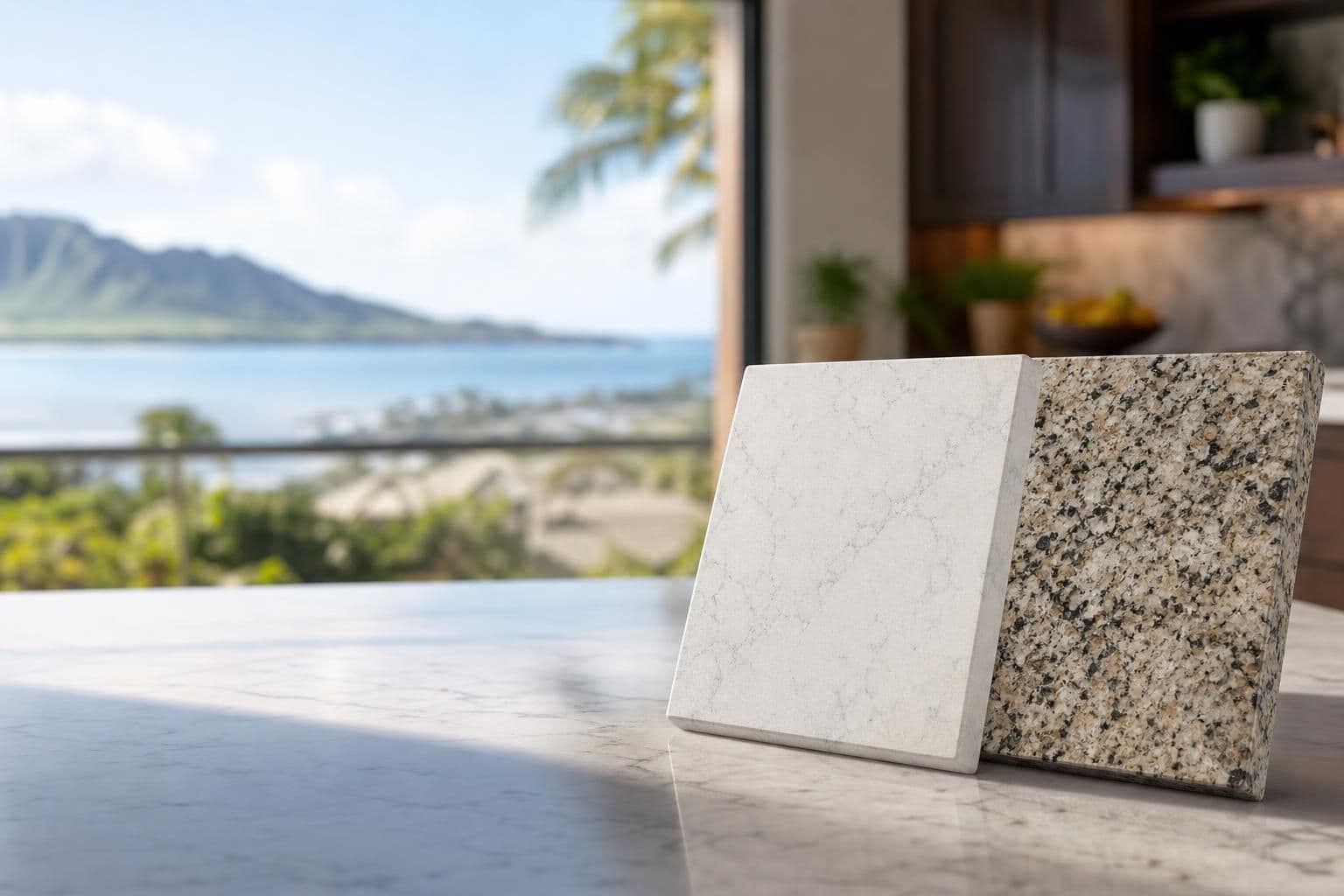
Granite is quarried stone, cut into slabs, and each piece is genuinely one of a kind — no two slabs match exactly, which is part of the appeal. Quartz countertops are engineered: roughly 90-95% ground quartz mineral bound with resins and pigments, which is why quartz comes in far more consistent colors and patterns, including looks that mimic marble without marble's staining risk. Because quartz is manufactured rather than quarried, slab-to-slab color matching is more predictable — useful if you're ordering extra for a matching island or bar top later.
Side-by-Side Comparison
| Factor | Quartz | Granite |
|---|---|---|
| Sealing required | Never | Every 1–2 years |
| Heat resistance | Good, but trivets recommended | Excellent, handles hot pans well |
| Stain resistance | Very high, non-porous | Good once sealed, porous if not |
| Pattern variation | Consistent, engineered look | Unique, natural veining |
| Lead time for special-order slabs | Often longer if a specific pattern must be freight-shipped to Oahu | Can be longer for rare or imported veining, subject to slab availability |
| Install complexity | Straightforward seams, consistent slab thickness | Seam placement often dictated by natural veining, can add fabrication time |
| Best for | Low-maintenance kitchens, rentals | Buyers who want natural, one-of-a-kind stone |
Durability and Everyday Maintenance
Granite is genuinely heat-tolerant — you can set a hot pan on it briefly without much worry — but it's porous, so unsealed granite can absorb oils, coffee, or the vinegar in salad dressing and leave a dull stain over time. Quartz's resin binder makes it non-porous, so spills wipe off without soaking in, and there's no sealing schedule to track. The tradeoff is heat: quartz's resin content means sudden temperature swings, like setting a pan straight off the stove, can discolor or crack the surface, so a trivet is worth keeping on the counter either way.
For rental units and vacation properties where a property manager isn't always tracking a resealing calendar, that difference tends to matter more than the look. If you're weighing countertops as part of a bigger rental refresh, the flooring side of that decision is covered in the guide to choosing durable materials for a Hawaii rental property.
Humidity, Salt Air, and Oahu's Climate
Neither quartz nor granite absorbs moisture the way wood or laminate can, so both hold up fine against Oahu's humidity in terms of warping or swelling. The bigger climate factor is UV exposure near windows and lanai-facing counters: resin-based quartz can yellow slightly with prolonged direct sun exposure over years, while granite's mineral composition is more UV-stable. If your kitchen gets strong afternoon sun through sliding doors, that's worth mentioning when you're comparing slab options.
What Actually Drives the Cost
Quartz and granite pricing on Oahu depends far less on which material you pick than on the specifics of your kitchen and your order. The factors that move the number most are:
- Slab grade and origin: Commodity-grade slabs kept in local stock are simplest to source; rarer patterns or colors often have to be special-ordered and freight-shipped to Oahu, which adds both cost and lead time.
- Edge profile: A simple eased edge is the fastest and least labor-intensive to fabricate; waterfall edges, ogee profiles, or mitered edges take more shop time and more careful handling on install day.
- Seam count: Larger islands or L-shaped runs may need more seams, and seam placement on granite is also constrained by where the veining looks best — both add fabrication and template time.
- Tear-out and disposal: Removing and hauling away an old stone or tile countertop adds labor that a laminate tear-out doesn't.
- Access and building logistics: In Honolulu high-rises, elevator reservations and loading-dock scheduling can extend install timelines, and heavy slabs sometimes require extra crew to move them safely from dock to unit.
- Cabinet support: Older cabinet boxes may need reinforcement before they can carry a heavier granite slab, which is a factor a fabricator checks during template.
Because these variables interact differently on every job, there's no single number that applies across Oahu kitchens — the only reliable figure comes from a quote measured against your actual layout. For a fuller breakdown of what drives labor and material costs on countertop jobs specifically, see the guide to countertop installation costs on Oahu.
Condo Considerations Before You Order
If you're in a condo, check your AOAO's house rules before committing to either material — some buildings restrict plumbing relocations tied to a countertop change, and heavier granite slabs can affect cabinet support requirements that inspectors look at. Elevator size and loading-dock booking windows can also dictate how large a single slab piece can be brought up, which sometimes forces an extra seam that wouldn't otherwise be needed. Getting specs written up in a format the board recognizes avoids a rejected application partway through a remodel. If the countertop swap is part of a larger kitchen update that also touches your cabinets, it's worth reading the comparison of cabinet refacing versus full replacement costs before finalizing a layout, since cabinet decisions affect how much slab and how many seams you'll need.
Getting an accurate number for either material starts with real measurements rather than a rough estimate — the process for that is outlined in how to get an accurate flooring or countertop quote on Oahu.
A Note on Fabrication Safety
Cutting either quartz or granite generates fine silica dust, which is classified as a health hazard when inhaled in uncontrolled settings — this is why fabrication shops use wet-cutting methods and dust controls rather than dry-cutting slabs. The Occupational Safety and Health Administration sets exposure limits for respirable crystalline silica specifically because of this risk, and licensed fabricators are expected to follow those controls during cutting and polishing. This isn't something a homeowner needs to manage directly, but it's a reasonable question to ask a fabricator before hiring them.
Frequently Asked Questions
Q: Is quartz more expensive than granite?
Quartz generally carries a higher baseline than granite because engineered slabs involve manufacturing costs that quarried stone doesn't, but the gap can close or reverse depending on slab grade — a rare, high-demand granite pattern can cost as much to source and fabricate as a standard quartz slab. Material choice alone isn't a reliable predictor; slab grade, edge detail, and seam count matter more.
Q: Does granite need to be resealed every year?
Most granite benefits from resealing roughly every 1–2 years, though denser granite varieties can go longer between sealings. A simple water-drop test — if water beads instead of darkening the stone, the seal is still holding — tells you when it's time.
Q: Can quartz crack from hot pans?
Quartz can discolor or crack from sudden, direct heat exposure because of its resin content, so using a trivet is recommended even though quartz handles everyday cooking heat fine. Granite tolerates direct heat better due to its all-mineral composition.
Q: Which material is better for resale value?
Both are considered upgrades over laminate in most Oahu real estate markets, and buyer preference often comes down to look rather than material type. Natural stone's unique veining appeals to some buyers, while quartz's consistent, low-maintenance surface appeals to others — neither has a clear resale edge over the other.
Q: Do condo associations restrict countertop material choices?
Some AOAOs have rules tied to plumbing changes, weight load on cabinets, or noise/vibration from fabrication work rather than the material itself. Checking your building's house rules before ordering slabs avoids delays once fabrication has started.