Quartz vs Marble Countertops: Which Fits Oahu Kitchens?
Key takeaway
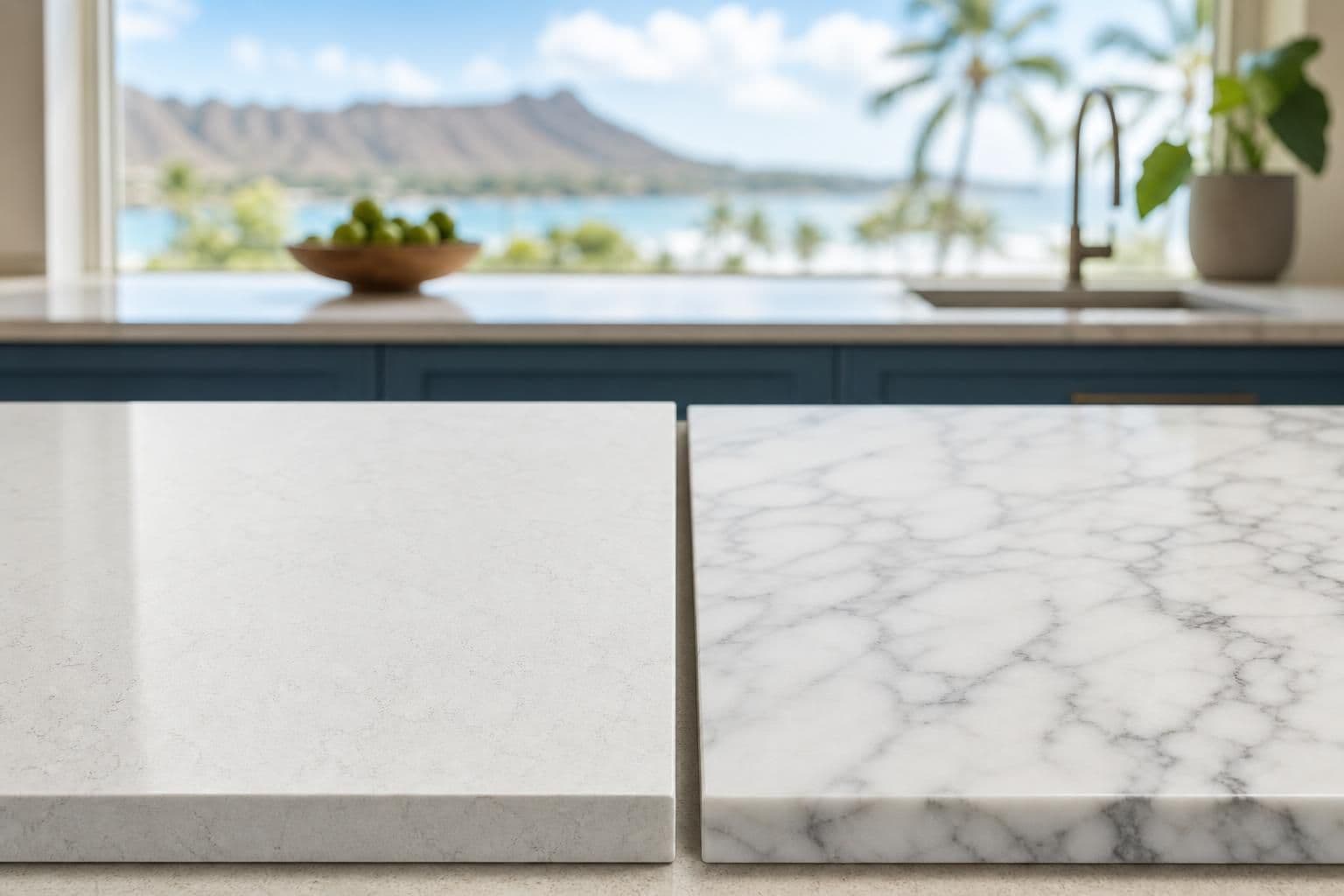
Quartz is the better fit for most Oahu kitchens because it's engineered to resist stains, scratching, and moisture without sealing — a real advantage in a humid, salt-air climate. Marble is a natural stone prized for its veining and cool surface, but it's porous, etches from acidic foods, and needs regular sealing to hold up. The right choice depends on how the kitchen gets used and whether the homeowner is willing to maintain a natural stone surface.
Key takeaways
- Quartz resists stains and doesn't need sealing; marble is porous and etches from lemon juice, wine, and vinegar.
- Oahu's humidity and salt air favor low-maintenance engineered surfaces over natural stone that requires upkeep.
- Condo owners should confirm AOAO paperwork requirements before ordering either material, since board approval can affect timelines.
What Quartz and Marble Actually Are
Quartz countertops are engineered from crushed natural quartz mineral bound with resins and pigments, typically around 90–93% quartz by content, which is why the surface is non-porous straight out of the factory. Marble is a metamorphic rock formed from limestone under heat and pressure, cut into slabs and polished — no two slabs are identical, and the material is inherently porous at a microscopic level. If you want the full breakdown of what goes into an engineered slab, see what quartz countertops are made of.
Durability and Everyday Use
The practical difference shows up the first time something acidic hits the counter. Marble reacts with acids in citrus, tomato sauce, and wine, leaving a dull etch mark that can't be buffed out without professional resurfacing. Quartz doesn't react to acids the same way and holds up better against daily kitchen traffic, cutting boards aside, since both materials can still scratch under a direct blade.
Heat tolerance is another point of separation. Marble handles brief heat exposure reasonably well, but quartz's resin content means it can discolor or crack if a hot pan is set directly on it — trivets are worth using on either surface.
Maintenance and Sealing
Marble needs periodic sealing to slow moisture and staining, and that maintenance schedule doesn't pause because a kitchen is on an island. Skipped sealing shows up as dark rings around sinks and faucet bases faster in humid conditions. Quartz asks for none of that: warm water and a mild cleaner is the standard routine, which matters for rental units and condos where a property manager, not the owner, ends up doing the upkeep.
Why Oahu's Climate Tips the Scale
Honolulu's year-round humidity and coastal salt air create conditions that natural stone sealants weren't designed to fight indefinitely. According to the National Oceanic and Atmospheric Administration, Hawaii's marine climate keeps relative humidity elevated most of the year, and salt-laden air accelerates the breakdown of many building materials faster than in drier mainland climates. That steady moisture load is one reason quartz has become the default recommendation for Oahu kitchens and bathrooms, while marble tends to get reserved for lower-moisture accent areas like a dry bar or fireplace surround.
Cost Drivers Worth Understanding (Without a Price Tag)
Neither material has one fixed cost, because what moves the number is specific to the job, not the slab. The real drivers include:
- Slab size and seams — larger islands may require book-matched slabs or visible seams depending on layout.
- Edge profile and thickness — a simple eased edge costs less in fabrication time than a mitered waterfall edge.
- Subfloor and cabinet leveling — many older Oahu homes have settled floors, so cabinets sometimes need shimming before a slab template is even taken.
- Elevator and loading-dock access — Honolulu high-rise condos often require scheduled freight-elevator windows for slab delivery, which affects install timing more than material choice.
- Island freight on special orders — a marble slab or specialty quartz color not stocked locally adds shipping lead time.
- Tear-out and disposal of the old countertop, especially if it's tile or a heavy stone that needs careful removal.
A quote built around actual square footage and site conditions is the only way to get an accurate number — a free quote priced for your project answers within 24 hours rather than guessing from a published range.
Quartz vs Marble at a Glance
| Factor | Quartz | Marble |
|---|---|---|
| Porosity | Non-porous, no sealing required | Porous, needs periodic sealing |
| Acid/etch resistance | Resists citrus, wine, vinegar | Etches visibly from acidic contact |
| Heat tolerance | Can discolor near direct heat | Handles brief heat better |
| Look | Consistent pattern, engineered colors | Unique veining, natural variation |
| Maintenance | Mild soap and water | Regular sealing and gentle cleaners |
| Best use in humid climates | Kitchens, baths, high-traffic areas | Low-moisture accents, dry bars |
If you're weighing quartz against other stone entirely, the differences carry over similarly when comparing quartz to quartzite or quartz to granite for Oahu homes.
Condo Considerations
Marble and quartz slabs both add weight and require a template visit, which condo AOAO boards often want documented before approving a countertop swap, particularly in high-rise buildings with elevator scheduling restrictions. Getting the paperwork right the first time avoids delays — a longer look at what boards typically ask for is in the guide to condo renovation approval rules in Honolulu.
Which One Should You Choose?
For a primary kitchen counter in a Honolulu, Kailua, Kapolei, Mililani, or North Shore home, quartz is the lower-maintenance, more forgiving choice against daily cooking acids and coastal humidity. Marble earns its place where the look matters more than daily wear — a powder room vanity, a fireplace surround, or a low-use wet bar — and where the owner is committed to sealing on schedule. The Natural Stone Institute publishes general care guidance for natural stone if marble is still the direction you want to go.
Frequently Asked Questions
Q: Does quartz scratch easier than marble?
No — quartz is generally more scratch-resistant than marble because of its engineered hardness, though both can be scratched by a knife blade used directly on the surface instead of a cutting board.
Q: Can marble countertops be used in a humid Oahu kitchen?
Yes, but they require more diligent sealing and cleanup of acidic spills than in a drier climate, since Hawaii's humidity and salt air accelerate wear on unsealed or under-maintained stone.
Q: Is quartz more expensive than marble?
Cost depends on the specific slab, edge profile, and installation conditions rather than the material category alone, so an accurate comparison only comes from measuring your actual kitchen and getting a project-specific quote.
Q: Do quartz countertops need sealing like marble does?
No, quartz is non-porous as manufactured and doesn't require sealing, which is one reason it's popular for rental units and condos with less frequent maintenance oversight.
Q: Which material holds up better near saltwater exposure, like North Shore homes?
Quartz generally performs better in salt-air environments since it has no porosity for salt residue or moisture to penetrate, while marble's surface and sealant are more exposed to gradual breakdown.