How to Get an Accurate Flooring Quote on Oahu
Key takeaway
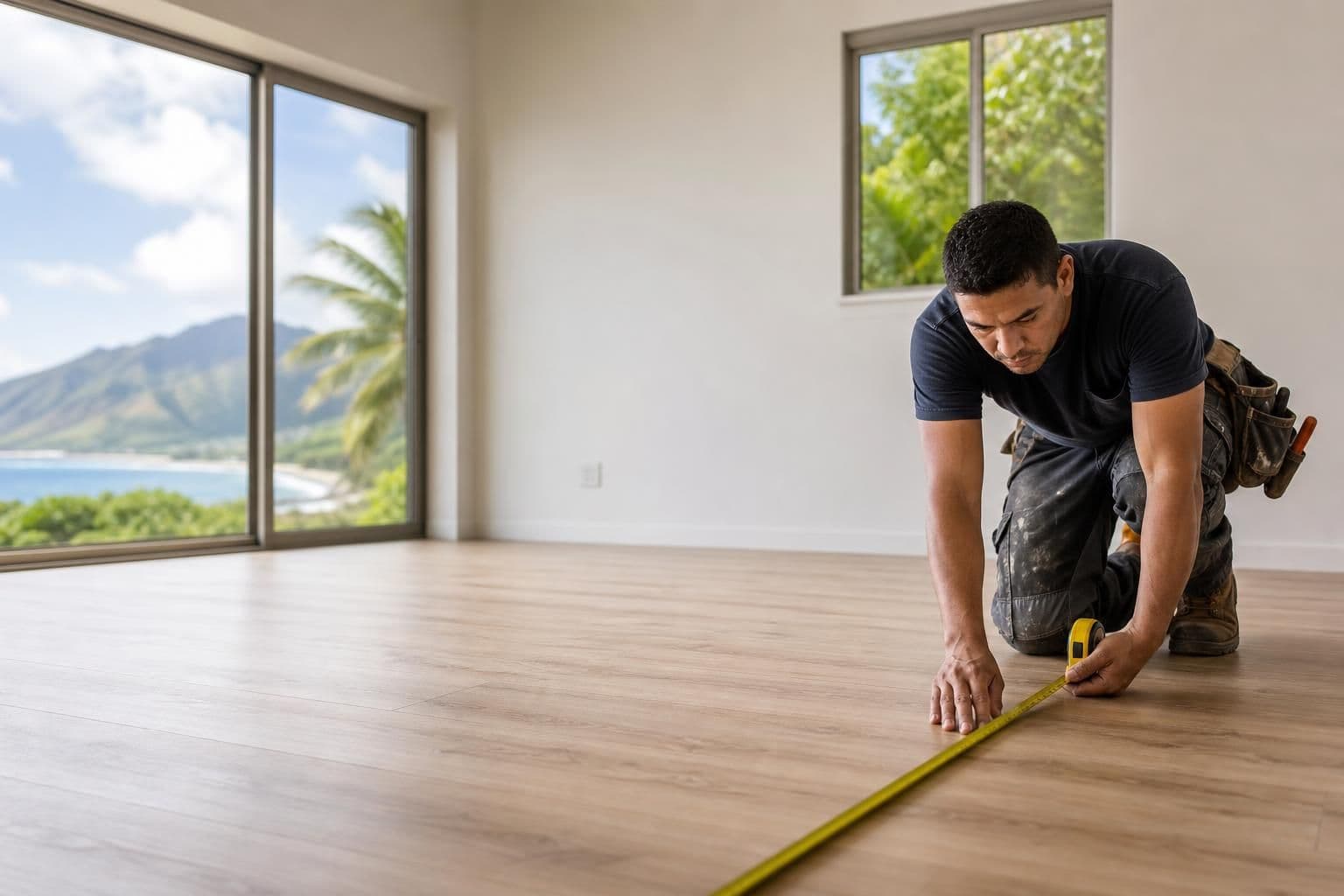
An accurate flooring quote requires your actual room measurements (not a guess), the material and installation method you want, and disclosure of any subfloor issues like moisture or unevenness before a number is calculated. Quotes based on square footage alone, without a walkthrough or photos of the space, are estimates — not prices you can hold a contractor to. The only way to get a number you can trust is to have someone measure the real space and account for waste, transitions, and prep work.
Key takeaways
- Measure room length x width in feet, add 7-10% for waste, and confirm whether that percentage is already built into any quote you receive.
- A quote without a site visit, photos, or floor plan is a rough estimate, not a firm number — ask what it's based on before you compare prices.
- Subfloor prep, moisture barriers, and stair transitions are the most common reasons a "per square foot" price changes once work starts.
Why Two Quotes for the Same Room Rarely Match
Two contractors can walk the same 300-square-foot living room and hand you numbers $2 apart per square foot, and both can be honest. The difference usually comes down to what's included: material only, or material plus labor, moisture barrier, baseboards, and disposal of the old floor. A quote that only lists a material price per square foot — say $3.50 to $7.00 for vinyl plank — tells you nothing about the other half of the job.
Ask every quote to break out four things separately: material cost, labor cost, subfloor prep, and any permit or AOAO paperwork fee if you're in a condo. If a quote won't separate those, it's not ready to compare against another one.
What Actually Goes Into an Accurate Measurement
Flooring is sold and installed by area, but rooms are rarely simple rectangles. An accurate measurement accounts for:
- Waste factor — plank flooring typically needs 7-10% extra material for cuts, pattern matching, and mistakes.
- Closets and nooks — often forgotten in a homeowner's own tape-measure estimate, then added as a surprise later.
- Transitions — thresholds between rooms, stairs, and different flooring heights each add labor time.
- Direction of the plank run — running planks the long way through an open floor plan can increase waste versus running them room by room.
A supplier or installer who calculates square footage from a floor plan or in-person walkthrough — rather than a number you texted them — is giving you a figure closer to what you'll actually pay. For a breakdown of what typical vinyl plank pricing looks like by tier, see this vinyl plank flooring price guide, which separates material-only and installed ranges.
Subfloor and Moisture: The Line Item Estimates Skip
Oahu's humidity and the age of the building both affect what's under your existing floor. Concrete slabs in older buildings can hold moisture that needs to be addressed before vinyl plank or any flooring goes down, and skipping that step is a common reason a "finished" floor fails early. The EPA's guidance on indoor moisture control explains why unaddressed moisture in a structure leads to warping, mold, and adhesive failure — all of which show up as callbacks, not upfront cost.
A quote that doesn't ask whether your subfloor is concrete, plywood, or existing tile, and doesn't ask about known moisture issues, is guessing at labor time. This is one of the fastest ways to tell a rough number from a real one: did anyone ask what's underneath?
Condo Owners: AOAO Paperwork Changes the Timeline, Not Just the Price
If you live in a condo, an accurate quote also has to account for what your Association of Apartment Owners requires before work starts. Many AOAOs require specific flooring specifications — sound rating, thickness, underlayment — submitted for board approval before installation can be scheduled. Hawaii's condo associations operate under state association law, and the Hawaii Department of Commerce and Consumer Affairs publishes the governing rules for how these boards operate and what they can require of owners.
A flooring quote for a condo unit that doesn't mention board approval or spec sheets is missing a step that can delay your project by weeks. Ask upfront whether the company preparing your quote can also generate the paperwork your board needs — that's a different service than simply pricing the material.
Getting Multiple Quotes Without Wasting Your Time
The Federal Trade Commission's guidance on hiring contractors recommends getting quotes in writing and comparing scope, not just the bottom-line number, before signing anything. In practice, that means:
- Give every contractor or supplier the same measurements or floor plan, so you're comparing apples to apples.
- Ask each one to itemize material, labor, prep, and disposal separately.
- Confirm the waste-factor percentage each one used — a 5% waste factor and a 10% waste factor on the same room can shift the final material cost noticeably.
- Ask what happens if the installer finds a subfloor problem after work starts — is that a change order, or is it already priced in?
Quotes that survive this process — the ones that hold up once material and labor are actually delivered — are the ones based on real square footage, not a phone-call guess.
Typical Oahu Price Ranges (For Comparison, Not a Final Number)
These are typical ranges seen on Oahu projects, meant to help you sanity-check a quote — not to replace one:
- Vinyl plank flooring: roughly $3.50-$7.00 per sq ft material only; $6.00-$12.00 per sq ft installed, depending on subfloor prep.
- Quartz countertops: roughly $55-$100 per sq ft installed, depending on slab grade and edge profile.
- Custom cabinets: priced per linear foot rather than square foot, varying widely by material and hardware.
A quote is the only exact number for your specific space — these ranges exist to help you spot a quote that's unusually high or suspiciously low before you commit.
Frequently Asked Questions
Q: What information do I need before requesting a flooring quote?
Room dimensions (length x width in feet), photos or a floor plan of the space, the type of existing flooring being removed, and whether the property is a condo requiring AOAO approval. The more of this you provide upfront, the closer the first quote will be to the final price.
Q: Why did my flooring quote change after the installer saw the space in person?
Quotes given over the phone or by text are usually based on estimated square footage; once an installer sees the actual subfloor condition, room shape, and transitions, the number often adjusts to reflect real waste and prep work. This is why a site visit or photo-based measurement produces a more reliable number than a verbal estimate.
Q: Is a per-square-foot price the same as a final quote?
No. A per-square-foot price is a starting point for material or labor; the final quote multiplies that rate by your actual measured area and adds any prep, transitions, or disposal costs specific to your space.
Q: Do condo owners need a different kind of flooring quote?
Condo owners typically need a quote that includes specifications like sound rating and underlayment thickness written up for AOAO board approval, in addition to the standard material and labor pricing. Skipping this step is a common reason condo flooring projects get delayed.
Q: How much extra material should I budget for waste?
Most vinyl plank installations budget 7-10% extra material for cuts and pattern matching; larger rooms with fewer obstructions may need less, while rooms with lots of angles or stairs may need more.