Best Flooring for a Hawaii Rental Property
Key takeaway
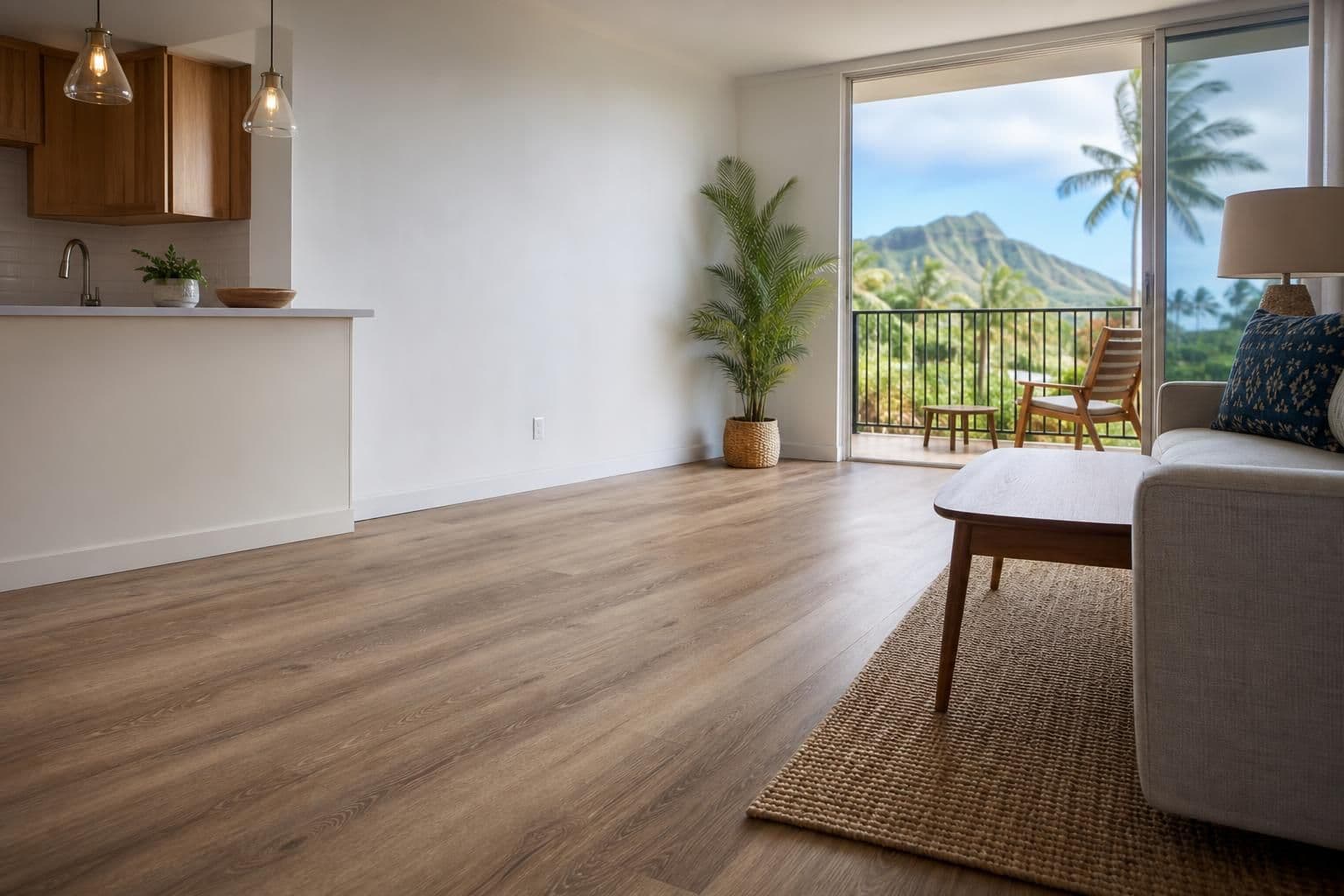
For most Oahu rental units, waterproof rigid-core vinyl plank flooring is the best choice because it resists the island's humidity and salt air, shrugs off tenant turnover damage, and costs less to replace than tile or hardwood. It doesn't warp with moisture the way laminate can, and it holds up better under rolling furniture and pet traffic than carpet. The right pick still depends on the unit type, budget, and whether it's a long-term rental or vacation rental with faster turnover.
Key takeaways
- Waterproof vinyl plank (SPC or WPC core) is the top pick for humid Hawaii rentals because it won't swell or delaminate from moisture the way laminate and some engineered wood can.
- Typical installed cost on Oahu runs $4–$8 per square foot for vinyl plank, versus $6–$12 for tile and $8–$14 for hardwood — get an exact price for your unit's square footage rather than guessing from averages.
- If the rental is inside a condo building, AOAO flooring rules (especially sound-rating requirements) usually apply and should be checked before you order material.
Why Hawaii's Climate Changes the Flooring Decision
Oahu's year-round humidity, salt-laden air near the coast, and the moisture that seeps through slab foundations in older buildings all shorten the life of flooring materials that work fine on the mainland. Solid hardwood expands and contracts with humidity swings, and laminate's fiberboard core can swell if water gets under a seam — both are common complaints in humid coastal climates according to the U.S. Environmental Protection Agency's guidance on moisture and mold control. Honolulu's average relative humidity sits high enough, per National Weather Service Honolulu climate data, that any flooring choice for a rental should be rated for moisture exposure, not just foot traffic.
That's a bigger deal for landlords than for owner-occupants, because a rental floor gets less daily monitoring — a slow leak under a refrigerator or a bathroom seal that fails can go unnoticed between tenants.
Flooring Options Compared for Rental Use
| Material | Moisture resistance | Typical Oahu installed cost | Tenant-turnover durability |
|---|---|---|---|
| Waterproof vinyl plank (SPC/WPC) | Excellent | $4–$8/sq ft | High — scratch and dent resistant, easy spot repair |
| Porcelain/ceramic tile | Excellent | $6–$12/sq ft | High but grout needs upkeep; cold underfoot |
| Laminate | Fair to poor | $3–$6/sq ft | Moderate — swells if water sits on seams |
| Carpet | Poor | $2–$4/sq ft | Low — stains, odor retention, frequent replacement |
| Solid/engineered hardwood | Poor to fair | $8–$14/sq ft | Moderate — scratches show, humidity movement |
These are typical Oahu ranges for material plus installation; the only way to get an exact number for a specific unit is a free quote priced to your actual square footage, with answers usually back within 24 hours.
What Makes Vinyl Plank the Practical Default
Rigid-core vinyl plank flooring is built in layers — a waterproof core, a printed wear layer, and a protective top coat — so water can sit on the surface without reaching a subfloor that could rot or grow mold. That matters in units with in-unit washers, lanai doors that let in rain, or bathrooms with less-than-perfect caulking. It also clicks together in floating installations, which means damaged planks near an entryway or under a bed frame can sometimes be swapped out without redoing the whole room. For a deeper breakdown of material grades and what drives the price up or down, see this vinyl plank flooring cost guide for Oahu, and browse current vinyl plank flooring options by finish and thickness.
Long-Term Rentals vs. Vacation Rentals
A long-term rental with the same tenant for years can tolerate a slightly more delicate floor since wear is gradual and predictable. A vacation or short-term rental sees suitcases, sandy feet, and rolling luggage on a weekly basis, which favors a thicker wear layer (12 mil or higher) and a textured finish that hides scuffs. Owners running short-term units also tend to prioritize fast turnaround between guest bookings — vinyl plank's floating installation typically moves faster than tile setting and curing time, which matters when a unit needs to be rentable again within days.
Condo Rentals and AOAO Approval
Condo association rules are the detail owners most often miss. Many AOAO documents specify a minimum Impact Insulation Class (IIC) rating for hard-surface flooring to limit noise transfer to the unit below, and some require submitted specs before installation begins. Getting the paperwork wrong can mean a rejected application and a delayed rental turnover, so it's worth having sound-rating and product specs prepared in the format the board expects before ordering material.
Budgeting for Turnover Cycles
Rental flooring gets replaced on a different schedule than owner-occupied flooring — usually driven by damage or a new tenant's move-in condition rather than aesthetic preference. Because vinyl plank sits at the lower end of the installed-cost range and holds up to repeated cleaning between tenants, it often has a lower cost-per-year of use than carpet, even though carpet has a cheaper sticker price. Landlords managing multiple units on Oahu, from Kapolei to Kailua, also benefit from sourcing the same product line across properties so replacement planks stay available and finishes stay consistent from unit to unit.
Frequently Asked Questions
Q: Is vinyl plank flooring good for humid climates like Hawaii?
Yes. Rigid-core vinyl plank has a waterproof core that doesn't swell or warp when exposed to humidity or standing water, unlike laminate or solid hardwood, which makes it a common choice for Hawaii rentals and ground-floor units.
Q: What's the cheapest durable flooring for a rental property on Oahu?
Waterproof vinyl plank generally offers the best balance of low cost and durability, typically running $4–$8 per square foot installed, compared with $6–$12 for tile — an exact number depends on the unit's square footage and subfloor condition.
Q: Do condo rentals need special approval for new flooring?
Most Oahu condo AOAOs require a minimum sound-rating (often measured by IIC) for hard-surface flooring and want product specs submitted before installation, so check the association's rules and have documentation ready ahead of time.
Q: How long does vinyl plank flooring last in a rental unit?
Lifespan depends heavily on wear-layer thickness and tenant turnover volume; thicker wear layers (12 mil or more) hold up better to repeated move-ins, luggage, and furniture moves than thinner residential-grade products.
Q: Should landlords choose the same flooring across multiple rental units?
Standardizing on one product line makes future repairs and partial replacements easier since matching planks stay available, and it simplifies budgeting across a portfolio of units.