Best Flooring for a Laundry Room in Hawaii
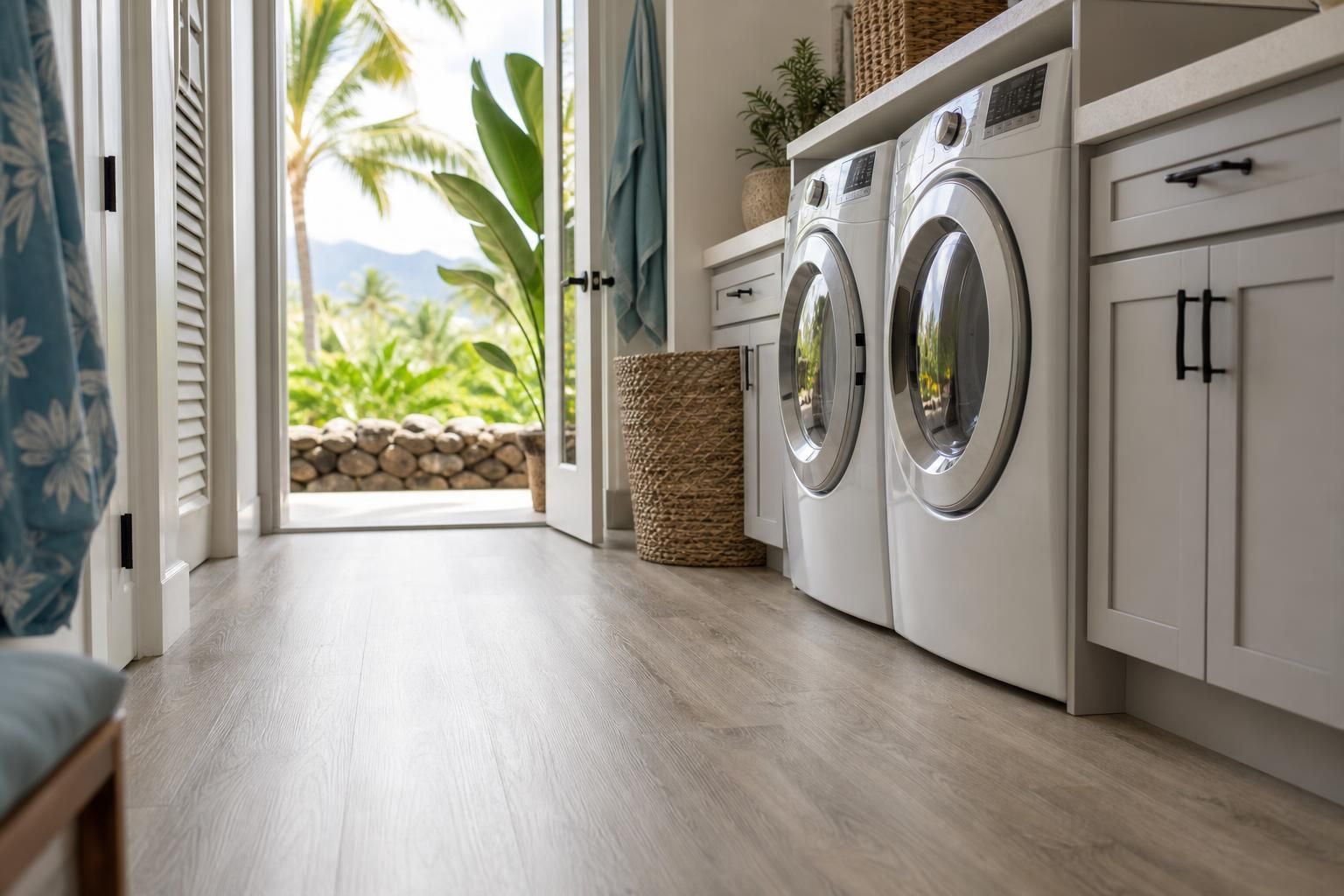
Key takeaway
The best flooring for a laundry room in Hawaii is waterproof rigid-core vinyl plank, specifically an SPC (stone polymer composite) product with a fully sealed, click-lock edge. It resists the humidity, hose-bib splashes, and occasional washer-hose failures that are common in island homes, and it won't swell or delaminate the way laminate or engineered wood can when water sits on a seam overnight. Porcelain tile is the only material that outperforms it, but tile costs more in labor and feels colder underfoot on a laundry closet floor people stand on barefoot.
Key takeaways
- Choose a fully waterproof core (SPC, not WPC or laminate) for any laundry room, closet, or stacked-unit nook.
- Confirm the subfloor is level and, for condos, that the product meets your building's AOAO sound-rating requirement before you order.
- Get a free quote against your actual laundry room square footage rather than guessing from a showroom sample — tiny rooms often have the highest material waste percentage in a house.
Why laundry rooms fail differently than other rooms
A laundry room isn't just a wet room — it's a room where water arrives suddenly and in volume. A burst supply line or a failed drain hose can dump gallons across a floor in minutes, unlike a bathroom where moisture is usually gradual and shows up as vapor. That changes what "waterproof" needs to mean: the flooring has to survive standing water at the seams for hours, not just resist splashes.
Hawaii adds two more stressors on top of that. Ambient humidity in Honolulu averages well above mainland norms for most of the year, according to NOAA's National Centers for Environmental Information, which keeps subfloor moisture content higher even without a leak. And in older Oahu plantation-era homes, laundry rooms are often additions or converted lanais with uneven, sometimes untreated subfloors — a detail covered in more depth in our guide to preparing a home for flooring installation.
What actually holds up: a material comparison
| Flooring type | Water tolerance | Feel underfoot | Best for |
|---|---|---|---|
| SPC rigid-core vinyl plank | Fully waterproof core and seams | Firm, stable | Standalone laundry rooms, closets, garages |
| WPC vinyl plank | Water-resistant, less dense core | Softer, slightly warmer | Low-splash utility rooms |
| Porcelain tile | Fully waterproof when grout is sealed | Hard, cold | Commercial laundry, mudrooms with floor drains |
| Laminate | Not waterproof — swells at seams | Warm | Not recommended for laundry use |
| Engineered hardwood | Not waterproof — can cup or warp | Warm | Not recommended for laundry use |
SPC and WPC are both vinyl, but they're built differently. SPC uses a dense limestone-composite core that resists denting under the weight of a loaded washer and won't expand when the seam gets wet. WPC uses a lighter, foam-based core that's more comfortable to stand on but can compress or separate at the edges under sustained moisture. For a full breakdown of how the two perform across Oahu's climate zones, see SPC vs. WPC vinyl flooring.
Condo and stacked-unit laundry rooms have an extra rule
If the laundry nook sits inside a Honolulu high-rise, the flooring choice isn't only about water — it's about sound. Most AOAO boards require a minimum Impact Insulation Class (IIC) rating for any hard-surface flooring, including the laundry closet, because a washer's spin cycle transmits vibration through a slab to the unit below. Before ordering material, confirm the rating your building requires; our guide to Honolulu condo flooring noise-rating requirements walks through how that number is set and verified. Boards also typically want a cut sheet and underlayment spec submitted with the approval packet, which is the kind of paperwork that differs from HOA rules on a single-family lot — a distinction explained in HOA vs. AOAO rules in Hawaii.
Subfloor prep matters more in a laundry room than anywhere else
A washer is one of the heaviest, most vibration-intensive appliances in a home, and it sits on a floor that's often smaller and less reinforced than a kitchen or living room subfloor. Any dip or high spot under the machine gets amplified — a washer that rocks during spin cycle will eventually work a seam loose no matter how good the vinyl is. Leveling compound and moisture-barrier underlayment aren't optional upgrades here; they're the difference between a floor that lasts and one that needs a seam repair within a year.
What drives the actual cost of a laundry room floor
Three things move the price on a laundry room job more than almost anywhere else in the house:
- Room size and waste percentage. Small, irregular rooms (laundry closets, under-stair nooks) often waste more material per square foot than open rooms because of cuts around the washer box, drain, and door swing.
- Appliance disconnect and reconnect. Moving a washer and dryer, capping lines, and reconnecting them after install adds labor that a bedroom or living room job doesn't require.
- Subfloor condition. Older Oahu homes with plywood subfloors over a crawl space sometimes need leveling or moisture-barrier work before vinyl can go down — a factor our home renovation cost-driver guide covers across every room type, not just laundry.
None of those factors show up accurately in a per-square-foot estimate pulled from a website, because they depend on your specific room. A free quote measured against your actual laundry room footprint accounts for all three at once.
A short checklist before you order material
- Measure wall-to-wall, including the closet door swing and any adjacent hallway transition.
- Check for a floor drain — if there isn't one, confirm the sill plate and surrounding wall base are water-resistant.
- Note your building type: single-family lot, low-rise, or high-rise condo, since condo units need an IIC-rated product and board paperwork.
- Ask whether the washer box and shutoff valves need relocating before flooring goes in.
- Request samples you can touch and wet-test in the room's actual light before committing.
Touching a sample under real conditions catches issues a photo never will — a slightly glossy vinyl that looks fine in a showroom can show every water spot in a dim laundry closet. Oahu Flooring Quote's two Honolulu showrooms carry physical samples for exactly this reason, and a vinyl flooring quote can be priced against your laundry room's real dimensions rather than a generic estimate.
Frequently Asked Questions
Q: Can you put regular vinyl plank in a laundry room in Hawaii?
Standard WPC vinyl plank can work in a low-risk laundry room, but SPC rigid-core vinyl is the safer choice because its seams won't swell if a hose fails or water sits overnight. For any room with a washer supply line, waterproof core construction is worth the small step up from standard vinyl.
Q: Is tile better than vinyl for a laundry room?
Porcelain tile is fully waterproof and holds up slightly better under standing water than vinyl, but it costs more to install, feels cold underfoot, and grout lines need periodic resealing. For most residential laundry rooms, SPC vinyl offers comparable water protection without those tradeoffs.
Q: Do Honolulu condos require special flooring for laundry closets?
Yes — most AOAO boards apply the same Impact Insulation Class requirement to a laundry closet that they apply to any other hard-surface flooring in the unit, since washer vibration transmits through the slab. Check your building's specific IIC minimum before ordering material.
Q: What causes laundry room flooring to fail fastest on Oahu?
The two most common causes are an unlevel subfloor that lets the washer rock during spin cycle and a non-waterproof core that swells after a slow leak goes unnoticed. Both are preventable with proper subfloor prep and a fully sealed vinyl product.
Q: How do I find out what a laundry room floor will actually cost?
Because waste percentage, appliance disconnection, and subfloor condition vary so much from house to house, the only accurate figure comes from a quote measured against your room's real dimensions. A free quote request typically returns pricing within 24 hours based on your actual square footage.