Best Flooring for a Garage in Hawaii
Key takeaway
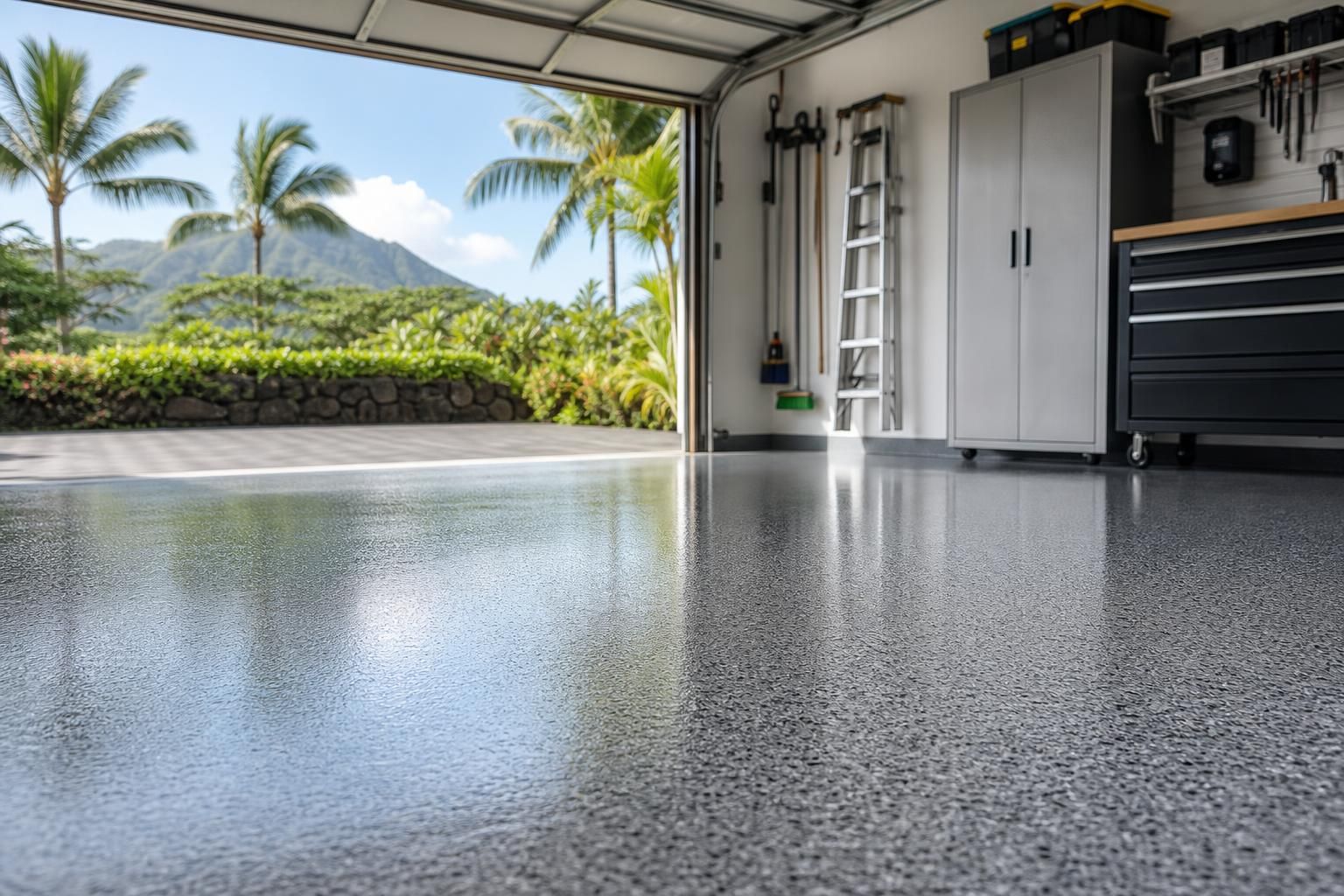
For a garage that stores vehicles and tools, a moisture-tolerant epoxy or polyaspartic coating over the existing slab is usually the best flooring for a garage in Hawaii, because it resists the vapor pushing up through slab-on-grade foundations and handles tire traffic, fluid drips, and salt air. If the garage has been converted into a gym, home office, or flex room with AC control, rigid-core SPC vinyl plank is a better fit than a coating because it feels warmer underfoot and comes in wood-look finishes.
Key takeaways
- True vehicle garages do best with a sealed or coated slab, not a floating floor product, because of moisture vapor from below.
- Converted/flex garages (gym, office, ohana space) can use rigid-core SPC vinyl plank once the room is climate-controlled.
- Older Oahu homes often lack a vapor barrier under the garage slab, which is the single biggest factor in what flooring will actually hold up.
Why Garage Floors Fail Faster in Hawaii
Garage slabs sit directly on grade, and in much of Honolulu, Kailua, Kapolei, Mililani, and North Shore, homes built before vapor barriers became standard practice let groundwater moisture migrate up through the concrete as vapor. Add Hawaii's year-round humidity and, in coastal neighborhoods, salt-laden air that accelerates corrosion of metal trim and fasteners, and you get a slab that behaves differently than one in a dry mainland climate. The EPA's guidance on moisture and mold notes that any flooring installed over a damp substrate without addressing the moisture source is likely to trap it, which is exactly the failure mode that peels coatings and warps the wrong plank product in a garage.
Average relative humidity on Oahu runs high nearly every month, a pattern documented in NOAA's climate records, which is why garage flooring decisions here lean more on vapor management than on finish color or texture.
Comparing Garage Flooring Options
| Flooring Type | Best For | Moisture Tolerance | Vehicle Traffic | Notes |
|---|---|---|---|---|
| Sealed/stained concrete | Budget-conscious storage garages | Moderate — seal must be reapplied | Good | Lowest maintenance, shows slab imperfections |
| Epoxy or polyaspartic coating | Daily-use vehicle garages | High when applied over a tested slab | Excellent | Needs a moisture vapor test before install |
| Rigid-core SPC vinyl plank | Flex/converted garages with AC | High for surface moisture, not standing water | Fair, not for daily vehicle parking | Click-together, comfortable underfoot |
| Porcelain tile | Showcase garages, car collectors | High | Good with proper substrate prep | Hard, cold, grout lines need sealing |
When a Flex-Space Garage Calls for Vinyl Plank
Plenty of Oahu homeowners convert part or all of a garage into a home gym, office, or extra living space, especially on lots where square footage is tight. Once that space is air-conditioned and no longer used for daily vehicle parking, rigid-core SPC vinyl plank performs well: it's dimensionally stable in humidity swings and doesn't rely on an air gap the way laminate does. The tradeoffs between flooring cores matter here, and the breakdown in SPC vs. WPC vinyl flooring: which holds up on Oahu? covers which core type handles standing moisture better if the converted garage shares a wall or drain with a laundry area.
That overlap with wet utility spaces is worth noting — a garage-turned-laundry-nook faces similar splash and humidity exposure to the rooms covered in best flooring for a laundry room in Hawaii, and the same moisture logic applies to either space.
When Epoxy or a Coating Is the Better Call
If the garage still parks a car, truck, or motorcycle daily, a floating vinyl product isn't the right match — tire weight, point loads from jack stands, and fluid exposure all favor a bonded coating over the slab itself. Before any coating goes down, a vapor emission test on the concrete (commonly performed to ASTM International's calcium chloride or in-situ probe methods) tells an installer whether the slab needs a moisture-mitigating primer first. Skipping that step is the most common reason a garage coating bubbles or delaminates within a year or two on Oahu slabs that lack a vapor barrier.
What Actually Changes the Scope of the Job
A few conditions specific to Oahu homes change how much prep a garage floor project needs, regardless of which material you choose:
- Slab age and vapor barrier status — older homes may need a moisture test and mitigating primer before anything else goes down.
- Existing stains and oil penetration — these often require mechanical grinding rather than just cleaning before a coating will bond.
- Drainage and slope — garages used to hose down vehicles need a coating system rated for standing water near the door.
- Door thresholds and transitions — where the garage meets a laundry room or interior floor, height differences affect what material can transition cleanly.
These same prep steps apply broadly across flooring installs, and the walkthrough in how to prepare your home for a flooring installation covers what to clear out and expect on install day, garage or otherwise.
Getting an Accurate Answer for Your Garage
Garage square footage, slab condition, and whether the space stays a vehicle bay or becomes living space all change which material makes sense — which is also why a number quoted for someone else's garage won't translate to yours. A measurement-based quote against your actual garage, run through Oahu Flooring Quote, accounts for slab condition and material tier rather than a generic per-square-foot estimate.
Frequently Asked Questions
Q: Can you put vinyl plank flooring in a garage in Hawaii?
Yes, but only in garages converted to climate-controlled flex space — not in garages used daily for vehicle parking, where slab moisture and point loads from tires and jacks are harder on a floating floor product.
Q: Does a garage floor coating need a moisture test first?
Yes, especially on older Oahu slabs without a vapor barrier. A vapor emission test tells the installer whether a moisture-mitigating primer is needed before epoxy or polyaspartic goes down, which prevents peeling later.
Q: Is tile a good option for a Hawaii garage?
Porcelain tile holds up well to moisture and vehicle weight when installed over a properly prepped substrate, but it's harder and colder underfoot than a coated slab and the grout lines need regular sealing in humid air.
Q: What's the difference between epoxy and polyaspartic coatings?
Both bond to concrete and resist fluids, but polyaspartic cures faster and tolerates UV and temperature swings better, which matters for garages with direct sun exposure from an open door.
Q: Does salt air affect garage flooring choices near the coast?
Salt-laden air accelerates corrosion on metal trim, thresholds, and fasteners more than it affects the flooring surface itself, so coastal garages benefit from corrosion-resistant hardware regardless of which floor material is chosen.