What Noise Rating Do Honolulu Condos Require for Flooring?
Key takeaway
Most Honolulu high-rise AOAOs require a minimum Impact Insulation Class (IIC) rating of 50, though a growing number of newer towers and stricter boards now ask for IIC 60. The number that actually matters is often the field-tested rating (FIIC), not the lab rating printed on the box, because real floors, walls, and ceiling assemblies rarely perform as well as a lab sample. Your specific building's house rules — not a general Oahu standard — set the number you have to hit.
Key takeaways
- Oahu condo boards typically require IIC 50 minimum; some ask for IIC 60, especially in newer or stricter buildings.
- Lab-tested IIC numbers on a product box are not the same as the FIIC rating an inspector measures in your actual unit.
- Get your building's exact house rules and required underlayment spec in writing before you buy flooring, not after.
Why Condos Regulate Flooring Noise at All
Impact noise — footsteps, dropped items, dragged chairs — travels through a concrete slab far more efficiently than airborne noise like voices or music. In a wood-frame house that's rarely an issue. In a Honolulu high-rise where someone's living room ceiling is your bedroom floor, impact noise is the single most common cause of neighbor complaints after a flooring swap from carpet to hard surface. That's why nearly every AOAO document packet includes a flooring and noise section, usually tucked into the house rules or a separate alteration application.
IIC vs FIIC: The Distinction That Trips People Up
IIC (Impact Insulation Class) is a laboratory rating measured under controlled conditions with a standardized tapping machine, following methods set by ASTM International. FIIC (Field Impact Insulation Class) measures the same thing but inside an actual finished building, with its real slab thickness, real underlayment, and real structural quirks.
Field ratings almost always come in lower than lab ratings — often by 5 to 10 points — because:
- Slab thickness and construction vary by building and even by floor
- Penetrations, ductwork, and plumbing chases transmit sound around the flooring assembly entirely
- Flanking noise (sound traveling through walls or structural connections) isn't captured by a lab test
A product boasting "IIC 72" on its packaging tells you almost nothing about what your downstairs neighbor will actually hear. If your AOAO requires a minimum field-tested rating, a flooring and underlayment combo rated well in the lab can still fail inspection once installed.
What Oahu AOAO Boards Typically Ask to See
Requirements vary building to building — there's no single county-wide code that sets flooring noise limits for condos the way there is for new residential construction. Each AOAO sets its own standard through its house rules or declaration. That said, a typical board submission packet asks for:
- The manufacturer's published IIC (and ideally FIIC) rating for the flooring plus underlayment combination
- A cut sheet or spec sheet showing underlayment thickness and material
- Written confirmation that the installer will follow the manufacturer's installation method (floating vs. glued vs. nailed can change the rating)
- Sometimes a sample board or physical sample for the building manager's file
Boards reject applications most often because the paperwork shows a lab IIC number with no underlayment data, or because the flooring type submitted (hard tile with thin underlayment, for example) can't plausibly hit the building's required number regardless of what's claimed.
What Actually Changes Your Noise Rating
The flooring surface itself is only part of the equation. What sits underneath it does most of the acoustic work:
- Underlayment material and thickness — cork, rubber, and foam composites each perform differently, and thicker isn't automatically better once you factor in door clearance and threshold transitions
- Flooring construction — rigid-core vinyl plank with an attached acoustic pad behaves differently than vinyl plank requiring a separate underlayment layer
- Installation method — floating installations and glue-down installations transmit impact sound differently even with identical materials
- Subfloor condition — an unlevel slab can force thicker leveling compound or extra underlayment, which changes the final assembly and its rating
This is also where Oahu's older buildings complicate things: concrete slabs poured decades ago aren't always flat, and the leveling work needed before flooring goes down can affect which underlayment system still fits under your door thresholds without an awkward step.
Vinyl Plank and Noise Ratings in Practice
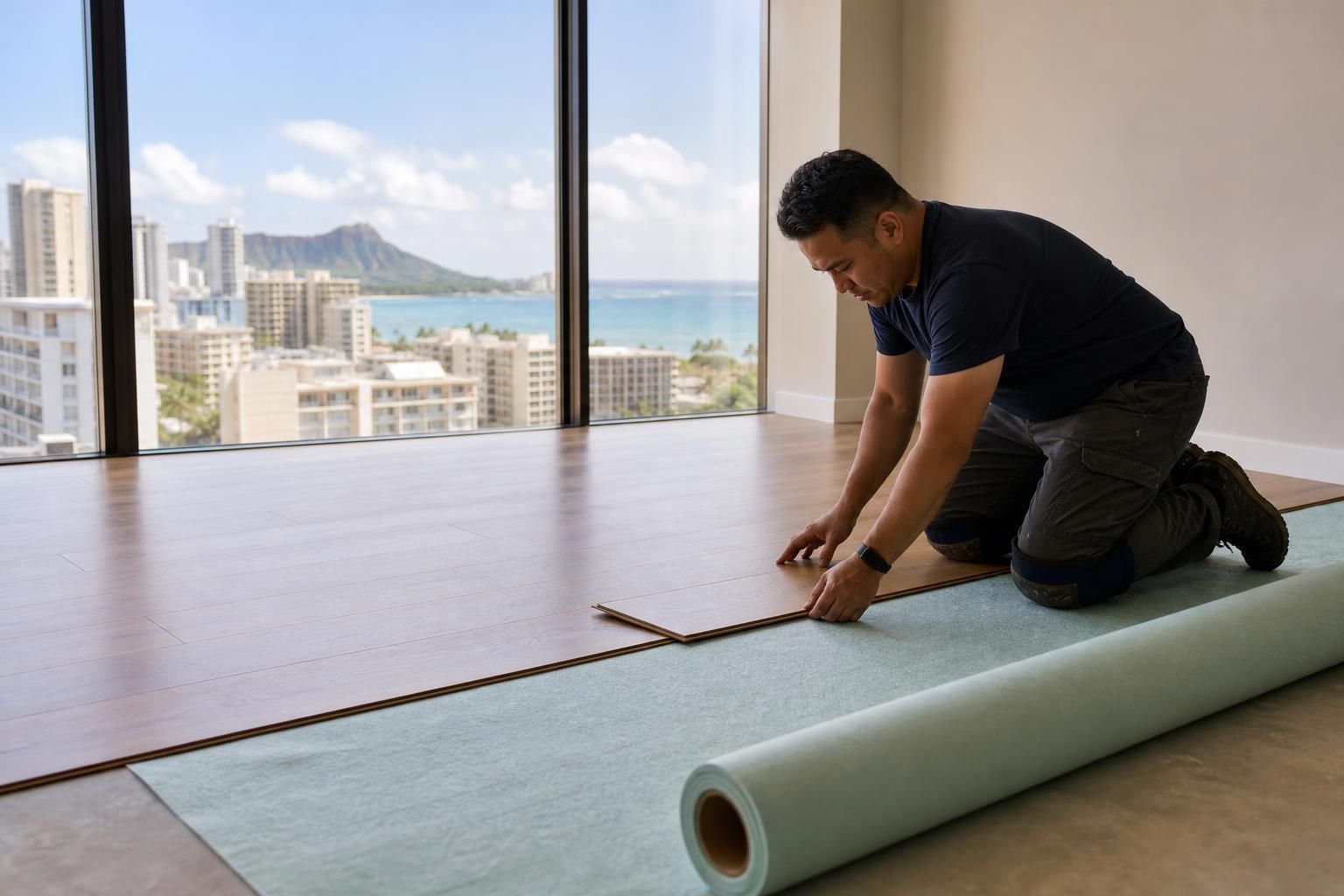
Vinyl plank is the most common replacement material in Honolulu condos partly because many manufacturers now sell it pre-attached to an acoustic backing, simplifying the paperwork board members have to review. If you're comparing options, it helps to see and feel the underlayment layer yourself rather than trust a spec sheet alone — something worth doing in person at a flooring showroom before you commit to a product for board submission. The same plank-and-pad research that applies in condo towers is relevant if you're also comparing options for a Kailua home or a Mililani remodel, since the underlying acoustic mechanics don't change — only the requirement to document them does.
Getting the Number Right Before You Buy
The only way to know what your specific building requires is to request the current house rules or alteration guidelines directly from your AOAO or managing agent — requirements get updated, and a neighbor's old flooring job approved five years ago may not meet today's standard. Once you have that number, matching it to a specific product and underlayment combination, and getting that documented clearly enough for a board to approve on the first submission, is a separate step worth getting right the first time. Research from organizations like the National Association of Home Builders on multifamily sound transmission backs up what most property managers already know: assemblies tested together as a system perform more predictably than components chosen separately and hoped to work.
Frequently Asked Questions
Q: What IIC rating do most Honolulu condos require for flooring?
Most AOAOs require a minimum IIC of 50, though some buildings — particularly newer towers or those with a history of noise complaints — require IIC 60. The exact number is set by each building's own house rules, not a single island-wide standard.
Q: Is IIC the same as FIIC?
No. IIC is measured in a controlled lab setting, while FIIC (Field Impact Insulation Class) is measured inside the actual finished building and is almost always a lower number due to real-world construction variables.
Q: Does carpet automatically meet condo noise requirements?
Not automatically, but carpet with pad is generally the easiest flooring type to meet high IIC requirements because the pad absorbs impact energy directly at the surface. Hard flooring types need engineered underlayment systems to approach similar performance.
Q: Can I use any underlayment with vinyl plank in a condo?
No. Most AOAOs require the underlayment to match what was tested with the specific flooring product to achieve the stated rating; swapping in a different, untested underlayment can invalidate the rating on your board submission.
Q: Who sets the noise rating requirement for my specific building?
Your building's AOAO board sets and enforces the requirement through its house rules or declaration documents. Contact your managing agent for the current written standard before purchasing flooring.