Vinyl Plank Flooring in Kailua: What to Know Before You Buy
Key takeaway
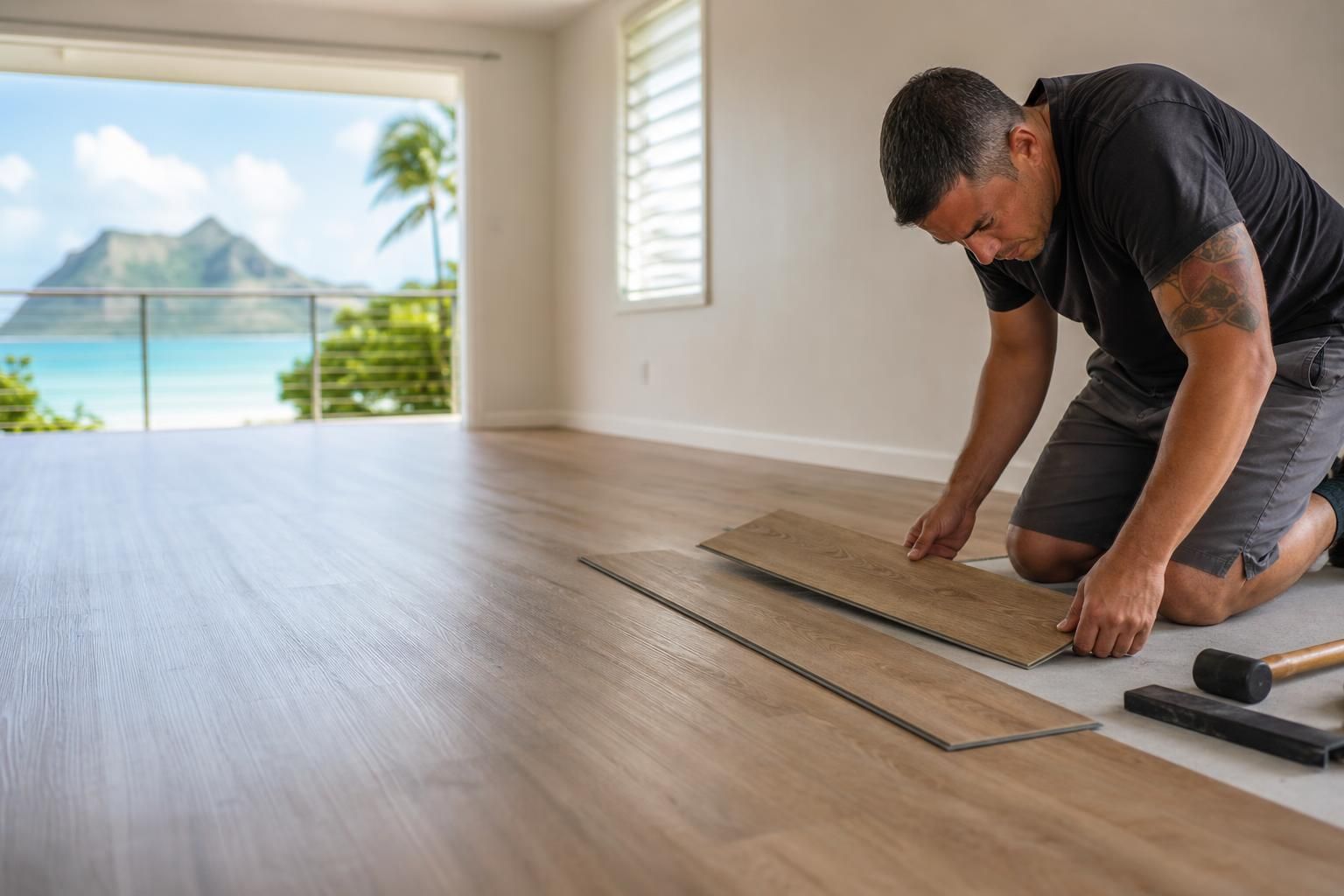
Vinyl plank flooring works well in Kailua homes because it resists the moisture, salt air, and temperature swings that come with living near Kailua Beach and Lanikai, while standing up to sand tracked in from daily beach trips. The right product and underlayment matter more here than on the mainland — a plank rated for a dry inland climate can cup or gap in a beachfront bungalow within a couple of years. What actually determines cost and performance is the subfloor condition, moisture levels, and install details specific to your unit, not the plank itself.
Key takeaways
- Choose a vinyl plank with a waterproof rigid core (SPC) for Kailua homes near the shoreline or with poor crawlspace ventilation.
- Older Kailua homes on post-and-pier or uneven slab foundations often need subfloor leveling before install — this, not the material, is usually the biggest line item.
- Condo owners in Kailua's low-rise buildings still need AOAO-approved flooring specs, including sound-rating documentation, before work can start.
Why Kailua's Climate Changes What Floor You Should Buy
Kailua sits on Oahu's windward side, which means more rainfall and higher ambient humidity than Honolulu's leeward neighborhoods. The National Oceanic and Atmospheric Administration tracks Hawaii's trade-wind pattern, which pushes moist air onshore most of the year and keeps windward towns like Kailua and Kaneohe consistently damper than Kapolei or Ewa Beach. That persistent humidity is hard on flooring that isn't built for it — wood swells, laminate cores can delaminate, and adhesives under old vinyl sheet goods break down faster.
Rigid-core vinyl plank handles this better than most alternatives because the core itself doesn't absorb water, and a quality wear layer shrugs off the fine sand and salt residue that blows in through open lanai doors. If you're deciding between flooring types for a Kailua remodel, the climate comparison in vinyl plank vs. carpet for Oahu homes covers why carpet struggles in this kind of moisture environment specifically.
What Actually Drives the Price of a Kailua Flooring Job
No two Kailua homes price out the same way, and the plank itself is rarely what moves the number. The variables that matter:
- Subfloor condition — Many Kailua homes built before the 1980s sit on post-and-pier foundations or original concrete slabs that have settled unevenly over decades. Leveling compound and moisture barrier work to prep that subfloor is often the single largest cost driver, well before material is even selected.
- Tear-out and disposal — Pulling up old tile, sheet vinyl, or glued-down hardwood and hauling it off-site adds labor and disposal fees that vary by how many layers of old flooring are down.
- Stairs and transitions — Stair-nosing and transition strips take more labor per linear foot than open-room installation. If your project includes a staircase, see what actually holds up on Oahu stairs for the install details that affect both safety and price.
- Furniture moving — Whether you clear rooms yourself or need the crew to move and reset furniture changes labor time.
- Special-order freight — Less common plank colors or widths sometimes have to be shipped in, and island freight on special orders adds lead time and cost that in-stock material doesn't carry.
Because these variables differ from one Kailua house to the next, the only number that means anything is one measured against your actual square footage and subfloor condition — not a generic estimate.
Condo and AOAO Flooring Rules Still Apply in Kailua
Kailua has fewer high-rise towers than Waikiki or downtown Honolulu, but its low-rise condo buildings — along Kailua Road, near Enchanted Lake, and along the Coconut Grove area — still operate under an Association of Apartment Owners (AOAO) with its own flooring rules. Most boards require a minimum Impact Insulation Class (IIC) rating to limit noise transfer to the unit below, and they typically want written specs before approving any work. The underlayment, not just the plank, determines whether a product meets that sound rating.
Getting a flooring spec that's already formatted for AOAO submission saves weeks of back-and-forth with a board. This is a documented, repeatable step rather than a guess — if the paperwork is wrong, approval gets delayed and so does your installer's schedule.
Picking Between LVP, SPC, and WPC for a Kailua Home
Vinyl plank flooring isn't one product — the core construction changes how it performs in a humid, sand-heavy environment:
- SPC (stone plastic composite) core — Rigid, dense, and the most dimensionally stable option in fluctuating humidity. Best choice for homes close to the shoreline or with lanai access that tracks in moisture.
- WPC (wood plastic composite) core — Softer underfoot and quieter, but slightly less rigid than SPC. Works fine in interior rooms away from direct moisture exposure.
- Standard flexible LVP — Lower upfront cost but more prone to telegraphing subfloor imperfections, which matters on the uneven slabs common in older Kailua construction.
Sun exposure is also a factor in open-plan Kailua homes with large sliding doors facing the ocean. Prolonged UV exposure can affect the wear layer and color over time, a topic covered in more depth in does vinyl plank flooring fade in Oahu sunlight. For rooms with heavy afternoon sun, a UV-stabilized wear layer is worth asking about specifically.
Seeing and Touching Samples Before You Commit
Photos and online swatches don't show you how a plank reflects Kailua's bright coastal light, and they can't tell you how a texture feels underfoot. Bringing your own cabinet or counter samples to a showroom visit, and knowing what to bring to a Honolulu flooring showroom, makes it easier to confirm a color match before material gets ordered.
A single point of contact through the process — from first measurement to delivery — matters more on a Kailua project than it sounds, since tear-out, AOAO paperwork, and installer scheduling all need to line up in order. Oahu Flooring Quote coordinates that sequence and provides a free quote priced for your actual square footage, with an answer within 24 hours, along with access to vinyl plank flooring options suited to windward-side conditions.
Frequently Asked Questions
Q: Is vinyl plank flooring a good choice for a Kailua home near the beach?
Yes, provided you choose a rigid SPC core with a waterproof design — standard flexible vinyl or laminate alternatives are more vulnerable to the sustained humidity and sand exposure common in beachfront Kailua homes.
Q: Do Kailua condos require AOAO approval for vinyl plank flooring?
Most Kailua condo associations require written flooring specs and a minimum sound-rating (IIC) before approving an installation, even in low-rise buildings, so check with your AOAO board before ordering material.
Q: Why do older Kailua homes cost more to floor than newer construction?
Many pre-1980s Kailua homes sit on post-and-pier foundations or settled slabs that need leveling and moisture-barrier work before vinyl plank can be installed correctly, which adds labor independent of the material chosen.
Q: Can I install vinyl plank flooring over existing tile in a Kailua home?
In many cases yes, as long as the tile is structurally sound and flat, but grout lines and any unevenness usually need leveling compound first to prevent the new plank from telegraphing the pattern underneath.
Q: How does trade-wind humidity affect vinyl plank differently than other Oahu areas?
Kailua's windward location sees more consistent onshore moisture than leeward towns like Kapolei, so subfloor moisture barriers and rigid-core planks matter more here to prevent long-term cupping or edge lifting.