Best Flooring for Stairs: What Holds Up on Oahu
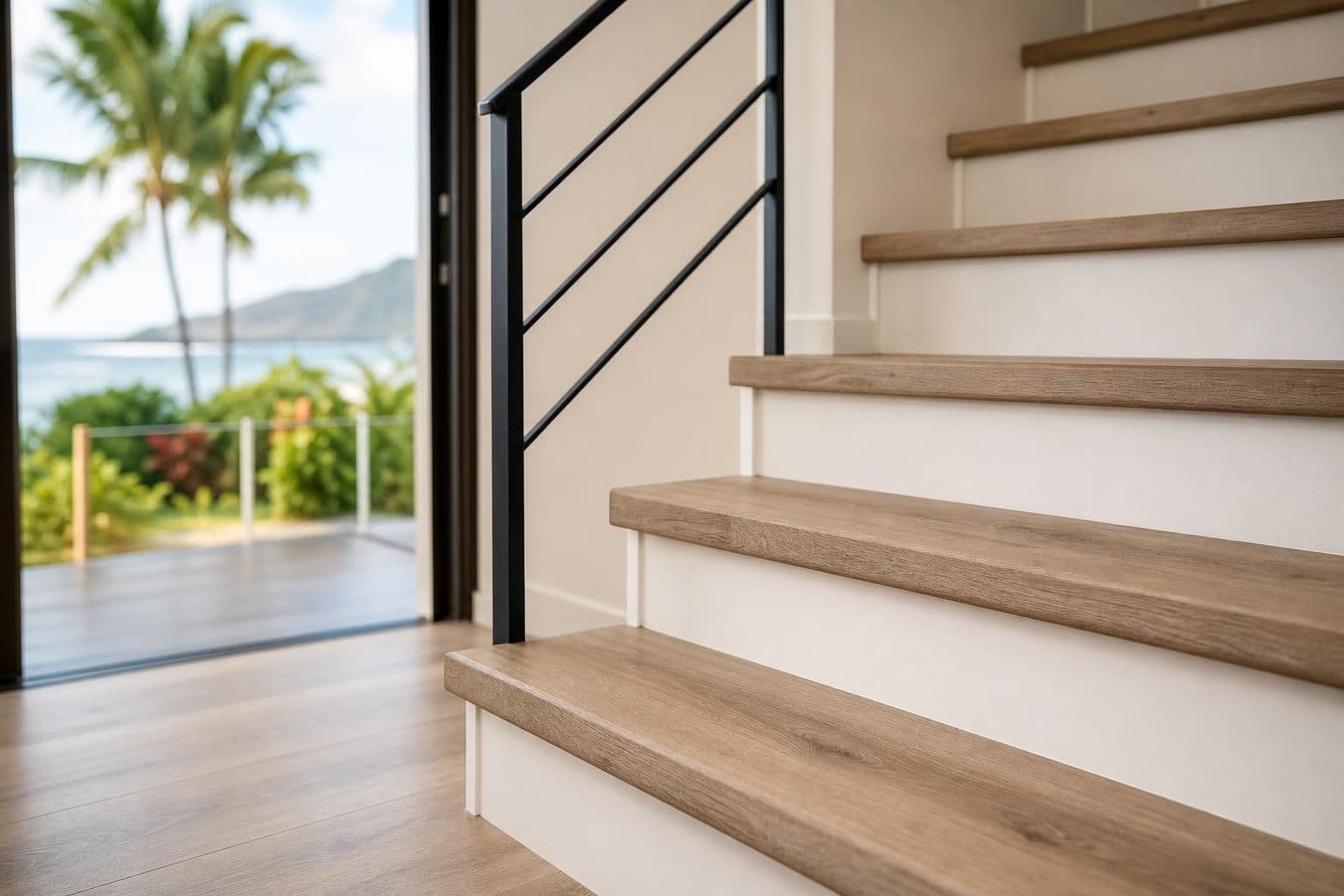
Key takeaway
For most Oahu homes, rigid-core vinyl plank with a textured, slip-resistant finish is the best flooring for stairs — it handles humidity swings better than hardwood, grips better than polished tile, and can be cut into treads and risers without the seams that trip up laminate. The right choice still depends on whether the stairs are indoor or open to trade winds, how many people use them daily, and whether a condo board has sound-rating rules attached to the approval.
Key takeaways
- Textured rigid-core vinyl plank or engineered wood with a non-slip coating outperforms tile, laminate, and bare hardwood on most Oahu staircases.
- Stair nosing and tread thickness matter more than the wear layer number on the box — a rounded, contrasting nose cuts slip risk on every material.
- Condo stairs often carry AOAO sound-rating requirements (impact insulation class, or IIC) that rule out hard surfaces before style even enters the conversation.
Why stairs need a different answer than the rest of the floor
A stair tread takes more direct impact per square inch than a living room floor because every step lands at an angle, with weight shifting forward onto the edge. That edge — the nosing — is where flooring fails first: it chips, delaminates, or gets slick from foot oil and sunscreen residue tracked in from the yard or a nearby pool deck. Materials that look identical in a showroom sample can behave very differently once they're mitered into stair-shaped pieces and walked on dozens of times a day.
Humidity adds a second variable that's specific to Hawaii. Solid hardwood stair treads expand and contract with Oahu's humidity swings, and over enough cycles that movement loosens the tread-to-stringer connection, producing the squeak that shows up a year or two after installation. Vinyl and most engineered products move far less, which is one reason vinyl plank is generally preferred over solid hardwood or tile in Hawaii's climate.
Comparing the main options for stairs
| Material | Slip resistance | Humidity tolerance | Stair-specific durability | Typical sound level |
|---|---|---|---|---|
| Rigid-core vinyl plank (textured) | High with textured finish | High — minimal expansion | High; holds up to pets and daily traffic | Moderate; can add underlayment |
| Engineered wood (matte/textured) | Moderate | Moderate — better than solid hardwood | Moderate; nosing can wear faster | Moderate |
| Tile | Low unless textured/slip-rated | High | High if installed correctly | Loud, echoes in stairwells |
| Laminate | Moderate | Low — swells if treads get wet | Low; seams and edges chip over time | Moderate to loud |
| Carpet (stair runner or full) | High | Moderate — can trap moisture in pad | Moderate; wears at nose first | Quiet |
No single row wins every category, which is the point — the right pick depends on which row matters most for a given household: a family with young kids and a dog weighs slip resistance and durability heavier than sound; a condo above another unit weighs sound heaviest of all.
What actually changes the recommendation
Indoor vs. covered outdoor stairs. Stairwells open to the weather — common in older walk-up buildings and some North Shore homes — see direct sun, salt air, and occasional rain blowing in. Tile or a fully waterproof vinyl product with UV-stable finish holds up there; carpet and most laminate don't belong on an exposed stair at all.
Condo and multi-unit sound rules. Many Honolulu AOAOs require a minimum Impact Insulation Class rating on hard-surface flooring, and stairs are usually included in that requirement because footfall noise travels through a stairwell more than through a flat floor. If the project is in a condo, get the flooring spec written before ordering material — it's one of the most common reasons board approval gets delayed, something covered in more detail in the site's guide to getting condo flooring approved by an AOAO board.
Traffic and household makeup. A staircase used by a family of five, a dog, and visiting grandparents needs a higher-grip, higher-durability surface than a staircase in a two-person household. Textured finishes and contrasting nosing reduce fall risk for older adults in particular — a factor worth weighing heavily if aging-in-place is part of the plan.
Existing stair structure. Older Oahu homes sometimes have stair stringers cut for a specific tread thickness, and switching materials can mean re-cutting nosing pieces or adding a transition strip at the top and bottom landings. That's a labor and material detail a general online guide can't price — it depends on the actual stairs.
Stair-specific installation details that matter more than the material
- Nosing profile: a rounded, slightly overhanging nose with color contrast from the tread reduces missteps, a detail the U.S. Consumer Product Safety Commission flags as a leading factor in home stair falls.
- Riser height consistency: building codes generally require riser heights to stay within a small tolerance from step to step; new flooring that's thicker than the old material can throw that off if it's not accounted for.
- Underlayment choice: a sound-dampening underlayment under vinyl or engineered wood stair treads cuts the hollow "clack" sound common in stairwells, which matters most in condos and two-story homes with bedrooms below.
- Edge fastening: stair nosing should be mechanically fastened or fully adhered, not just friction-fit — loose nosing is the single most common stair flooring complaint after installation.
Carpet, tile, or vinyl: picking by room type
For a full-house material comparison beyond stairs, the vinyl plank versus carpet breakdown for Oahu homes covers how each performs in bedrooms and living areas, which is useful context if the stairs connect to carpeted upper floors and the goal is a visual match rather than a hard transition at the top step.
Getting a number that actually applies to a given staircase
Material cost, nosing pieces, underlayment, and labor all shift based on the number of risers, the landing configuration, and whether the old flooring needs tear-out first — none of which a general guide can price accurately. The only way to get a number that applies to a specific staircase is to measure it and get a quote against those exact measurements, which is what a free flooring quote is built to do, priced for actual square footage with an answer within 24 hours. For homeowners still comparing materials for the whole project, the room-by-room flooring guide is a useful next stop before requesting a quote.
Frequently Asked Questions
Q: What is the safest flooring for stairs?
Textured, slip-rated rigid-core vinyl plank and slip-rated tile are generally the safest choices, especially when paired with a contrasting, rounded stair nose. Smooth, high-gloss finishes on any material increase slip risk regardless of what the base material is.
Q: Is vinyl plank flooring good for stairs?
Yes, rigid-core vinyl plank with a textured wear layer holds up well on stairs because it resists humidity-driven expansion and takes impact at the nosing better than laminate. It needs properly fastened stair-nose trim pieces rather than a friction-fit edge to perform well long-term.
Q: Can you put laminate flooring on stairs?
Laminate can be installed on stairs, but it's more prone to chipping at the nose and swelling if moisture reaches the edges, which makes it a weaker choice than vinyl plank for Oahu's humidity. It also typically needs a separate stair-nose kit purchased to match the plank profile.
Q: Do condo stairs have special flooring requirements on Oahu?
Many Oahu AOAOs set a minimum sound rating (often an Impact Insulation Class requirement) for hard-surface flooring, and stairs are usually covered by that rule since footfall noise carries through a stairwell. Getting the flooring spec approved by the board before ordering material avoids delays.
Q: How often does stair flooring need to be replaced?
There's no fixed timeline — it depends on material, traffic, and how well the nosing was installed, since the nose almost always wears out before the flat part of the tread. A loose or chipped nosing piece is usually the first sign it's time to look at replacement.