How to Find Quartz Countertop Installers Near You
Key takeaway
Finding qualified quartz countertop installers near you starts with checking three things: a Hawaii contractor's license, a templating process that measures your actual cabinets before fabrication, and a clear answer on who handles tear-out and disposal of your old counters. On Oahu, add a fourth check if you live in a condo — whether the installer can supply spec sheets your AOAO board will accept.
Key takeaways
- Verify the installer's Hawaii contractor license number through the state's DCCA license search before signing anything.
- Ask whether templating happens in person with a digital or physical template — quartz is cut to the exact cabinet opening, not a catalog size.
- If you're in a condo, confirm upfront that the installer can produce the documentation your AOAO board needs for approval.
What "near me" actually means on Oahu
Search results for installers "near me" on Oahu will mix contractors based in Honolulu with crews who travel island-wide, and the distinction matters more here than on the mainland. Slab material typically ships to a single fabrication shop, then gets routed to your home for templating and install — so the fabricator's location matters less than whether they regularly work your side of the island. A company based in town that routinely installs in Kailua, Kapolei, Mililani, or the North Shore will already know things a one-off crew won't: which high-rises require certificates of insurance before the loading dock will release an elevator, which older neighborhoods have out-of-level cabinet boxes that need extra shimming, and which condo associations have their own noise-window rules for cutting and grinding.
Licensing and insurance: what to verify before you book
Hawaii requires a contractor's license for countertop fabrication and installation work above a minimal threshold, issued through the Department of Commerce and Consumer Affairs. Before you commit to an installer:
- Ask for their license number and confirm it's active on the DCCA Professional and Vocational Licensing lookup.
- Confirm they carry general liability insurance and ask whether they can provide a certificate naming your building if you live in a condo.
- Ask who is actually doing the templating and cutting — some companies subcontract fabrication to a separate shop, which can add time to your schedule if communication between the two isn't tight.
A single point of contact who manages the project from the first measurement through delivery removes one common failure point: the gap where a sales rep hands you off to a fabricator who's never seen your kitchen.
How templating and fabrication actually work
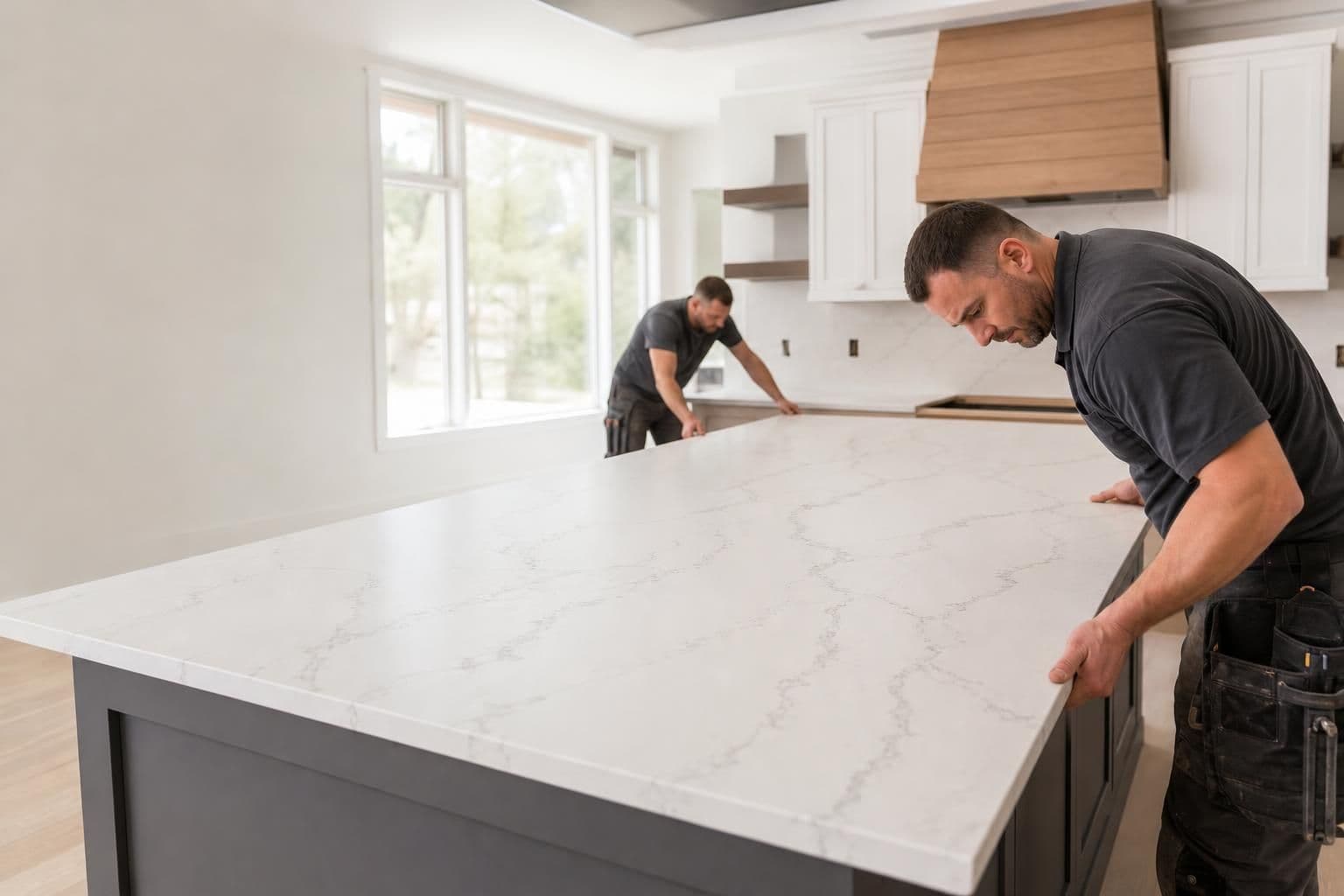
Quartz isn't cut from a fixed-size slab the way tile is laid from a box. After you choose a slab or pattern, a templater comes to your home — usually after cabinets are set but before a final seal coat — and measures the exact opening with a digital laser template or a physical pattern. That template goes to the fabrication shop, which cuts the slab, polishes the edge profile you selected, and cuts sink and cooktop openings to the exact appliance dimensions you provide. Installation typically happens as a separate visit once fabrication is complete. If you're still deciding on an edge style, this breakdown of edge profile options covers how each one affects both look and cost drivers before you get to templating.
What changes the price — without a dollar number
Every quartz countertop job on Oahu is priced against the customer's actual square footage, cabinet layout, and site conditions, so any number published outside that context is either wrong for your kitchen or a lowball a competitor undercuts. What actually moves the price from one Oahu job to another:
- Material tier — quartz slabs range from entry-level solid colors to premium veined patterns that mimic marble, and tier affects both material cost and how much slab is wasted matching veining across seams.
- Edge profile complexity — a simple eased edge takes less fabrication time than a built-up ogee or waterfall edge.
- Elevator and loading-dock restrictions — Honolulu high-rises often require scheduled freight-elevator windows, which can add labor hours even on a straightforward job.
- AOAO sound-rating and work-hour rules — some condo buildings restrict grinding and cutting to specific hours, which can split an install across two visits.
- Tear-out and disposal — removing old laminate or tile counters, especially if they're glued to particleboard, adds demo time.
- Island freight on special orders — a slab not already in a Honolulu warehouse has to ship in, which affects lead time more than price but is worth asking about upfront.
- Cabinet condition — older Oahu homes sometimes have cabinet boxes that have shifted out of level, which needs correcting before templating.
The only accurate number for your project comes from measuring your actual kitchen. A free quote priced for your real square footage, with an answer within 24 hours, is the fastest way to replace a guess with a real figure.
Condo owners: the AOAO step most installers skip
If you own a condo, your installer needs to do more than show up with the right slab — they need to produce documentation your building's AOAO board will actually approve. Many Oahu associations require material specs, sound-rating information, and sometimes a certificate of insurance before work can even be scheduled, and a missing document can push your install back by weeks while the board meets again. Ask any installer directly whether they've prepared AOAO submission paperwork before, not just whether they've "worked in condos." For a fuller walkthrough of what boards typically ask for, see what to expect at a countertop showroom on Oahu and how a countertop quote on Oahu typically unfolds.
Comparing quartz to other material options first
Before you lock in an installer, it's worth confirming quartz is the right call for your kitchen. Quartz is engineered stone — crushed quartz bound with resin — which the Natural Stone Institute notes gives it more consistent nonporous performance than natural stone, since it doesn't require periodic sealing the way granite or marble does. That consistency matters in Hawaii's humidity, where porous surfaces can be more prone to staining if sealing lapses. If you're weighing it against a natural-stone look, this comparison of quartz and marble for Oahu kitchens walks through maintenance differences in more detail.
Questions to ask before you sign
A short list to run through on a call or showroom visit:
- Can you show me physical samples of the exact slab, not just a photo?
- Who templates my kitchen, and when does that happen relative to cabinet installation?
- What's your typical lead time from template to install, including any special-order freight?
- Do you handle tear-out and disposal of my existing counters, or is that separate?
- If I'm in a condo, can you provide the paperwork my AOAO board needs?
Touching an actual slab sample matters more for quartz than almost any other material choice, since photos and screens shift color temperature and can't show pattern movement accurately. If you're early in the color decision, how to choose a countertop color for a small kitchen covers how lighting and cabinet tone interact with slab choice before you get to installer selection.
Frequently Asked Questions
Q: How long does quartz countertop installation take on Oahu?
Templating usually happens on one visit after cabinets are set, and installation is a separate visit once fabrication is complete. Total time from template to install varies with fabrication shop schedules and whether the slab is in-stock locally or a special order that requires island freight.
Q: Do I need a licensed contractor for quartz countertop installation?
Hawaii requires a contractor's license for countertop fabrication and installation work above a minimal threshold, and you can verify any installer's license status through the state's DCCA lookup before booking.
Q: Can quartz countertops be installed in a condo on Oahu?
Yes, but most AOAO boards require specs and sometimes insurance documentation before approving the work, and some buildings restrict cutting and grinding to certain hours. Ask the installer directly whether they've prepared AOAO submission paperwork before.
Q: Is quartz better than granite or marble for Oahu's climate?
Quartz is nonporous and doesn't require periodic sealing, which makes it more forgiving in humid conditions than natural stone that needs regular resealing to resist staining. Natural stone can still be a good fit if you prefer its look and are comfortable with the maintenance schedule.
Q: What should I bring to a quartz countertop consultation?
Bring your kitchen's rough measurements, appliance specifications if you're installing a new sink or cooktop, and any cabinet or AOAO documents if you live in a condo. Touching physical slab samples in person is also worth prioritizing over choosing from photos alone.