How to Choose a Countertop Edge Profile
Key takeaway
Choose a countertop edge profile based on three things: how the kitchen or bath will be used (kids, wheelchairs, heavy traffic), the style of the cabinets and fixtures around it, and how much extra fabrication the profile requires. A simple eased or bullnose edge suits most families and rentals, while an ogee or waterfall edge fits a more formal or contemporary design but takes more shop time to cut. The only way to know exactly how a profile affects your project is to measure the counter and get a quote against those real dimensions.
Key takeaways
- Rounded edges (bullnose, quarter-round) reduce chipping and injury risk in kitchens used by kids or elderly residents.
- Decorative edges like ogee or dupont add fabrication steps, which is why they're often reserved for lower-traffic surfaces like a bar or vanity.
- Edge profile should echo a detail already in the room — a cabinet door curve, a window frame, a piece of trim — so it doesn't look like an afterthought.
What an edge profile actually changes
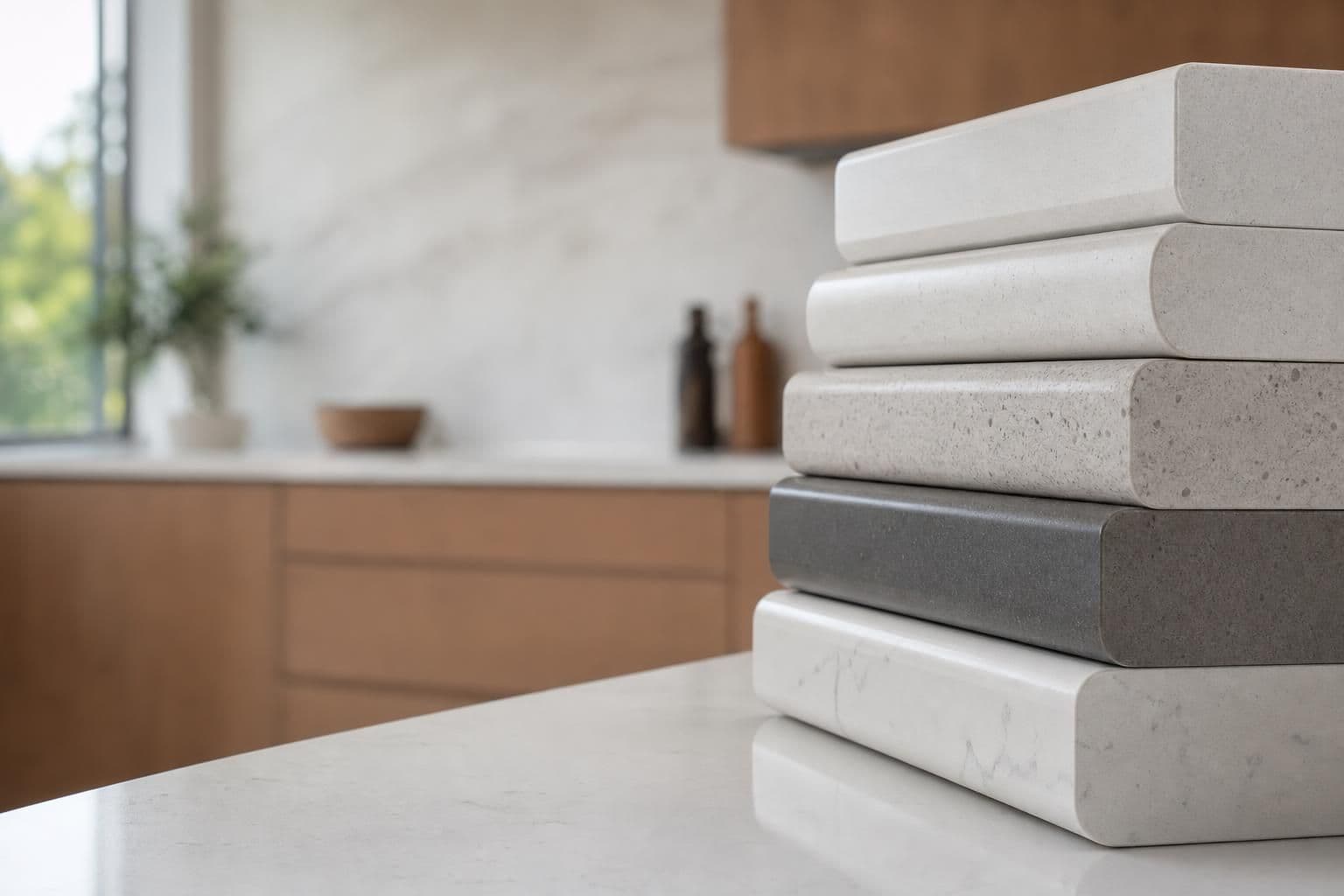
The edge profile is the shape of the countertop's front-facing lip, not the color or the slab itself. It changes three practical things: how the counter feels against a forearm or hip, how visible the material's edge thickness looks, and how much labor the fabricator spends routing and polishing that edge before installation. A flat polished edge and a rounded bullnose can come from the identical slab of quartz — the difference is entirely in how that edge is finished.
Because edge work happens after the slab is cut to size, it's one of the last decisions made before fabrication, which is also why it's easy to overlook until a template appointment is already scheduled.
Common edge profiles and what each one is good for
- Eased edge — a small bevel or softened corner, roughly 1/8 inch, so the top face doesn't have a sharp 90-degree line. This is the most common default because it's fast to fabricate and looks clean with almost any cabinet style.
- Bullnose — a full half-round on the top edge, sometimes both top and bottom (double bullnose). It removes sharp corners entirely, which matters in households with toddlers or anyone unsteady on their feet.
- Ogee — an S-curve profile with a raised lip and recessed curve below it. It reads as traditional or formal and is common on furniture-style vanities, but the double-curve routing takes longer to cut than a single-radius edge.
- Waterfall edge — the countertop material continues straight down the side of the cabinet to the floor, so the "edge" is really a mitered vertical panel. It reads as modern and is popular on islands, but it uses significantly more slab material and requires precise miter cuts to hide the seam.
- Dupont / quarter-round — a shallow, single-radius curve, less pronounced than a full bullnose. It's a middle ground between the eased edge's simplicity and the bullnose's softness.
Fabricators can usually show physical edge samples rather than just photos, which matters because a profile that looks dramatic in a rendering can feel very different under your hand.
Edge choice matters differently in Oahu kitchens and condos
Salt air and humidity don't change which edge profile holds up better — quartz is non-porous and stable regardless of shape, unlike natural stone, which the National Kitchen & Bath Association notes can be more sensitive to edge detail because thin, sharply cut natural stone edges are more prone to chipping than engineered quartz. What does change locally is household composition: many Oahu kitchens serve multigenerational families, and a rounded profile reduces the number of hard corners at hip and head height for both toddlers and older residents. The Consumer Product Safety Commission tracks home injuries from sharp furniture and counter edges as a recurring category in fall and impact incidents, which is one practical reason many households default to an eased or bullnose profile in a kitchen rather than a sharper, more architectural edge.
For condo remodels, the edge profile itself rarely needs AOAO sign-off, but the overall countertop spec sheet often does. If your building requires board approval before work starts, it helps to have that paperwork ready alongside your material selection — something covered in more detail in the site's guide to Honolulu condo AOAO flooring rules, which touches on the same approval process that applies to countertop and cabinet swaps in shared buildings.
How edge profile affects fabrication, not just looks
Every additional curve or step in a profile means another pass on the router and more polishing time before the piece leaves the shop. A single eased edge is one clean pass. An ogee edge is two curves cut in sequence, then polished to remove tool marks from both. A waterfall edge isn't really an edge cut at all — it's a full vertical panel that has to be mitered to match the top at a precise 45-degree angle so the seam disappears, and any book-matching of veining (visible in some quartz patterns) adds another layer of care during layout.
None of that changes what any specific job costs to quote — that depends on your slab choice, square footage, and how many corners and cutouts the fabricator has to route around, which is exactly why the site avoids publishing generic price ranges. A free quote priced against your actual countertop dimensions, with an answer within 24 hours, is the only number that reflects your edge choice, your layout, and your material tier together.
Matching the edge to your kitchen's overall style
The edge profile should agree with the cabinet door style, not fight it. A shaker or flat-panel cabinet door pairs naturally with a simple eased or dupont edge — clean lines on both surfaces. A raised-panel or furniture-style cabinet with more ornamentation can carry an ogee edge without looking busy. If you're working through a full cabinet redesign already, it's worth choosing the edge profile at the same time you're finalizing door style and hardware, rather than treating it as a separate decision — the guide to designing a kitchen island that works covers how island counters in particular benefit from an edge that's decided alongside the cabinet base, since a waterfall or thick-look edge changes how much clearance the island needs.
If you're still comparing quartz materials themselves — pattern, thickness, and brand differences — the breakdown of what quartz countertop material is actually made of is a useful companion read before you get to edge selection, since slab thickness affects which profiles are even possible.
Frequently Asked Questions
Q: What is the safest countertop edge profile for a kitchen with young children?
A full bullnose or double bullnose removes sharp corners entirely and is the profile most often recommended for households with toddlers, since there's no 90-degree edge at counter height for a child to walk into.
Q: Does a fancier edge profile like ogee cost more to fabricate?
Yes, in general — a multi-curve profile like ogee requires more routing passes and polishing time than a simple eased edge, though the exact difference depends on the fabricator, the material, and total linear footage, which is why it shows up as a line item on a project-specific quote rather than a flat rate.
Q: Can I mix edge profiles on the same countertop, like a waterfall island with an eased perimeter counter?
Yes, this is common — an island is often treated as a design feature with a waterfall or thicker-look edge, while surrounding perimeter counters use a simpler eased or bullnose edge to keep the daily-use surfaces practical.
Q: Does the edge profile need approval from a condo association board?
The edge shape itself typically isn't reviewed, but many Oahu condo boards require a full material and installation spec sheet before work begins, and that paperwork can include the edge detail alongside slab type and thickness.
Q: Is a waterfall edge harder to repair if it chips?
Because a waterfall edge is a mitered vertical panel rather than a simple rounded lip, a chip or seam separation is more visible and typically requires a fabricator to address it rather than a simple field repair, which is one tradeoff against its more dramatic look.