How Thick Should a Quartz Countertop Be?
Key takeaway
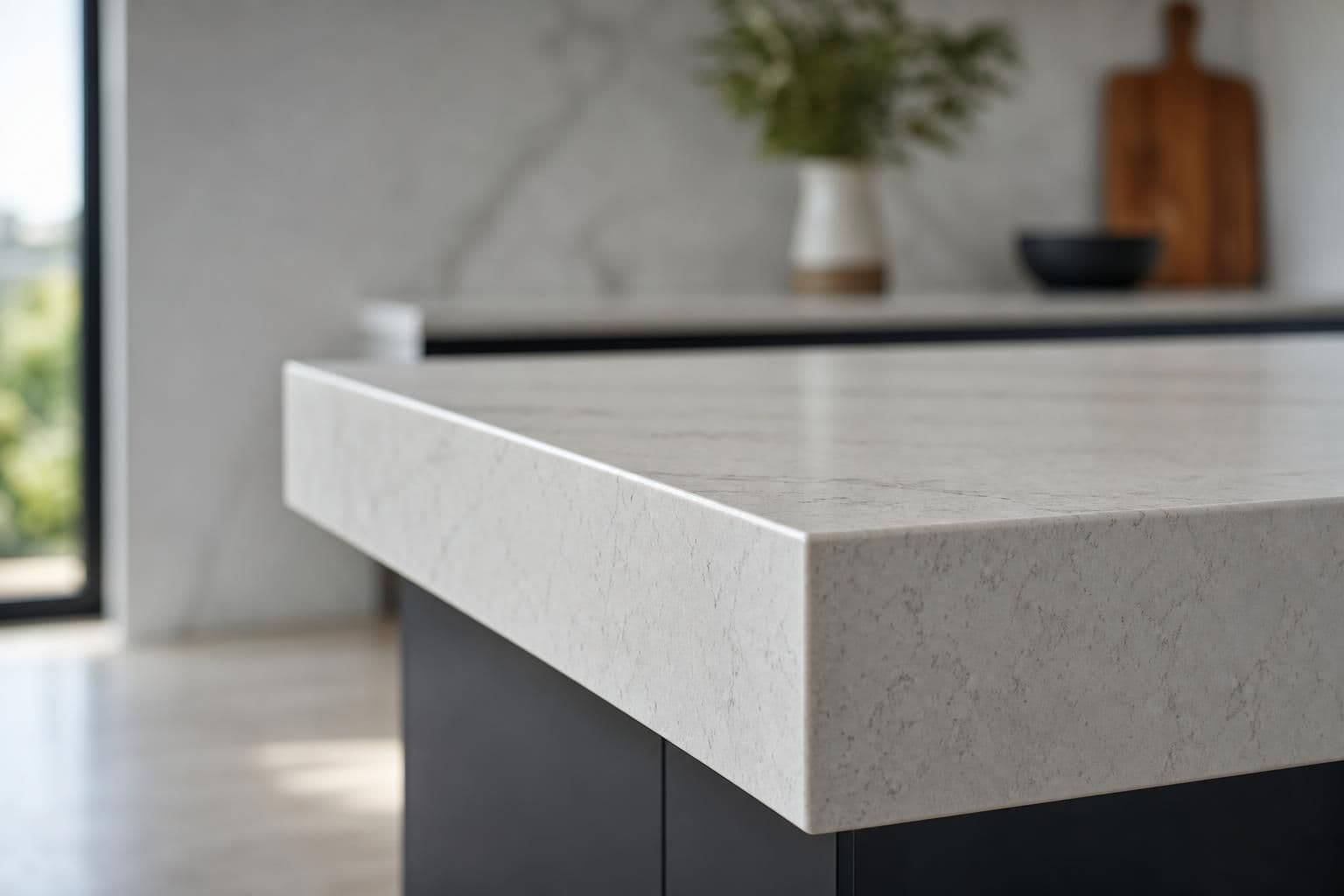
Most kitchen quartz countertops are either 2cm (about 3/4 inch) or 3cm (about 1.2 inches) thick, with 3cm being the more common choice for a substantial, furniture-grade look. Thinner 1.2cm quartz exists but is meant for vertical surfaces like backsplashes and tub surrounds, not load-bearing countertops. The right thickness for your project depends on the cabinet support underneath, how far the counter overhangs its base, and how the slab will be fabricated.
Key takeaways
- 2cm and 3cm are the two standard thicknesses for quartz kitchen and bath counters; 1.2cm is for vertical applications only.
- Unsupported overhangs are the main structural limit — beyond roughly 6-8 inches on 2cm quartz, you typically need corbels or brackets.
- Thickness is one of several things that move installed cost, so get a quote based on your actual layout rather than guessing from a generic figure.
The Two Standard Thicknesses, and Why 3cm Dominates
Quartz slabs are manufactured in a small number of set thicknesses because the material is engineered — roughly 90-95% crushed quartz bound with resin — rather than cut to custom depth like some natural stone. The two workhorse options are:
- 2cm (3/4 inch): Lighter, less material, and often the more economical option. Common in production kitchens and rentals where the counter sits on continuous cabinet support.
- 3cm (1.2 inch): The look most homeowners picture when they think of a "thick" stone counter. It contains about 50% more raw material than 2cm, which is why it's heavier and more involved to fabricate and set.
A lot of kitchens that look like they have a full 3cm edge are actually 2cm quartz with a mitered strip glued underneath the front edge, faking the thicker profile while using less raw material. It's a common, accepted fabrication technique — just ask whichever fabricator quotes your job whether the edge is solid 3cm or mitered.
What Drives Quartz Thickness Cost on Oahu
Material shipped to Hawaii carries freight considerations that mainland guides don't account for, so it's more useful to know what moves the number than to anchor to a flat figure. On Oahu, the biggest swings come from:
- Material tier: quartz is priced by brand and design tier, and premium veining or matte finishes take more fabrication effort than entry-level colors, independent of thickness.
- Freight and special orders: less common colors or thicknesses often have to be special-ordered from the mainland, which adds lead time and shipping on top of the base material.
- Edge style and seam count: waterfall edges, mitered build-ups, and multi-slab layouts with more seams all add fabrication labor beyond the raw slab.
- Sink and cooktop cutouts: each cutout adds templating and fabrication time, plus reinforcement if it falls near an overhang.
- Tear-out and disposal: removing and hauling away an existing countertop, especially heavy old granite or tile, adds labor before the new slab goes in.
- Access: condo jobs with elevator or loading-dock restrictions, or homes with a long carry from the driveway to the kitchen, add setup time for moving heavy slabs.
Thickness itself is one input among several, since 3cm quartz uses roughly 50% more raw material than 2cm and is heavier to ship and set. But two kitchens using the same thickness can land in very different places once edge work, cutouts, and access are factored in. A free quote priced against your actual layout, access, and material choice is the only way to get an exact figure — everything above just explains which direction it moves.
Overhangs Are the Real Thickness Decision
Thickness matters most where the counter extends past its cabinet or support wall — think eat-in bar seating or a waterfall island edge. Quartz is strong for its density, but an unsupported slab edge can crack under point-load weight (someone leaning on the corner, for example) if it extends too far.
General fabricator guidance is:
- 2cm quartz: keep unsupported overhangs to around 6-8 inches, or add steel brackets/corbels beyond that
- 3cm quartz: can typically handle overhangs up to about 10-12 inches unsupported before bracing is recommended
These aren't universal code numbers — they vary by fabricator warranty terms — but the mechanism is the same everywhere: more material depth resists bending stress better, so a thicker slab tolerates a longer unsupported reach. The Natural Stone Institute publishes fabrication and installation guidance that covers engineered surfaces like quartz alongside natural stone, and it's worth asking your fabricator whether their overhang recommendation matches industry norms before you finalize a bar-seating design.
Sink Cutouts and Weight Load
A sink cutout removes material exactly where the slab is already under the most stress, since it's spanning an open cabinet base rather than resting on solid support. With 2cm quartz, fabricators often add a plywood or particleboard build-up strip around the cutout for reinforcement. 3cm quartz generally doesn't need that extra support because the added mass carries the load on its own.
The tradeoff is weight: a 3cm slab is heavier to move and set, which is one reason large kitchen islands sometimes get built with a torsion box or extra cabinet bracing underneath before the counter goes on — something worth flagging with your installer if you're planning a big island in an existing or new custom cabinet layout.
Waterfall Edges and Vertical Applications
A waterfall edge — where the countertop material wraps down the side of an island to the floor — needs enough visual mass to look intentional rather than like a thin panel glued on. Most waterfall edges use full 3cm slabs, or a mitered 2cm edge built to mimic 3cm, matched at the seam so the veining lines up around the corner.
At the other end of the spectrum, thin 1.2cm quartz shows up on shower walls, tub decks, and backsplashes, where it isn't carrying any structural load and the goal is just a flat, low-maintenance surface. Don't spec 1.2cm for a horizontal counter — it isn't rated for that use and most fabricators won't install it that way.
Choosing Thickness for an Oahu Kitchen or Condo Remodel
If you're bundling counters with new flooring in the same remodel, it's worth pricing both at once since scheduling and delivery often overlap — the vinyl plank flooring cost guide outlines what drives flooring costs for that side of the project. Condo owners have an added wrinkle: some AOAO boards ask for material specs, including thickness and weight, as part of remodel approval, so it helps to confirm your slab thickness before submitting paperwork rather than after fabrication starts.
Touching an actual slab sample changes this decision more than any spec sheet — the weight difference between 2cm and 3cm quartz is obvious the moment you pick up an edge sample, and it's easier to decide once you've felt it.
Frequently Asked Questions
Q: What is the standard thickness for a kitchen quartz countertop?
Most kitchen quartz countertops are either 2cm (about 3/4 inch) or 3cm (about 1.2 inches) thick, with 3cm being the more common choice for a substantial look. Thinner 1.2cm quartz is used on vertical surfaces, not counters.
Q: Is 3cm quartz always better than 2cm?
Not necessarily — 3cm looks heavier and handles longer overhangs without extra support, but it weighs more per square foot and takes more effort to ship and set, which can matter for large islands. Many kitchens use 2cm quartz with a mitered edge to get a similar look with less raw material.
Q: How far can quartz overhang without support?
As general fabricator guidance, 2cm quartz should stay within about 6-8 inches of unsupported overhang, and 3cm quartz can often handle up to 10-12 inches, before corbels or brackets are needed. Exact limits vary by fabricator, so confirm with whoever installs the slab.
Q: Can I use quartz for a waterfall edge island?
Yes — waterfall edges typically use full 3cm slabs or a mitered 2cm edge built to mimic 3cm thickness, with veining matched across the corner seam for a continuous look.
Q: Does countertop thickness affect the price on Oahu?
Yes — 3cm quartz uses roughly 50% more raw material than 2cm and is heavier to ship and fabricate, so it generally costs more than 2cm. Edge style, seam count, sink cutouts, access (including condo elevator or loading-dock limits), and whether the color is stocked locally or special-ordered all move the number further, which is why pricing is quoted per project rather than off a flat rate.