Quartz Countertop Thickness: 2cm vs 3cm Compared
Key takeaway
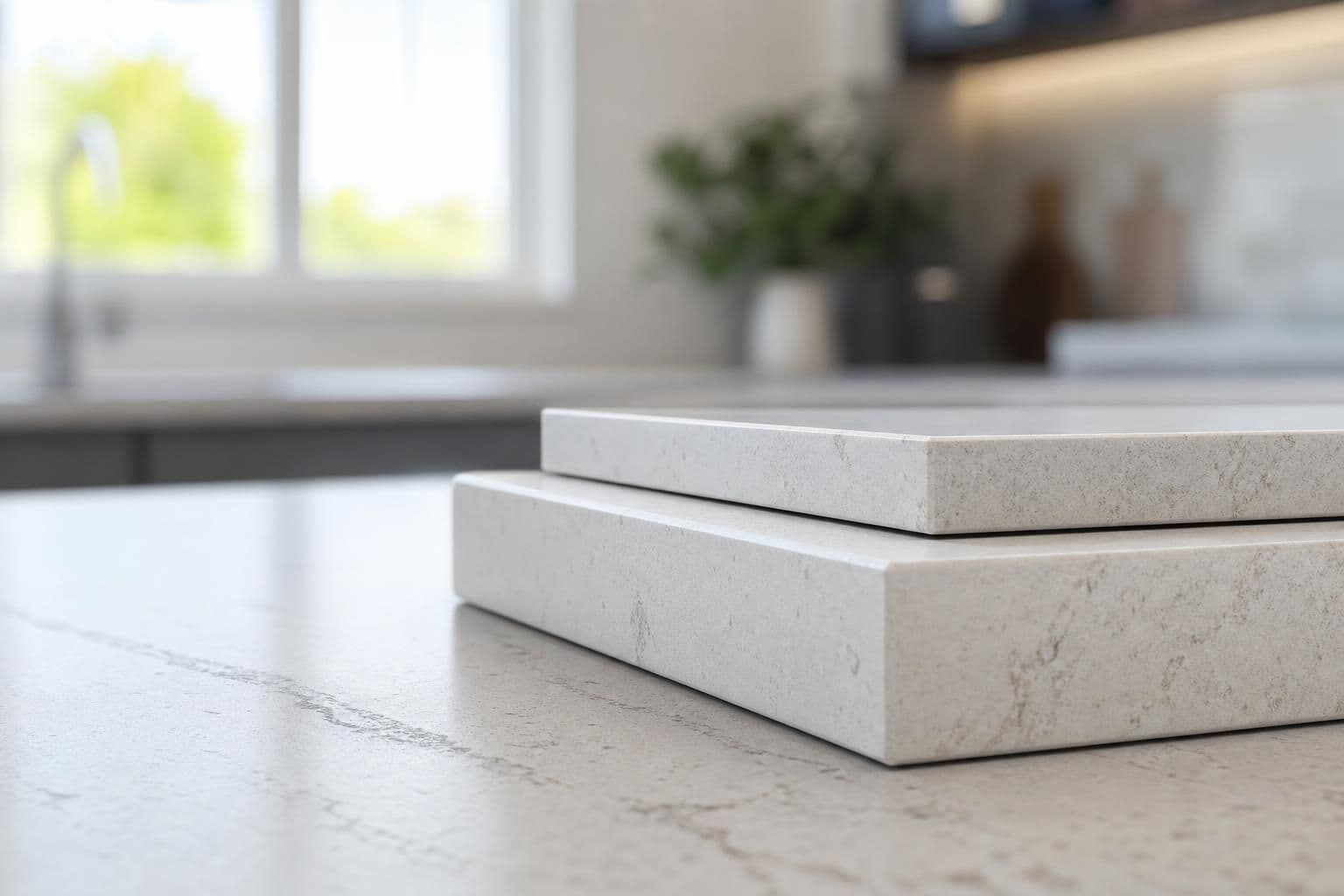
The main difference between 2cm and 3cm quartz is that 3cm slabs are thicker, stronger on their own, and generally more involved to fabricate and install, while 2cm slabs are lighter and simpler to handle but need a plywood substrate underneath to look and perform the same. Most Oahu kitchens today use 3cm because it needs no build-up edge and holds up better to daily use; 2cm is more common in vanities, bar tops, or budget-conscious remodels.
Key takeaways
- 3cm quartz is heavier and needs no backing, but the extra material and handling add labor; 2cm is lighter to move but almost always needs a plywood substrate, which adds its own labor step.
- 3cm doesn't need a plywood substrate; 2cm almost always does, which shifts the labor even though the slab itself is easier to fabricate.
- For kitchen counters that see heavy daily use, 3cm is the more common choice; 2cm works fine for vanities, laundry counters, or low-traffic surfaces.
What "2cm" and "3cm" Actually Mean
Quartz slabs are manufactured in standard thicknesses, and 2cm (about 3/4 inch) and 3cm (about 1 1/4 inch) are the two you'll see quoted almost everywhere. The number refers to the raw slab thickness before fabrication, not the finished edge profile — a 2cm slab can still get a thick-looking edge through lamination, where fabricators glue a strip of matching quartz underneath the front edge to fake the look of a thicker slab.
What Actually Drives the Cost Difference
Rather than a fixed price gap, the real difference between 2cm and 3cm comes down to what each thickness demands during fabrication and install:
| Thickness | Substrate Needed | Weight / Handling | Install Complexity | Common Use |
|---|---|---|---|---|
| 2cm | Yes, almost always | Lighter, easier to carry up stairs or into elevators | Extra step to bond and level plywood backing | Vanities, bar tops, budget kitchens |
| 3cm | No | Heavier, roughly 50% more per square foot than 2cm | Simpler backing, but heavier slabs are harder to maneuver in tight condo hallways | Kitchen counters, islands, high-use surfaces |
| 2cm with laminated edge | Yes | Lighter slab, added edge-lamination step | Extra fabrication time to match and bond the edge strip | Kitchens wanting a thick-edge look without solid 3cm |
Waterfall edges, complex cutouts, elevator or loading-dock restrictions in Honolulu high-rises, and premium slab colors all add fabrication and logistics time regardless of which thickness you choose. If you want a fuller breakdown of what moves quartz jobs up or down in complexity, the site's quartz cost drivers guide covers that in more depth.
Why Most Kitchens End Up With 3cm
A 3cm slab is rigid enough to span cabinet openings and sink cutouts without a backing layer, which simplifies fabrication and reduces the number of seams a fabricator needs to add for support. It also holds up better to point loads — someone leaning on a corner, a heavy stand mixer set down hard, or a countertop overhang used as informal seating. Because it doesn't require lamination to get a substantial-looking edge, 3cm is usually the default recommendation for kitchen islands and main counters.
When 2cm Makes Sense
2cm isn't a downgrade, it's a different tool. It's a common choice for:
- Bathroom vanities, where the counter is smaller and sees lighter use
- Laundry room counters or wet bars
- Budget remodels where a lighter, easier-to-fabricate slab offsets the added substrate step
- Projects using a laminated edge to mimic a thicker look without paying for solid 3cm material and handling
The plywood substrate under 2cm quartz isn't a weak patch — it's a standard fabrication method that the Natural Stone Institute and major quartz manufacturers both document as acceptable practice, provided the substrate is properly sealed and supported.
Durability and Everyday Use
Both thicknesses use the same quartz material — roughly 90–94% ground quartz bound with resin — so scratch and stain resistance don't change with thickness. What changes is impact resistance at edges and corners and how the slab handles unsupported spans, like a peninsula overhang. The Consumer Product Safety Commission has published guidance in past years reminding installers that any unsupported quartz or stone overhang needs corbels or brackets regardless of slab thickness, since thickness alone doesn't eliminate the risk of cracking under weight.
Weight and Installation Considerations
Thicker slabs weigh more, which matters for cabinet support and for condo buildings where load and delivery logistics can be tighter. A 3cm slab weighs roughly 50% more per square foot than 2cm, so cabinets underneath need to be level and properly shimmed before installation regardless of which thickness you choose. In older Oahu homes, uneven subfloors or cabinet boxes that have shifted over time can add leveling work before either thickness is set in place. For condo owners, this is also the point where AOAO paperwork tends to come up — boards often want to see the countertop spec, including thickness, before approving a remodel. If that's part of your project, the site's condo AOAO flooring rules guide walks through what boards typically ask for, and the same logic applies to countertop specs.
Edge Profiles and Look
Because 3cm has more material to work with, edge profiles like bullnose, ogee, or a thick waterfall edge look more substantial without extra fabrication. 2cm can achieve similar edge looks through lamination, but a laminated seam is sometimes visible up close on lighter colors or under certain lighting — something worth checking with a physical sample rather than a photo or swatch.
How to Decide
A few questions narrow it down fast:
- Is this a kitchen counter or island that gets daily heavy use? Lean 3cm.
- Is this a vanity, bar top, or low-traffic surface? 2cm is usually fine and simpler to handle.
- Do you want a thick-edge look without the weight of solid 3cm? Ask about 2cm with a laminated edge.
- Are you in a condo needing AOAO sign-off, or working around elevator and loading-dock limits? Get the thickness and edge spec in writing early, since boards and building management often ask for it before approving work.
Since the real cost of a project depends on layout, edge style, cutouts, tear-out of the old counter, stairs or elevator access, and the specific slab chosen, the only way to get a real number is a free quote measured against your actual kitchen — whether you're comparing 2cm and 3cm for a full kitchen or a single vanity through quartz countertops.
Frequently Asked Questions
Q: Is 3cm quartz stronger than 2cm quartz?
Yes, 3cm has more material and can span openings without a plywood substrate, making it more resistant to point loads and unsupported overhangs. Both thicknesses have similar scratch and stain resistance since they're made from the same quartz-resin material.
Q: Does 2cm quartz need a plywood backing?
Almost always. Fabricators add a plywood substrate under 2cm slabs to give the countertop enough rigidity and support, especially around sink cutouts and cabinet spans.
Q: Can 2cm quartz look as thick as 3cm?
Yes, through a laminated edge, where a fabricator glues a matching strip of quartz under the front edge to create the look of a thicker slab without the weight and handling of solid 3cm.
Q: Which thickness is better for a kitchen island?
3cm is the more common choice for islands because it doesn't require substrate build-up and handles the point loads that come with seating overhangs or heavy appliances set on the surface.
Q: Does thickness affect the project's complexity more than color or edge style?
Not usually. Slab color, edge profile complexity, cutouts (sinks, cooktops), tear-out of the old counter, and access issues like stairs or elevators often add more fabrication and labor than the thickness difference alone, which is why a project-specific quote gives a far more accurate picture than general thickness comparisons.