Quartz Countertop Seams: How to Hide Them
Key takeaway
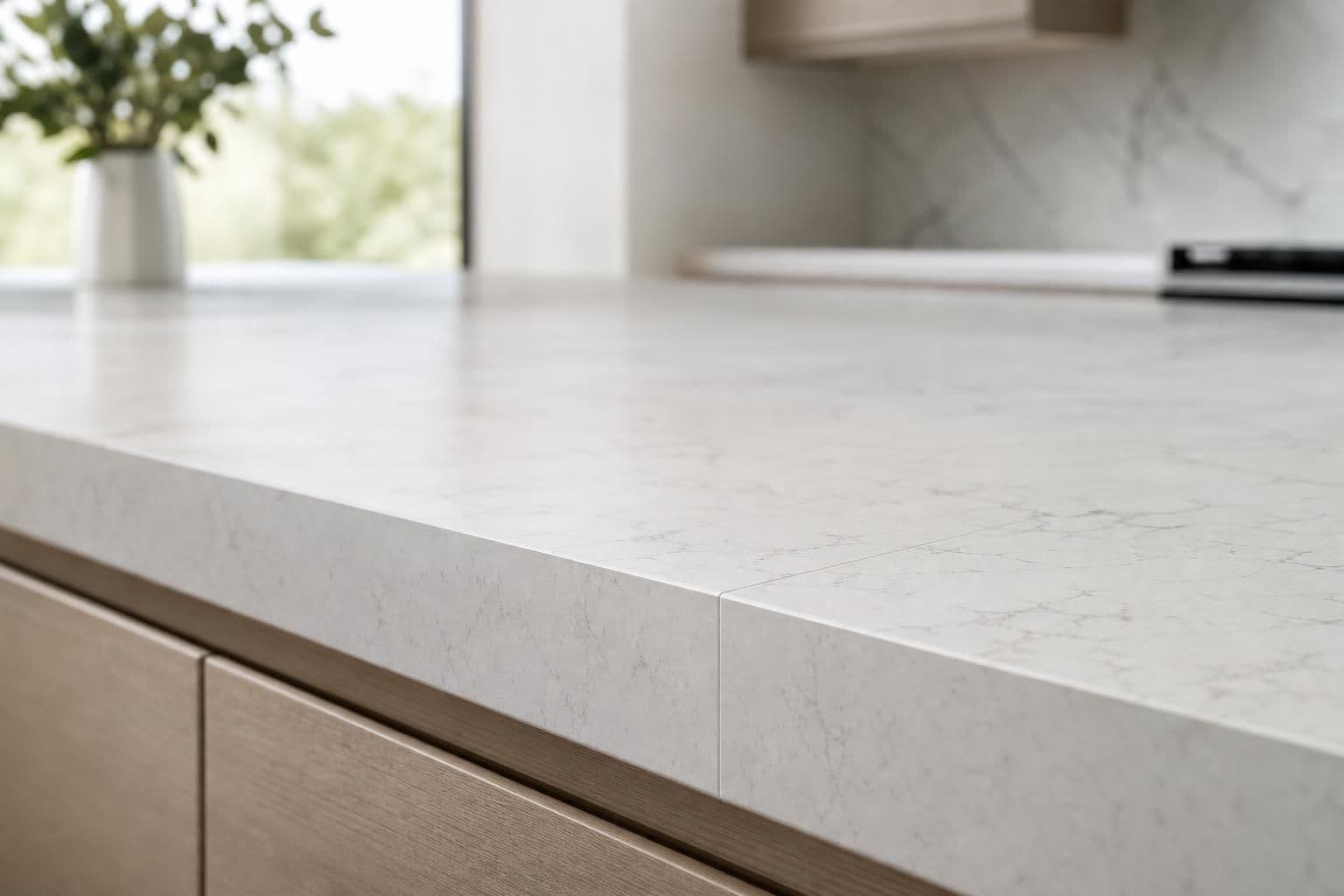
Quartz countertop seams are hidden by matching the seam filler color to the slab pattern, placing the seam where the pattern naturally breaks (like at a sink base or where two grain directions meet), and using a fabricator who book-matches slabs so veining lines up across the joint. Done well, a seam feels like a hairline you have to look for, not a visible stripe across your counter. No seam disappears completely, but a good layout plan and a skilled installer can get it close.
Key takeaways
- Seam placement matters more than seam filler — plan seams at sinks, corners, or pattern breaks before slabs are cut.
- Ask your fabricator to dry-lay or "book-match" slabs so veining continues across the joint instead of clashing.
- Bold, busy quartz patterns hide seams far better than plain white or solid colors, which show every line.
Why quartz always has some seam
Quartz slabs come out of the factory in standard sizes, most commonly around 120 by 55 inches to 126 by 63 inches depending on the manufacturer. Any countertop run longer or wider than one slab needs a seam — there's no way around it once a kitchen island or L-shaped run exceeds that footprint. The question isn't whether you'll have a seam, it's whether it will be noticeable.
A seam is a thin line of color-matched epoxy resin joining two slab edges, polished flush after curing. When fabricators use the right seam kit and match the resin tint to your slab color, the joint can shrink to about 1/16 inch wide. That's the realistic best case — not invisible, but easy to miss unless you're looking for it.
Where a good fabricator puts the seam
Seam placement is decided before a single cut is made, using a full-size template of your kitchen or bathroom layout. Experienced fabricators try to land seams in low-visibility spots:
- Directly in front of or behind a sink, where the faucet and basin already break up your sightline
- At an inside corner of an L-shaped counter, where two walls meet
- Along a natural break in a busy pattern, so the eye reads it as part of the design rather than a flaw
- Away from high-traffic sightlines like the counter edge facing your kitchen entry
A seam placed dead-center on a long, open run — the first thing you see walking into the kitchen — is the layout mistake that makes seams look bad. If your fabricator hasn't discussed seam placement with you before templating, ask.
Pattern choice does most of the hiding
The single biggest factor in how visible a seam looks isn't the installer's skill — it's the slab pattern you picked. Solid or near-solid colors (plain white, plain black, light gray with almost no veining) show a seam clearly because there's nothing to distract the eye. Busy, high-movement patterns with heavy veining or flecking camouflage a seam because the joint just becomes one more line in a field of lines.
If hiding seams is a priority, lean toward quartz with visible movement rather than a flat, uniform surface. Our quartz countertops selection includes both styles side by side in the showroom, which makes this trade-off easy to see in person rather than guess at from a photo.
Book-matching: lining up the veining
Book-matching means cutting two pieces from slabs (or from the same slab) so the veining continues across the seam like an open book, rather than two random patterns bumping into each other. It's a manual, skill-dependent step — the fabricator physically lays out slab pieces and rotates or flips them until the pattern lines up before cutting the final template. Not every fabricator offers this for standard jobs; it's worth asking for specifically, especially on an island or a long run where the seam will be visible from a seated dining position.
Because quartz is engineered rather than cut from a single stone block, its pattern repeats in a way natural stone doesn't, which actually makes book-matching easier and more consistent than it is with granite or marble slabs. The Natural Stone Institute has technical guidance on slab fabrication tolerances if you want to go deeper on how seams are engineered.
What actually drives the cost of seam work on Oahu
Seam quality and placement usually aren't billed as a separate line item — they're folded into the fabrication and installation labor on your quote. What moves that labor cost is worth understanding before you compare bids:
- Material tier. Entry-level quartz patterns are faster to fabricate and match at the seam; premium high-movement patterns take longer to lay out, rotate, and align, since the whole point is hiding the joint in the veining.
- Book-matching labor. A fabricator who dry-lays slabs and hand-matches veining across the seam is spending extra shop time before a single cut is made — that's added labor, not added material.
- Number of seams your layout needs. A galley kitchen that fits on one slab needs zero seams; an island plus L-shaped run often needs one or two, and each one adds template, cutting, and polishing time.
- Edge profile complexity. Mitered or waterfall edges near a seam take more finishing work than a standard eased edge.
- Access and logistics. Elevator size and loading-dock hours in Honolulu high-rises can slow slab delivery and require the fabricator to schedule around building move-in windows, which affects labor time more than material cost.
- Tear-out and old countertop disposal. Removing and hauling away an existing counter before templating the new one is its own labor step, separate from the seam work itself.
These factors shift your total up or down depending on your specific kitchen — there's no single number that applies to every layout. A free quote measured against your actual square footage, seam count, and edge profile is the only way to get an exact figure, and we typically respond within 24 hours.
Seams in small kitchens and condos
Smaller Oahu kitchens and condo galley layouts sometimes get lucky and fit an entire counter run on one slab, meaning zero seams. If you're a condo owner working through AOAO board approval, seam count and placement are worth flagging on your submitted spec sheet, since some boards want the layout drawing before sign-off. If you're weighing quartz against other surfaces for a full remodel plan, our guide on vinyl plank flooring cost on Oahu covers how flooring and countertop projects typically get sequenced in a kitchen renovation.
Maintenance doesn't make seams worse
Quartz is nonporous, so unlike natural stone, seams don't stain or darken over time from sealant breakdown — there's no sealant to maintain in the first place. According to Consumer Reports, quartz countertops resist scratching and staining better than most natural stone in standard household use, and that durability extends to the seam line itself. A seam that's cut and finished well on day one should look about the same years later, assuming normal use and no impact damage near the joint.
Frequently Asked Questions
Q: Can quartz countertop seams be completely invisible?
No. Even with color-matched resin and book-matched veining, a seam remains a visible hairline up close. The goal is to make it unnoticeable at normal viewing distance, not to erase it entirely.
Q: Does seam location cost extra on a quote?
Seam placement itself doesn't usually add labor since it's part of standard fabrication, but book-matched or mitered seams take extra shop time and often carry an added fee per seam. Ask your fabricator to break this out on your quote.
Q: Is a seam near the sink a bad idea?
It's actually one of the most common and preferred spots, since the sink and faucet already interrupt the sightline, making the seam far less noticeable than one on an open counter run.
Q: Do darker quartz colors hide seams better than light colors?
Not necessarily by darkness alone — pattern movement matters more than color depth. A busy dark pattern hides seams well, but a flat, solid dark color can show a seam almost as clearly as a flat white.
Q: How many seams will my kitchen countertop need?
That depends on your layout size versus standard slab dimensions, typically around 120 by 55 inches. A galley kitchen might need zero seams; an island plus L-shaped counter often needs one or two.