How Much Weight Can a Quartz Countertop Hold?
Key takeaway
A quartz countertop that's fully supported by cabinets below can hold whatever you set on it in normal kitchen use — appliances, cutting boards, a stack of cookbooks — without any real limit, because the cabinet box and substrate are carrying the load, not the slab itself. The number that actually matters is how much weight an unsupported overhang (like a bar seating area or waterfall edge) can take before it needs a corbel or steel bracket, and that depends on the overhang length, slab thickness, and whether the load is spread out or concentrated on one point. There's no single "quartz can hold X pounds" figure that applies to every kitchen, which is exactly why fabricators measure your specific layout before they tell you what support you need.
Key takeaways
- Fully supported quartz (sitting on cabinets or plywood) has no practical household weight limit — the cabinet structure, not the stone, carries the load.
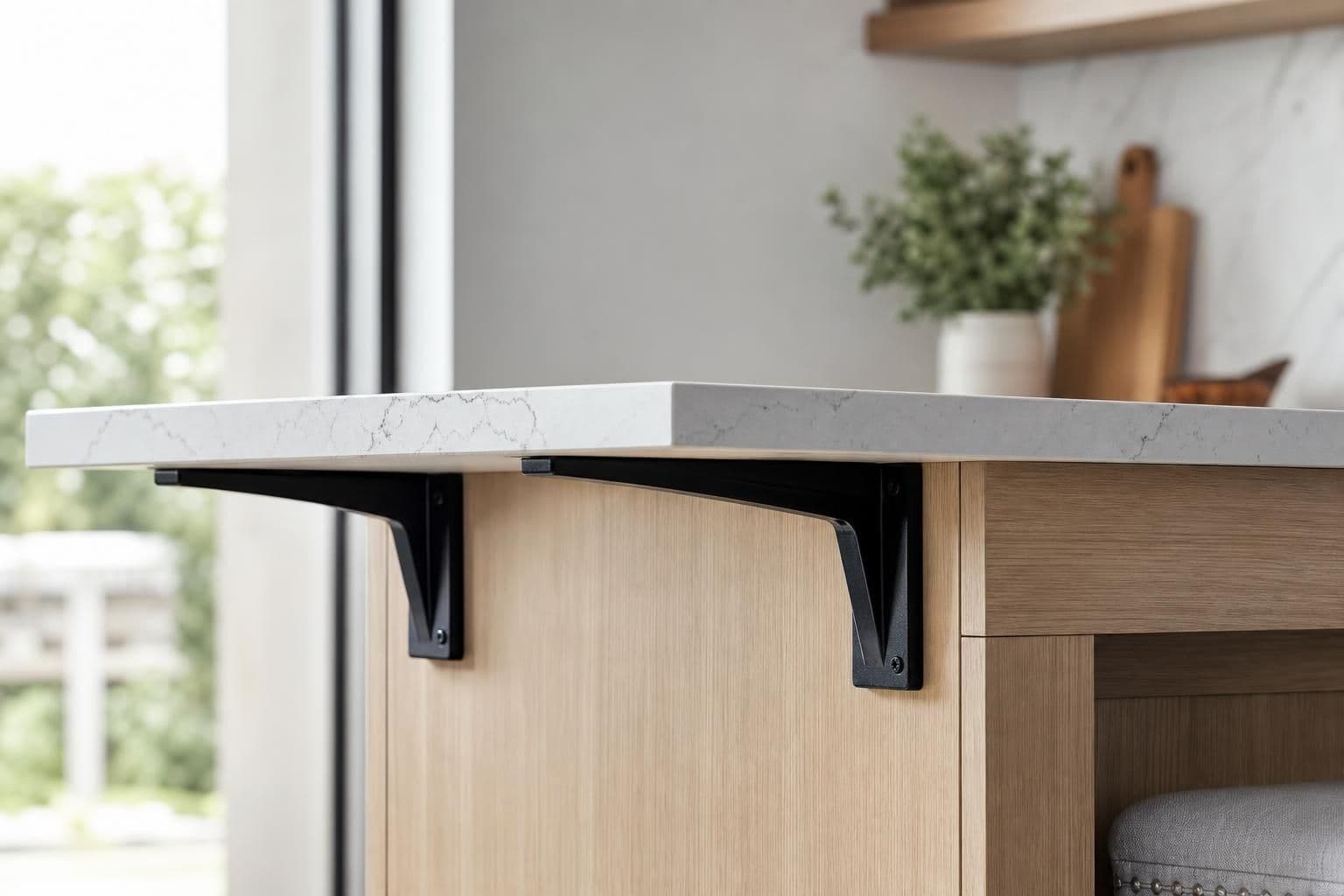
- Unsupported overhangs are the real weak point; most fabricators require a corbel or steel bracket once an overhang passes roughly 10 to 12 inches.
- A concentrated point load (a heel, a knee, a dropped cast-iron pan) does more damage to an edge than an evenly spread load of the same total weight.
Why "weight capacity" is the wrong question for most of the counter
Over 90% of a quartz slab's finished surface sits directly on cabinet boxes, plywood decking, or a support frame, so the question isn't really "how much can quartz hold" — it's "how much can your cabinets and subfloor hold," and that's a much higher number than most people worry about. Quartz itself is an engineered material, typically ground natural quartz bound with polymer resin, which Cambria, one of the larger quartz manufacturers, describes as a nonporous surface that's harder and more consistent than many natural stones precisely because the manufacturing process controls the mineral-to-resin ratio.
The part of the counter that actually needs engineering attention is the part with nothing underneath it — overhangs, waterfall edges, and floating shelves. That's where fabricators calculate support, and it's also where DIY installs and underbid jobs most often fail.
What determines how much an overhang can take
An overhang is a cantilever: the farther the slab extends past its support, the more leverage any weight on the end has to crack or snap the stone. The factors that change the safe load are:
- Overhang length. A short 6-inch overhang for a backsplash lip behaves very differently from a 15-inch bar overhang meant for stools.
- Slab thickness. Standard quartz comes in roughly 2cm and 3cm thicknesses; the thicker slab resists bending and point loads better, which is why many fabricators spec 3cm for any seating overhang.
- Support type. Plywood backing under a 2cm slab, steel brackets, or stone corbels each change how far an overhang can safely extend before needing extra support.
- How the load is applied. A person leaning their full weight on one elbow at the edge is a point load; a stack of plates spread across the surface is a distributed load. Point loads near an unsupported edge are the most common cause of cracked quartz.
Most fabrication guidelines call for additional support — a corbel, a steel bracket, or a plywood build-out — once an overhang passes somewhere around 10 to 12 inches, and some manufacturers tighten that further for 2cm material. Because these numbers shift by slab thickness and manufacturer, the only reliable way to know what your island or peninsula needs is to have it measured as part of your project, which is part of why a countertop quote on Oahu starts with the actual layout rather than a generic spec sheet.
Sink and cooktop cutouts change the math
Cutting a sink or cooktop opening removes material exactly where a slab would otherwise be strongest, so the strip of stone between a sink cutout and the front edge of the counter is often the most fragile section on the whole job. Fabricators commonly reinforce that strip with additional support underneath or avoid placing a seam too close to it. If you're standing at the sink and leaning on that narrow strip while reaching for something, you're applying a point load to the weakest part of the slab — worth knowing if you're the type to lean on the counter while doing dishes.
Can you stand or sit on a quartz counter?
Briefly and carefully, over a fully supported area, most quartz can take it — but manufacturers don't recommend it, and doing it on an unsupported overhang or near a sink cutout is how counters crack. The risk isn't the material failing under body weight in general; it's concentrated weight (a foot, a knee) landing on an edge or a thin section that wasn't designed to flex. The same caution applies to climbing on counters to reach a cabinet — OSHA and most building-safety guidance treat countertops as work surfaces, not step stools, for a reason that has nothing to do with the stone and everything to do with stability and fall risk.
Thermal and impact stress act like hidden weight
Quartz resists scratching and staining well, but sudden temperature changes and sharp impacts stress the resin binder in ways that aren't about static weight at all. Setting a hot pan directly on an edge near an unsupported overhang, or dropping a heavy pot from height onto the same spot, can chip or crack the stone faster than a slow, steady load ever would. If your kitchen design includes a lot of bar seating or a waterfall island edge, it's worth discussing both the mechanical support and the realistic daily use with whoever is fabricating the piece — including where people will actually set hot cookware.
What this means for island seating and condo kitchens
Homeowners planning bar-height seating on an island should decide on seating overhang and bracket placement before the countertop is templated, not after, because retrofitting steel supports under an installed slab is far more disruptive than building them in from the start. Condo owners have an added wrinkle: AOAO boards sometimes want documentation of how an island or peninsula is supported as part of renovation approval, alongside the usual flooring and plumbing specs. If you're still deciding on layout, color, or seating configuration, the countertop color guide for small kitchens and a walk-through of what to expect at a countertop showroom are good places to see support brackets and edge options in person before committing to a design.
Because overhang length, slab thickness, cutout placement, and support type all interact, the only number that actually tells you what your counter can hold is one calculated against your own island or peninsula dimensions — which is what a fabricator does during templating, not something a general guide can responsibly publish.
Frequently Asked Questions
Q: How much weight can a quartz countertop hold if it's fully supported by cabinets?
Fully supported quartz has no practical household weight limit — the cabinet box and substrate underneath carry the load, and normal kitchen use (appliances, cookware, people leaning on it) is well within what the structure handles.
Q: How far can a quartz countertop overhang without support?
Many fabricators require a corbel or steel bracket once an overhang extends past roughly 10 to 12 inches, though the exact limit depends on slab thickness and the fabricator's own engineering standards, so it should be confirmed for your specific island or peninsula.
Q: Is 2cm or 3cm quartz stronger for an overhang?
3cm quartz generally resists bending and point loads better than 2cm material, which is why many fabricators specify the thicker slab or add plywood backing for any overhang meant for seating.
Q: Can you sit or stand on a quartz island overhang?
Occasional sitting pressure on a properly supported overhang is usually fine, but standing or kneeling on an unsupported edge concentrates weight exactly where the slab is weakest and is how most overhang cracks happen.
Q: Does a sink cutout weaken a quartz countertop?
Yes — removing material for a sink or cooktop cutout leaves a narrower, more fragile strip of stone nearby, which is why that section often needs extra underside support rather than relying on the slab alone.