Countertop Replacement on Oahu: What to Know Before You Start
Key takeaway
Countertop replacement on Oahu typically runs through four stages — removal of the old surface, templating the new one to the exact cabinet layout, off-site fabrication, and a single-day install with sink and faucet reconnection. The steps are the same island-wide, but what changes the timeline and difficulty is the building: a single-family home in Mililani moves faster than a Honolulu high-rise condo that requires AOAO sign-off and a booked service elevator. The only way to know what your specific project will take is a quote measured against your actual kitchen, not a generic job.
Key takeaways
- Template-to-install usually spans one to a few weeks because the new slab is cut to your cabinets after old countertops come out, not before.
- Condo projects need AOAO paperwork and elevator/loading-dock scheduling built into the timeline before fabrication even starts.
- Cabinet condition, sink type, and whether plumbing or electrical needs rerouting affect labor more than the countertop material itself.
What "Replacement" Actually Involves
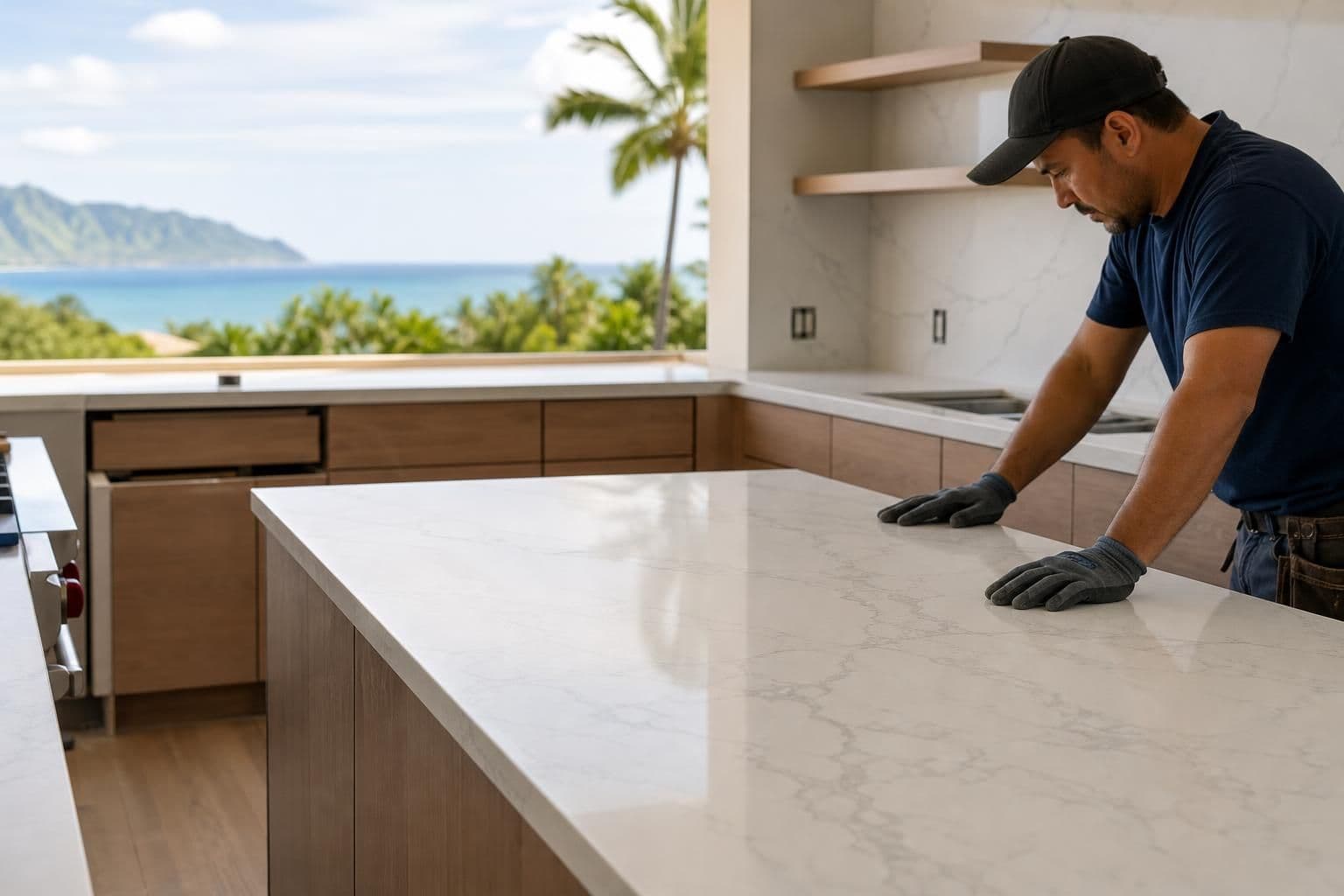
Countertop replacement isn't a swap-and-done job — it's a sequence with a built-in waiting period most homeowners don't expect. First, the old counters, backsplash, and often the sink are removed. Then a fabricator templates the new piece directly against your cabinets, because quartz and stone slabs are cut to the exact dimensions of the space they're going into, not to a standard size. That slab is then fabricated off-site, with edge profiles, sink cutouts, and faucet holes machined before it ever arrives at your house. Install day itself is usually fast; the fabrication window in between is where the real time goes.
If you're still deciding between materials, how much weight a quartz countertop can hold is a useful companion question, since slab thickness and support requirements affect how cabinets and backer boards need to be prepped before template day.
What Actually Moves the Timeline and Difficulty
No two Oahu kitchens cost the same to redo, because the variables aren't the countertop material — they're the house. The factors that actually move a project:
- Cabinet condition — out-of-level or water-damaged cabinet boxes need shimming or partial rebuilding before a slab can sit flat.
- Sink and faucet type — an undermount sink swap or a new faucet hole changes the cutout work at the fabrication stage.
- Old countertop material — tile and some stone backsplashes take longer to demo and generate more debris to haul than laminate.
- Plumbing and electrical — relocating an outlet for a new island or rerouting a drain line adds a licensed trade to the schedule.
- Elevator and loading-dock access — in Honolulu condo towers, slab delivery has to fit the building's service elevator and a booked time slot, not just the installer's calendar.
- Island freight on special orders — a material not kept in local stock has to be shipped in, which adds real days to fabrication regardless of installer availability.
None of these show up on a national cost calculator, because they're specific to how Oahu homes and buildings are actually built. A quote that accounts for them is worth more than a published number that doesn't.
Condo and High-Rise Considerations
If you own a unit in a Honolulu high-rise, the paperwork often takes longer than the install. Most AOAOs require specs submitted to the board before work starts — material type, underlayment or support details, and sometimes a certificate of insurance from the installer. Getting those specs drafted correctly the first time avoids a second board cycle, which can add weeks. What to expect at a countertop showroom covers how samples and specs typically get pulled together before that paperwork goes in.
Beyond the AOAO, the building itself sets real constraints: service elevators have weight and size limits that affect how a slab gets moved, and loading docks often require a reserved window. A straightforward single-family job can become a multi-day coordination exercise in a tower simply because of these building rules — not because the counter itself is harder to install.
Material and Fabrication Lead Time
Quartz is engineered stone — a mix of ground natural quartz and resin, pressed and cured into slabs — which is why it doesn't need sealing the way natural granite or marble does. That consistency also makes quartz predictable to fabricate, but lead time still depends on whether your chosen color is in local stock or has to be special-ordered from the mainland. Special orders carry island freight time on top of normal fabrication, so a color swap mid-project can add more delay than people expect.
Cutting engineered stone also produces fine silica dust, which is why fabricators follow dust-control practices during cutting and polishing — a known workplace hazard tracked by the Occupational Safety and Health Administration. That's a fabrication-shop concern more than a homeowner one, but it's part of why slab cutting happens off-site rather than in your kitchen.
Teardown in Older Oahu Homes
Homes built before 1978 may have lead-based paint on cabinets or walls near the counter, and disturbing it during teardown falls under the EPA's renovation rules for pre-1978 housing, which require specific containment practices by certified renovators — worth asking about if your kitchen hasn't been touched in decades (U.S. Environmental Protection Agency). Older subfloors and cabinet boxes in Oahu homes can also have hidden moisture damage from decades of humidity, which sometimes isn't visible until the old countertop and backsplash come off.
Getting an Accurate Quote Instead of a Guess
Because so much of the cost and schedule depends on cabinet condition, sink type, building access, and material lead time, a number that isn't based on your actual kitchen is either too low to be real or padded high enough to cover every possibility. Getting a countertop quote on Oahu walks through what information a fabricator actually needs — rough square footage, sink style, cabinet photos — to return a number that holds up once templating happens. A quote built from a tape measure and a few photos of your space is the only version worth planning around.
Frequently Asked Questions
Q: How long does countertop replacement take from start to finish?
Most projects run from template day to install within one to a few weeks, since the new slab is cut to your exact cabinets after the old counter is removed. Special-order materials or condo elevator scheduling can extend that window.
Q: Do I need AOAO approval to replace a condo countertop?
Many Honolulu condo associations require material specs and sometimes an installer's certificate of insurance submitted before work begins. Checking your building's rules early avoids delays once fabrication is already underway.
Q: Can I keep my existing sink when replacing the countertop?
Sometimes, but the sink type affects how the new slab is templated and cut, so it needs to be decided before fabrication starts, not during install. An undermount sink in particular requires precise measurements taken from the existing cabinet opening.
Q: Does the old countertop material affect how hard the teardown is?
Yes — tile and some stone surfaces take longer to remove and generate more debris than laminate, and in homes built before 1978 disturbing old paint during teardown can trigger specific containment requirements.
Q: What information does a fabricator need to give an accurate quote?
Rough square footage, the current sink and faucet style, and photos of the existing cabinets are usually enough for an initial number, with a final price confirmed after in-person templating.