Can Quartz Countertops Crack? Causes and Fixes
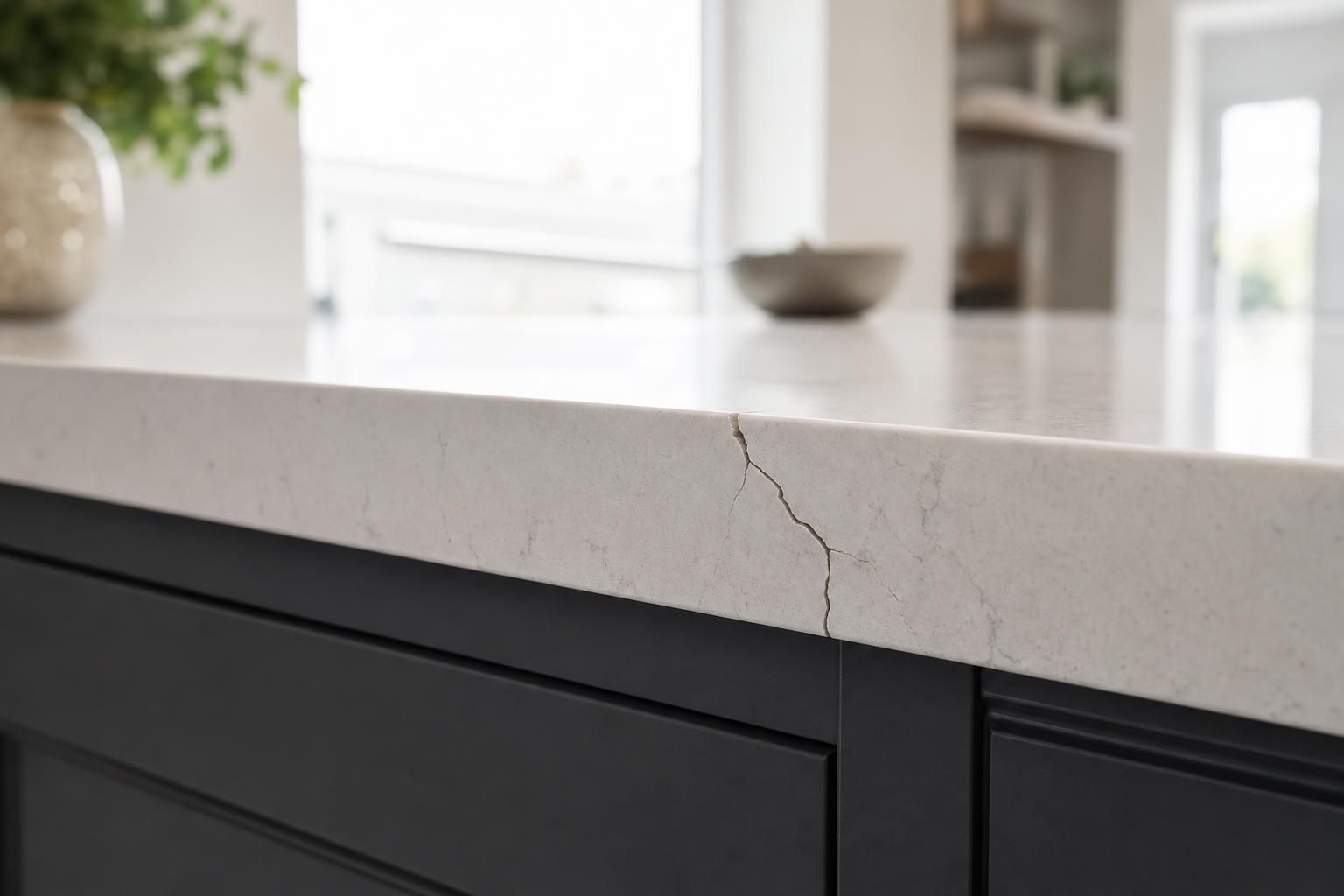
Key takeaway
Yes, quartz countertops can crack, though it takes more than everyday kitchen use to do it. Quartz is engineered stone — roughly 90% ground quartz bound with resin — which makes it harder and more chip-resistant than many natural stones, but it is not flexible, and cracking usually traces back to installation support, impact, or uneven heat rather than the material failing on its own. Most cracks are preventable with correct substrate support and reasonable care.
Key takeaways
- Cracks almost always start at a stress point: unsupported seams, cutouts for sinks or cooktops, or a cabinet base that isn't level — not from normal cooking and cleaning.
- Sudden temperature swings (a hot pan straight from the oven onto a cold slab) can shock the resin binder and cause hairline cracks, even though quartz tolerates everyday heat fine.
- A hairline crack almost never needs a full slab replacement — a trained fabricator can usually fill and polish it so it's hard to see.
What actually causes a quartz countertop to crack
Quartz slabs are rigid. That rigidity is what makes them resist scratching and staining, but it also means the slab can't flex the way wood or laminate does — so any unsupported section is a weak point waiting for enough pressure. The most common causes are:
- Inadequate cabinet support. If base cabinets aren't level or a section of countertop overhangs more than the manufacturer's recommended span without corbels or plywood backing, the unsupported area can crack under normal weight.
- Thermal shock. Going from a cold slab to a very hot pot or pan in one spot, repeatedly, stresses the resin that binds the quartz particles together.
- Impact at a thin point. Sink cutouts, cooktop cutouts, and the narrow strip of material between two cutouts are the thinnest parts of any countertop and the most likely place for a crack to start, especially if something heavy is dropped nearby.
- Settling or structural movement. In older homes, subfloor and framing movement can transfer stress up through cabinets into the countertop over time — one more reason why what actually drives renovation cost on older Oahu houses often comes down to what's happening underneath the finished surfaces, not the finished surfaces themselves.
Quartz versus other countertop materials for crack resistance
Quartz generally holds up better against everyday impact than natural stones like marble, because the engineering process creates a denser, more uniform material. The Natural Stone Institute, which represents both natural and engineered stone fabricators, notes that engineered quartz is valued in part for its consistency and resistance to chipping compared with some natural stones. That consistency is also why quartz is a common comparison point against other counter and surface materials — see how it stacks up against butcher block or against soapstone if you're still choosing a material.
Granite and marble can be more prone to surface cracking from impact because of natural fissures already in the stone. Quartz has no natural fissures, but its resin content makes it more sensitive to heat than granite, which is pure mineral. Each material trades one risk for another — none of them is crack-proof.
Where cracks are most likely to show up
- At and around sink cutouts — the narrowest section of material, especially undermount sinks where the edge is fully exposed.
- At seams, particularly in larger kitchens where two or more slabs are joined — a seam that wasn't supported evenly during installation is a long-term weak point.
- Near cooktops, where repeated heat exposure meets a thinner edge.
- At overhangs, like a peninsula or island edge used for seating, if it extends past the support structure beyond what the fabricator specified.
Hawaii-specific factors worth knowing
Oahu's building stock runs from new high-rise condos to older single-wall homes, and that range matters for crack risk. In older homes, uneven or settled subfloors can mean the cabinet base isn't perfectly level even after shimming, which transfers stress to the countertop above it — the same subfloor issues that come up in flooring installs. In condos, AOAO-governed buildings often have freight elevator and loading dock restrictions that affect how large a slab can be moved in one piece, which can mean more seams than a single-family home would need — more seams means more joints where support and leveling have to be exact. If you're in a high-rise, it's worth reviewing condo AOAO flooring rules style guidance before ordering, since paperwork and delivery logistics affect installation quality as much as the slab itself.
Salt air and humidity don't meaningfully affect quartz the way they affect some flooring materials, since the resin binder is non-porous and doesn't absorb moisture. Cracking here is almost entirely a structural and handling issue, not a climate one.
Can a cracked quartz countertop be repaired?
In most cases, yes. A hairline crack can typically be filled with a color-matched epoxy or resin and polished, a process a fabricator can often do on-site. The Environmental Protection Agency's indoor air guidance notes that most engineered stone repairs use standard epoxy resins that cure quickly and don't require removing the countertop. A crack that runs through a cutout or a full-thickness fracture across a seam is more likely to require replacing that section of slab rather than a surface repair.
How to prevent cracking after installation
- Use trivets or pads under hot pots and pans rather than setting them directly on the surface.
- Avoid standing or sitting on any countertop section, especially overhangs — they're sized for appearance and light use, not body weight.
- Have a fabricator confirm support spans before finalizing cabinet layout, particularly for peninsulas and islands.
- Ask your installer about expected seam placement before installation day, not after.
- If you notice a hairline crack early, have it looked at before it's used heavily — small cracks are far easier and cheaper to address than ones that have widened under repeated stress.
Frequently Asked Questions
Q: Can quartz countertops crack from heat?
Yes, repeated or sudden extreme heat — like a pan straight from the oven set on one spot — can stress the resin binder and cause a hairline crack, even though quartz tolerates normal cooking heat well. Using a trivet avoids this entirely.
Q: Is a cracked quartz countertop dangerous?
A hairline crack is typically cosmetic and not a safety issue, but a crack near a sink cutout or seam can widen over time under weight or impact. It's worth having a fabricator inspect any crack that's growing or located near a high-stress area.
Q: How much weight can quartz countertops hold before cracking?
There's no single weight threshold — it depends on the thickness of the slab, how well the section is supported underneath, and whether the load is concentrated (like standing on an edge) or spread out. A properly supported overhang handles normal use fine; an unsupported one is the most common failure point.
Q: Does quartz crack more easily than granite?
Quartz generally resists chipping and surface cracking better than granite because it has no natural fissures, but granite tolerates high heat better since it has no resin content. Each material has a different weak point rather than one being universally stronger.
Q: Can a small crack in quartz get worse over time?
Yes, a hairline crack left unaddressed can widen with continued stress, temperature changes, or impact near the same spot. Getting it evaluated and filled early is simpler than waiting until it runs further across the slab.