Butcher Block vs Quartz Countertops: Which Wins on Oahu?
Key takeaway
For most Oahu kitchens, quartz is the better long-term choice because it resists moisture, salt air, and daily wear without sealing or maintenance — conditions that are harder on wood than on the mainland. Butcher block still has a place for an island, a baking station, or a secondary counter where warmth and a cutting surface matter more than zero-maintenance durability. The right answer depends on how the counter gets used, not just how it looks.
Key takeaways
- Quartz needs no sealing and shrugs off Oahu's humidity; butcher block needs regular oiling or it can crack, cup, or stain.
- Butcher block is the only one of the two you can cut directly on; quartz always needs a board.
- Mixing both — quartz for main runs, wood for one island or baking zone — is common and solves most of the trade-off.
How each material actually behaves in a humid island kitchen
Wood is hygroscopic — it absorbs and releases moisture as humidity shifts, which is exactly what happens in a leeward Honolulu kitchen with the windows open most of the year. That movement is what causes butcher block to cup, crack at the seams, or separate from its edge banding over time if it isn't kept sealed. Engineered quartz is roughly 90–94% ground quartz bound with resin, so it has no grain to swell or dry out, and it doesn't need to acclimate to a room before installation the way solid wood does, according to NSF International, which certifies countertop materials for food-contact surfaces.
Salt air compounds the wood problem near the coast — Kailua, the North Shore, and anywhere with onshore breeze pushes more moisture and fine salt into an open kitchen than a sealed, air-conditioned interior would see on the mainland.
Maintenance: sealing oil versus almost nothing
Butcher block needs a food-safe mineral oil or board cream applied on a schedule — monthly is typical for a working counter, less often for a lightly used one — and it needs resealing any time water sits on the surface and dulls it. Skip that upkeep and the wood dries out, hairline cracks open at the grain, and bacteria can work into those cracks around a sink or prep zone, which is why food-service kitchens rely on nonporous surfaces for raw-protein prep, per food-safety guidance from the Centers for Disease Control and Prevention. Quartz asks for soap, water, and nothing else — no sealer, no oil, no periodic resurfacing.
Durability and daily use
| Factor | Butcher Block | Quartz |
|---|---|---|
| Scratch resistance | Low — knife marks show, sands out | High — resists daily knife and utensil contact |
| Heat tolerance | Moderate — trivets recommended | Good, but hot pans can still stress the resin; trivets still advised |
| Moisture/humidity | Needs sealing; vulnerable in open-air kitchens | Non-porous, unaffected by Oahu's humidity |
| Cutting directly on surface | Yes, by design | No — always use a board |
| Typical upkeep | Monthly oiling, periodic sanding | Soap and water |
| Repairability | Sand and reseal, DIY-friendly | Professional repair for chips or seams |
Wood also wins on one point quartz can't match: you can sand out a burn mark, a deep scratch, or a stain and bring butcher block back to like-new. A quartz chip or crack usually needs a professional repair or, if it's bad enough, a slab replacement — which matters more on an island where freight time on special orders can stretch a replacement timeline.
Where each one makes sense in an Oahu kitchen
Full-counter butcher block works best in a kitchen with strong ventilation, consistent indoor climate, and an owner willing to oil it on a schedule — a single-family home in Mililani or Kapolei with central air is a better candidate than an open-plan condo near the water. Full-counter quartz is the safer default for rental units, vacation rentals, and any household that wants to set the counter and forget it.
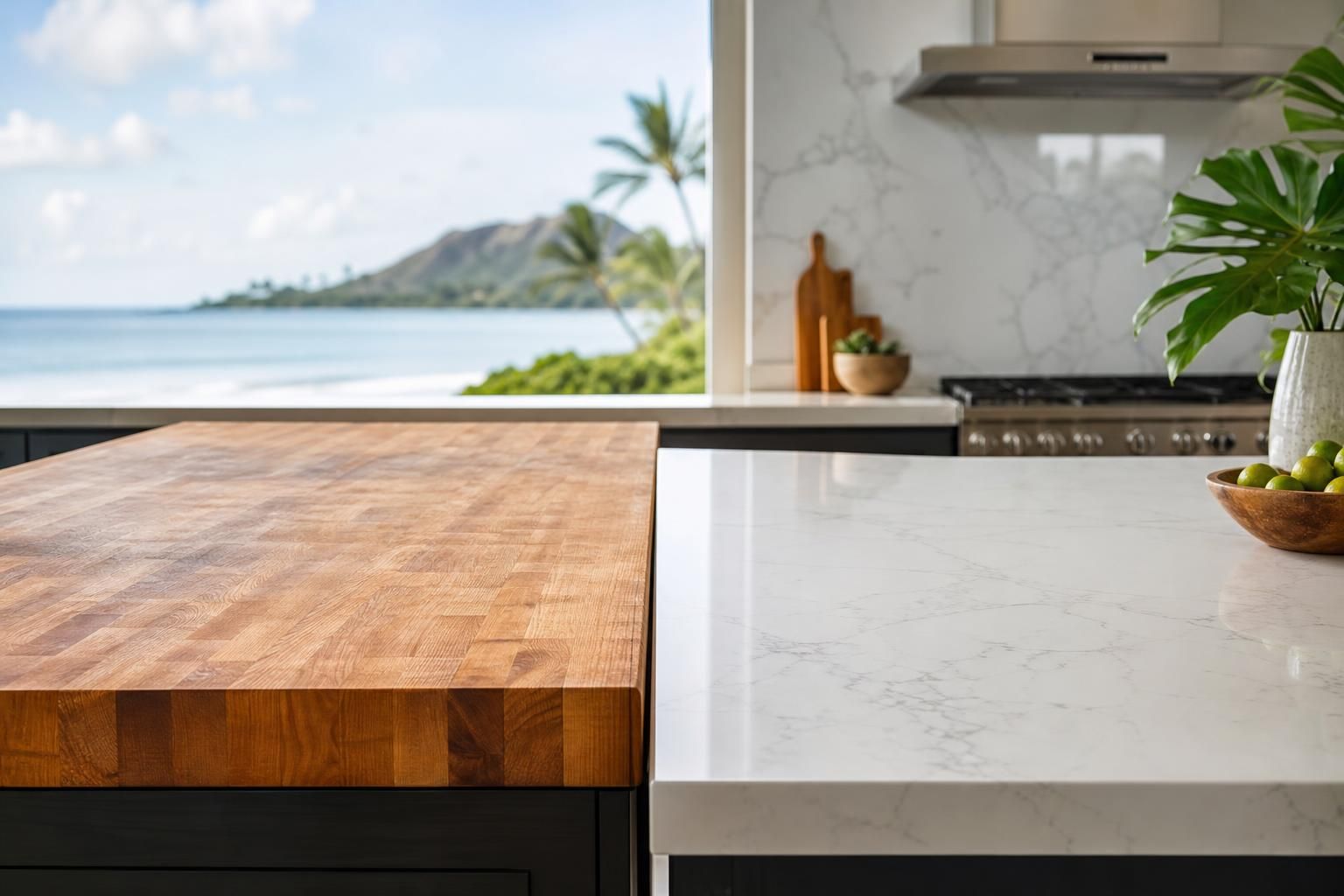
A common middle ground on Oahu projects: quartz on the main runs and sink area, with a butcher-block insert on an island or a dedicated baking station. That gives you the warm, cuttable surface where you actually use it and the low-maintenance surface everywhere water and heat concentrate. It's the same logic that comes up when homeowners weigh quartz against soapstone — pick the hardest-working material for the busiest zone, and let a softer, warmer material take a smaller role.
Condos and resale considerations
Condo boards reviewing flooring and countertop changes under AOAO rules generally care about water damage risk to units below more than material choice, but a non-porous, sealed-against-leaks surface is simply an easier sell to a board than a material that needs active maintenance to stay leak-resistant. If you're planning cabinets alongside a countertop swap, it's worth choosing cabinet materials that pair with whichever counter you land on, since edge profiles and overhangs differ between wood and engineered stone installs.
Resale buyers on Oahu also tend to read butcher block as a design choice that needs upkeep from day one, while quartz reads as neutral and move-in ready — a real factor if the kitchen is part of a broader remodel aimed at resale rather than long-term personal use. If you're weighing a countertop decision as part of a larger kitchen project, a full remodel walkthrough covers how countertop choice fits into cabinet layout, plumbing moves, and permitting on Oahu.
What actually moves the decision
Three things usually settle it for Oahu homeowners: how close the kitchen sits to salt air or an open lanai, whether the household will realistically keep up with oiling a wood surface, and whether the counter needs to double as a direct cutting surface. None of those are answered by a price comparison — wood and quartz both come in a range of grades, edge treatments, and slab sizes, and the only number that means anything is one priced against your actual counter dimensions and layout.
Frequently Asked Questions
Q: Is butcher block cheaper than quartz?
Material grade, edge profile, and slab size swing the cost of both materials enough that a flat comparison is misleading — the only reliable number comes from a quote against your actual square footage and layout.
Q: Can you cut directly on quartz?
No — quartz resists scratches better than wood, but direct knife contact will still dull a blade and can mark the resin surface, so a cutting board is still recommended.
Q: Does butcher block work in a humid Oahu kitchen?
It can, but it needs consistent sealing and a kitchen with good airflow or climate control; in an open, salt-air-exposed space it's more prone to cracking and cupping than quartz.
Q: Which is better for a condo kitchen?
Quartz is generally the easier choice for condos because it's non-porous and lower-maintenance, which reduces leak and water-damage risk that AOAO boards care about.
Q: Can you mix both materials in one kitchen?
Yes — a common Oahu layout uses quartz for the main counters and sink area with a butcher-block insert on an island or baking station, combining low maintenance with a cuttable surface where it's actually used.