Vinyl Plank Flooring Calculator: How Many Boxes Do You Need?
Key takeaway
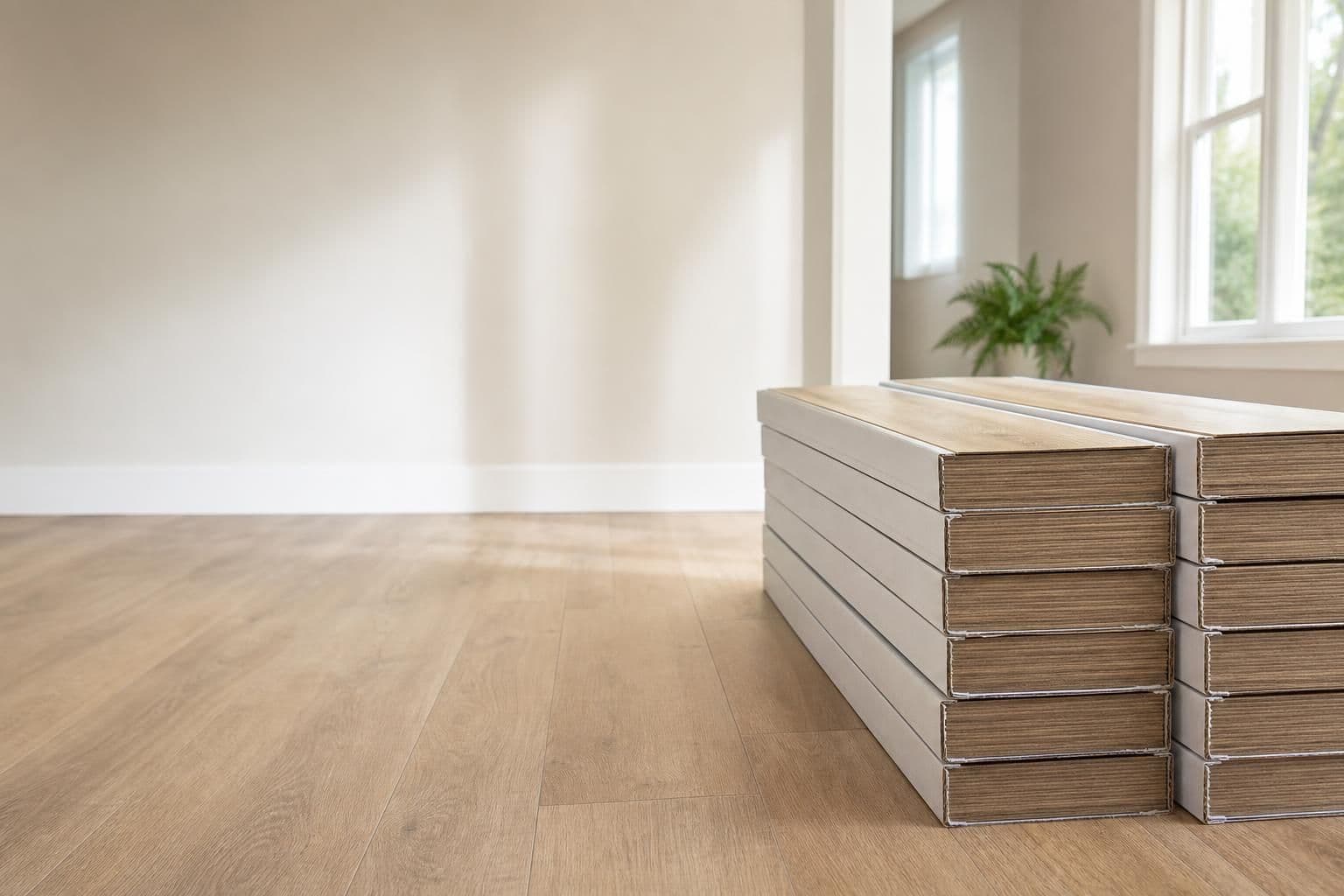
To find how many boxes of vinyl plank flooring you need, divide your total room square footage by the square footage one box covers, then add 10–15% extra for waste and cuts. Most vinyl plank boxes cover between 18 and 24 square feet, so a 200-square-foot room typically needs 9–13 boxes depending on the brand and layout. Rounding up to the next full box is standard practice, since partial boxes aren't sold separately.
Key takeaways
- Formula: (room sq ft ÷ sq ft per box) × 1.10 to 1.15, then round up to the nearest whole box.
- Box coverage varies by product — check the label, but 18–24 sq ft per box is typical for residential vinyl plank.
- Complex layouts (diagonal, herringbone, lots of closets or angles) need 15–20% waste, not the standard 10%.
The Basic Formula for Calculating Boxes
Start with the square footage of the room, measured wall to wall, length times width. If the room has an irregular shape, break it into rectangles, calculate each separately, and add them together. Once you have total square footage, the math is:
Boxes needed = (total sq ft × waste factor) ÷ sq ft per box
For example, a 12-foot by 15-foot bedroom is 180 square feet. Multiply by 1.10 for a 10% waste factor, which gives 198 square feet. If each box covers 20 square feet, divide 198 by 20 to get 9.9 — round up to 10 boxes.
How Much One Box of Vinyl Plank Actually Covers
Box coverage isn't standardized across manufacturers, so the number stamped on the box is the only one that matters for your specific product. Residential vinyl plank commonly ships in boxes covering 18, 20, 22.5, or 24 square feet, based on plank size and how many planks are packed per carton. A box of wider, longer planks (like 9-inch by 60-inch format) often covers more square footage per box than a narrow 6-inch plank, even with a similar carton weight.
Before you calculate anything, find the coverage number on the box label or the product spec sheet — guessing at this step throws off every calculation that follows. If you're still comparing products, the vinyl plank flooring cost guide for Oahu breaks down typical per-square-foot material pricing so you can budget alongside your box count.
Why You Always Add a Waste Factor
Waste factor covers cut-offs, mistakes, damaged planks, and pieces too small to reuse. It is not padding — it is a documented part of standard flooring installation practice recommended by trade groups like the Resilient Floor Covering Institute, which represents vinyl and resilient flooring manufacturers and installers.
Typical waste factors by layout:
- Simple rectangular room, straight layout: 10%
- Room with closets, doorways, or jogs: 12–15%
- Diagonal layout: 15–20%
- Herringbone or chevron pattern: 20% or more
- Room with lots of built-ins, islands, or curves: 15–20%
Skipping the waste factor is the single most common reason homeowners run short mid-installation and have to special-order a matching box later — a real risk with vinyl plank, since dye lots can shift slightly between production runs.
Step-by-Step Example Calculation
Here's a full walkthrough using a real-world layout: a 300-square-foot living room and hallway combination with one closet and a straight-plank layout.
- Measure and calculate total square footage: 300 sq ft.
- Apply a 12% waste factor for the closet and hallway transitions: 300 × 1.12 = 336 sq ft.
- Check the box label: this product covers 22.5 sq ft per box.
- Divide: 336 ÷ 22.5 = 14.9 boxes.
- Round up: order 15 boxes.
That extra half-box of margin also gives you a couple of spare planks for future repairs — useful in Hawaii homes where a dropped appliance or a slow leak can damage a plank years after installation.
Common Mistakes That Lead to Ordering the Wrong Amount
Most over- or under-orders trace back to a handful of repeatable errors:
- Measuring only the "open" floor space and forgetting closets, pantries, or under-cabinet toe-kick areas that still need flooring.
- Using a generic 10% waste factor for a diagonal or pattern layout that actually needs 15–20%.
- Assuming all boxes from the same product line cover the same square footage — coverage can change between plank widths even within one collection.
- Forgetting stairs, transitions, or closets in adjoining rooms that will be floored in the same material.
- Not accounting for acclimation loss — a small percentage of planks may be set aside if they arrive with visible defects, which a waste factor also absorbs.
When to Get an Exact Number Instead of Estimating
A calculator gets you close enough to know your budget range and place a reasonable order, but exact figures come from a supplier working off a scaled floor plan or an on-site measurement. That's especially true for L-shaped rooms, open floor plans that flow between multiple spaces, or homes where doorway transitions need matching thresholds. A supplier who prices by your actual project square footage — rather than a generic per-box estimate — can also flag if your layout choice (diagonal versus straight) changes the waste math before you buy.
For humid, salt-air environments like Oahu, planks also need time to acclimate to indoor conditions before installation, which is a separate consideration from box math but affects your install timeline. The guide to flooring for Oahu's humidity and salt air covers material behavior in island conditions if you're still choosing a product.
If you'd rather skip the manual math altogether, a free quote priced for your actual square footage answers within 24 hours and accounts for layout, waste, and box coverage in one number.
Frequently Asked Questions
Q: How many square feet does a box of vinyl plank flooring cover?
Most residential vinyl plank boxes cover between 18 and 24 square feet, but this varies by manufacturer and plank size. Always check the coverage printed on the box or spec sheet rather than assuming a standard number.
Q: Do I need extra flooring for waste, and how much?
Yes — plan for at least 10% extra on a simple rectangular room and 15–20% extra for diagonal, herringbone, or heavily cut layouts. This covers trim cuts, mistakes, and pieces too small to reuse.
Q: Should I round up or down when calculating boxes?
Always round up to the next full box. Vinyl plank is sold by the sealed carton, not by individual plank or partial box, so any fractional box amount becomes a full box on your order.
Q: Can I return unused boxes of vinyl plank flooring?
Return policies vary by supplier and are usually limited to unopened, undamaged boxes within a set timeframe. Check the specific return policy before over-ordering heavily just to be safe.
Q: Does room shape affect how many boxes I need?
Yes — irregular rooms with closets, angles, or multiple transitions require a higher waste factor than a simple rectangle, sometimes pushing your box count up by several boxes on a mid-size room. Breaking the space into rectangles and calculating each section separately gives a more accurate total than eyeballing the whole floor plan at once.