RTA vs Custom Cabinets: What's the Real Difference?
Key takeaway
RTA (ready-to-assemble) cabinets ship flat-packed in standard sizes and are bolted or clipped together on site, while custom cabinets are built to the exact dimensions and finish specs of one kitchen, often with options RTA lines don't offer. The core trade-off is standardization versus fit: RTA gives you a fixed catalog of sizes and finishes at a faster turnaround, custom gives you exact measurements, box depth, and finish control at a longer lead time. Which one makes sense depends less on taste and more on the shape of the kitchen and how much the layout has to compromise around fixed cabinet widths.
Key takeaways
- RTA cabinets come in fixed width/height increments (typically 3-inch steps); custom cabinets are built to the kitchen's actual dimensions, including odd corners and soffits.
- Box material and joinery — not just the door style — drive long-term durability in Hawaii's humidity; ask what the box itself is made of, not just the finish.
- Lead time is the biggest planning difference: RTA is a stocked or quick-order product, custom cabinetry is a built-to-order product with a longer production window, which matters for scheduling installers and any AOAO approval timeline.
What RTA Cabinets Actually Are
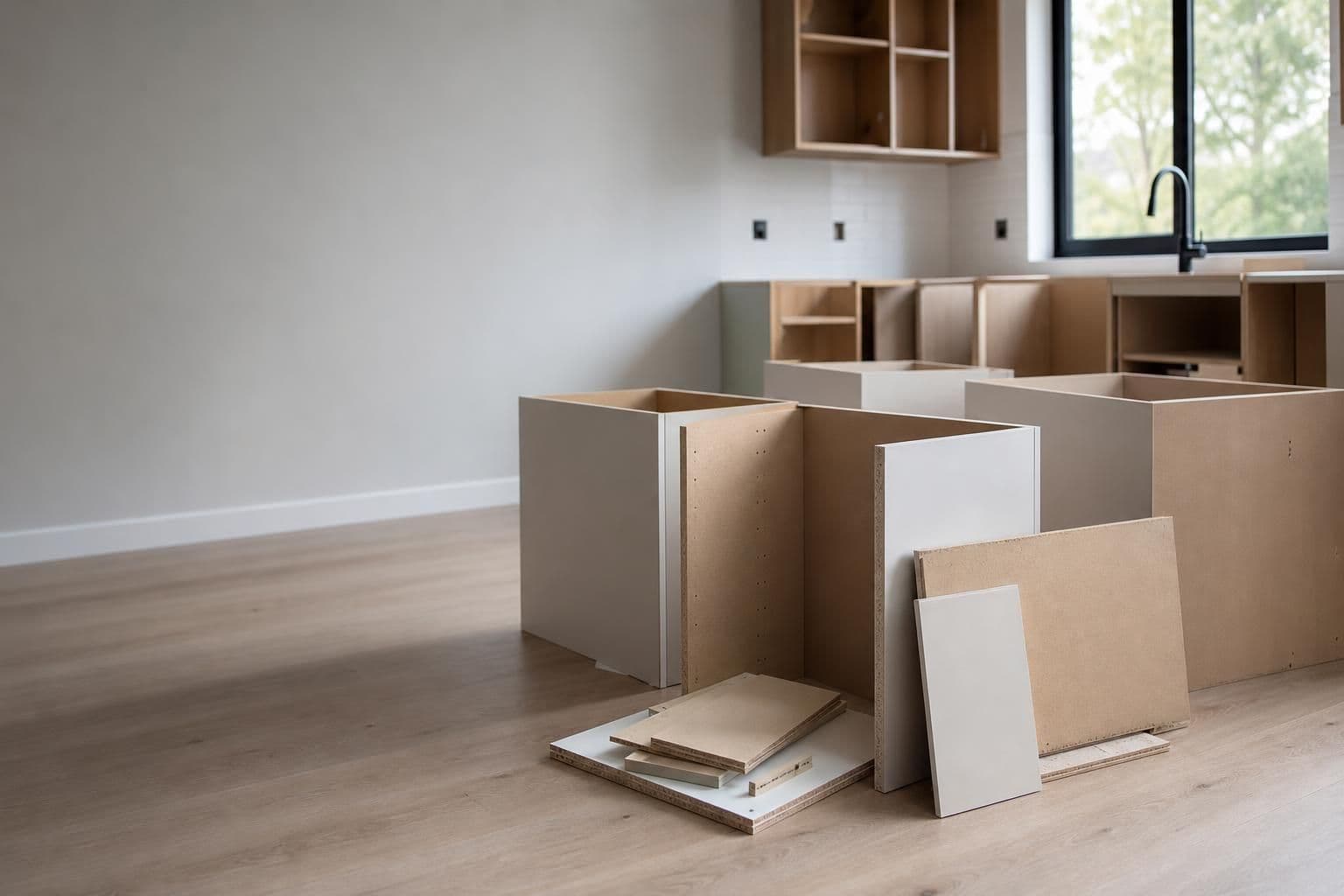
RTA stands for ready-to-assemble: the manufacturer cuts, drills, and finishes the panels, then ships them flat so the boxes are built on site with cam locks, dowels, or screws. This is the same basic idea as flat-pack furniture, scaled up to cabinet boxes. Sizes come from a published catalog — standard widths like 12", 15", 18", 24", 30", 36" in 3-inch steps — so the kitchen layout has to work around what's available rather than the other way around.
Because the parts are pre-cut, RTA is a faster product to get into a kitchen. It's a reasonable fit for a straightforward galley or rectangular kitchen where standard widths fill the run without much filler or custom panel work. For kitchens with unusual angles, low soffits, or an island that needs an odd depth, RTA often needs filler strips and scribe pieces to close the gaps, which changes the finished look.
What "Custom" Actually Means
Custom cabinetry is built to the kitchen's measured dimensions rather than selected from a size chart. That means a cabinet can be built 2 inches narrower than standard to clear a doorway, a corner unit can be shaped to match a non-square wall, and a hood cabinet can be built to the exact width of a range without a filler panel. Custom orders also typically open up choices that stock RTA lines don't carry: non-standard door profiles, finish color matching, interior configurations (built-in dividers, appliance garages, pull-out spice racks sized to the actual cabinet), and box depths other than the standard 24 inches base / 12 inches upper.
The trade-off is production time. A custom order is built after the design is finalized and measurements are confirmed, not pulled from existing stock, so it needs a longer window between order and delivery than a catalog product.
Construction and Material: The Part That Actually Matters in Hawaii
Door style gets most of the attention in showrooms, but the box material determines how a cabinet holds up in a humid coastal climate. Both RTA and custom cabinets can be built from plywood boxes or from particleboard/MDF boxes — "RTA" and "custom" describe how the cabinet is ordered and assembled, not what it's made of. A cheap RTA line and a cheap custom line can both use the same low-grade particleboard; a well-built RTA line can use plywood boxes that outperform a poorly specified custom job. The question to ask a supplier either way is what the box material is, not just whether it's called custom. This site's own comparison of plywood vs MDF cabinet boxes goes into which holds up better in Oahu's humidity and salt air.
Joinery is the other variable. RTA boxes rely on cam locks and dowels, which are strong enough for most kitchens but can loosen over years of humidity-driven wood movement if not reinforced. Custom shops more often use glued dado joints or pocket screws in addition to hardware, which holds up to repeated expansion and contraction better over time.
RTA vs Custom Cabinets at a Glance
| Factor | RTA Cabinets | Custom Cabinets |
|---|---|---|
| Sizing | Fixed catalog widths, usually 3-inch increments | Built to the kitchen's exact measurements |
| Lead time | Faster — stocked or quick-order | Longer — built to order after design is final |
| Finish/door options | Limited to published catalog | Wide range, including color-matched finishes |
| Assembly | Boxes assembled on site from flat-pack parts | Delivered pre-assembled, ready to install |
| Fit for odd layouts | Needs fillers/scribe pieces for corners, soffits | Built to fit corners, soffits, and appliance gaps directly |
| Box material | Varies by line — ask specifically | Varies by shop — ask specifically |
Where Layout Decides the Answer
A rectangular or galley kitchen with standard-depth counters and no unusual soffits is the easiest case for RTA, because standard widths line up without much filler work. A kitchen with a tight galley footprint, an island that has to clear a walkway, or cabinetry that needs to run to a non-standard ceiling height is where custom earns its lead time — the boxes are built to the actual opening instead of forcing the opening to match a catalog size. The guide to galley kitchen cabinet layouts covers how narrow kitchens specifically constrain cabinet width and walkway clearance, which is often the deciding factor between RTA and custom in a condo-sized kitchen.
Cabinet height is another place the two diverge. Standard upper and base heights are built into most RTA catalogs, but if a kitchen's soffit height or counter-to-upper gap is non-standard, custom cabinets can be built to that exact dimension instead of leaving a filler gap above the uppers. The breakdown of standard kitchen cabinet heights is useful for checking whether an existing kitchen's dimensions fall inside typical RTA ranges before committing to one path or the other.
Freight and Lead Time on Oahu
Both RTA and custom cabinets headed to Oahu typically travel by ocean freight from a mainland or international supplier, which means both are subject to shipping schedules that a local-only mainland comparison won't mention. RTA's advantage is that it's often stocked or pulled from a regular reorder cycle, so the freight timing is more predictable. Custom cabinets are produced after final measurements are locked in, so the production window stacks on top of the shipping window — worth building into any renovation timeline, especially if the kitchen needs to be functional again by a specific date.
For condo kitchens, there's an added layer: cabinet specs and finish selections sometimes need to be documented for an AOAO board before work starts, alongside the flooring and countertop specs typically submitted in the same package. Custom Cabinets vs IKEA Cabinets covers a related comparison — stock flat-pack cabinets versus true custom — that overlaps with the RTA decision and is worth reading alongside this one if IKEA is also on the table.
Standards Worth Knowing
Cabinet quality isn't regulated the way plumbing or electrical work is, but there are industry benchmarks. The Kitchen Cabinet Manufacturers Association runs a voluntary certification program (ANSI/KCMA A161.1) that tests cabinet construction for structural performance, door/drawer cycling, and finish durability — asking whether a line is certified to that standard is a fair question for either RTA or custom cabinets. The National Kitchen & Bath Association also publishes planning guidelines for clearances and cabinet dimensions that many designers use as a baseline before customizing a layout.
Frequently Asked Questions
Q: Is RTA cabinetry lower quality than custom cabinetry?
Not inherently — quality depends on box material and joinery, not on whether the cabinet was assembled at a factory or on site. A well-built RTA line with plywood boxes can outlast a poorly specified custom line with thin particleboard.
Q: Can RTA cabinets be used in a kitchen with an unusual layout?
Yes, but odd corners, low soffits, or non-standard appliance widths usually require filler strips or scribe panels to close gaps, since RTA sizing is limited to catalog increments. Custom cabinets avoid this by being built to the exact opening.
Q: How much longer does custom cabinetry take compared to RTA?
RTA is typically a stocked or quick-reorder product, while custom cabinetry is built after final measurements are confirmed, adding a production window on top of shipping time. The exact difference depends on the supplier's production schedule and current order volume.
Q: Do condo owners need different paperwork for RTA versus custom cabinets?
The cabinets themselves aren't usually the AOAO concern — sound rating, plumbing, and electrical changes tied to a remodel are. Either cabinet type can be documented with specs for board approval if the project includes those changes.
Q: Can RTA and custom cabinets be mixed in the same kitchen?
It's possible — for example, RTA base cabinets paired with a custom island or custom corner unit — but finish and box-depth matching between the two lines needs to be checked carefully so the mismatch isn't visible once installed.