Best Underlayment for Condo Flooring Over Concrete Slab
Key takeaway
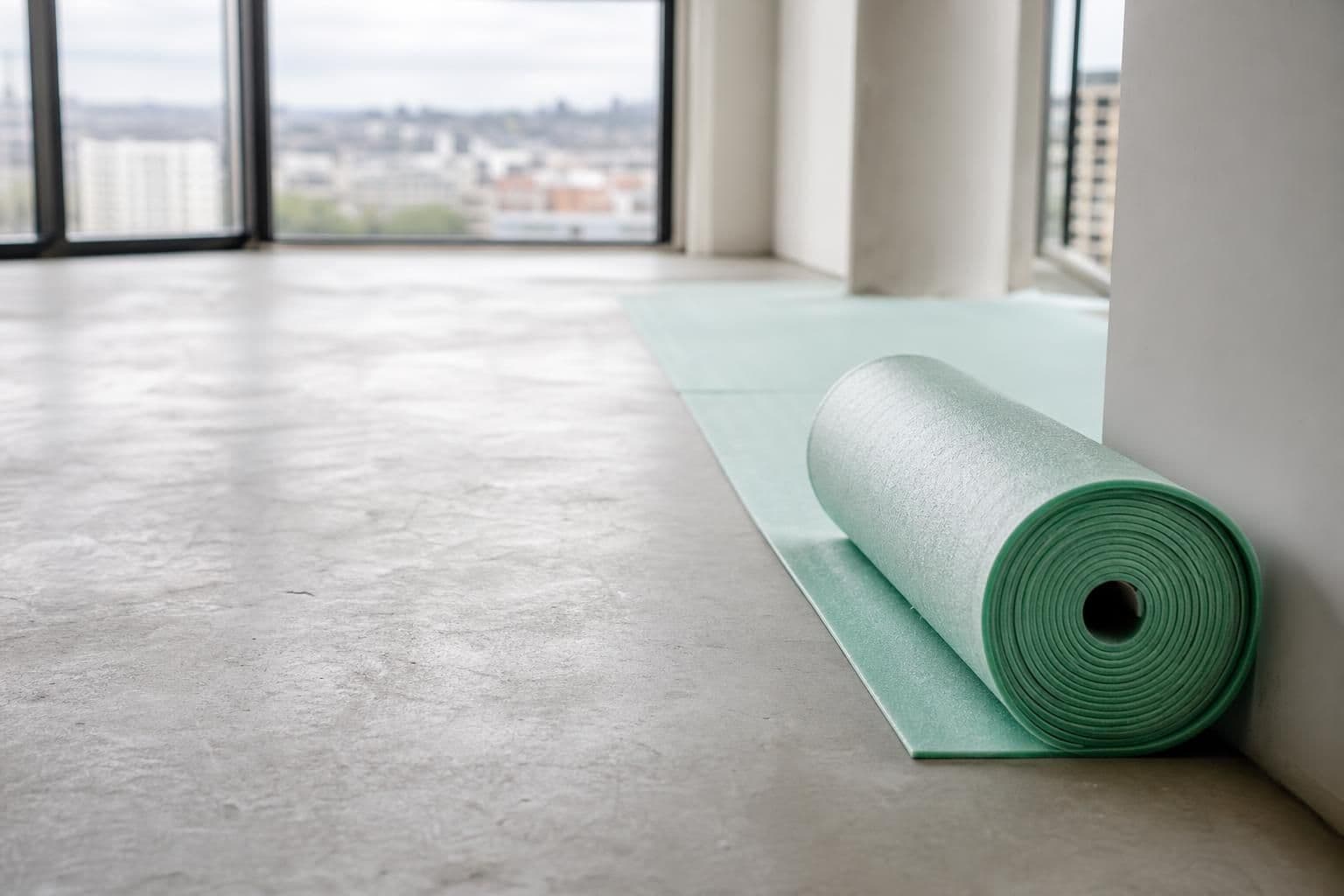
For a condo unit built on a concrete slab, the right underlayment is a combined moisture barrier and sound-control layer — typically a 1.5mm to 2mm closed-cell foam or rubber product with an attached vapor barrier, chosen to meet the building's Impact Insulation Class (IIC) requirement, not just whatever comes bundled with the flooring box. On Oahu, most AOAO boards require a minimum IIC rating (commonly 50 or higher) before they'll approve flooring over a slab, so the underlayment spec often matters more than the flooring itself for approval purposes.
Key takeaways
- Slab moisture and sound transmission are two separate problems — one underlayment rarely solves both without the right layers.
- Most Oahu AOAO boards require a minimum IIC/STC rating in writing before approving new flooring; check your house rules before buying anything.
- Vapor barrier underlayments matter more in ground-floor and ocean-facing units where slab moisture and salt air are constant factors.
Why Concrete Slabs Need Special Underlayment
A concrete slab is porous and sits in direct contact with the ground or the structure below it, which means it can carry moisture vapor upward for years after the building was poured, even if the surface feels dry to the touch. This is different from a wood subfloor, where moisture typically comes from spills or leaks rather than the material itself. Flooring installed directly over a damp slab without a vapor barrier can trap moisture underneath, leading to adhesive failure, mold growth, or planks that cup and lift at the seams.
The Environmental Protection Agency notes that indoor moisture control is one of the most effective ways to prevent mold growth in buildings, and a slab-moisture barrier is one of the few underlayment features that directly addresses this at the source rather than after the fact.
Moisture Barrier vs. Sound Control: Two Different Jobs
It helps to separate what an underlayment is actually doing:
- Moisture barrier — a poly film or foam layer (often 6-mil or thicker) that blocks vapor from the slab from reaching the flooring adhesive or the planks themselves.
- Sound control (IIC/STC rating) — a denser foam, rubber, or cork layer that absorbs impact noise (footsteps, dropped items) so it doesn't transmit to the unit below.
Some underlayment products combine both in one roll, which is usually the simplest option for a condo project since it avoids installing two separate layers. Others are single-purpose, meaning a moisture-only foam pad won't help with a downstairs neighbor's noise complaints, and a sound mat with no vapor layer won't stop slab moisture from working its way up.
What Oahu AOAO Boards Typically Require
Most condo associations on Oahu specify a minimum Impact Insulation Class rating in their house rules or bylaws before approving any hard-surface flooring replacement, and it's common to see requirements in the IIC 50–IIC 55 range, sometimes higher for buildings with a history of noise complaints. Boards often ask for:
- The underlayment product name and its tested IIC/STC rating (a cut sheet or spec page from the manufacturer)
- Confirmation that the flooring assembly, not just the underlayment alone, was tested to that rating
- A written installation plan showing which floors will get the new underlayment
Boards rarely approve "trust us, it's quiet" verbally — they want a document. If you're not sure what your building requires, our guide on Honolulu condo AOAO flooring rules walks through the paperwork most boards ask for before you get to the underlayment question at all. High-rise buildings add another layer of logistics worth planning for: freight elevator booking windows, loading-dock access hours, and material staging space can all affect how quickly an underlayment upgrade can actually happen, independent of which product you choose.
What Actually Drives Underlayment Selection on Oahu
Rather than comparing products on a single number, it's more useful to compare what each tier of underlayment actually does, since that's what determines whether it fits your building and your slab:
| Underlayment Tier | Sound Performance | Moisture Tolerance | Install Complexity | Typical Lead Time |
|---|---|---|---|---|
| Basic foam (no sound rating) | Minimal; won't satisfy most AOAO IIC requirements | Low; not designed as a vapor barrier | Simple, roll-and-go | Usually in stock |
| Combination moisture barrier + sound mat (IIC 50+) | Meets common AOAO minimums | Good; built-in vapor layer suited to slab moisture | Moderate; seams must be taped correctly to preserve the rating | Often in stock, some specialty widths special-order |
| Premium rubber or cork (high-rise sound spec) | Highest IIC/STC performance, suited to strict boards | Good to excellent depending on backing | Denser material is harder to cut and seat tight to walls and thresholds | Frequently special-order, longer lead time due to island freight |
Whichever tier fits your building's requirements, the only way to know the real cost for your unit is a free quote measured against your actual square footage, floor plan, and AOAO paperwork — material tier, slab prep, and access logistics all move the number in either direction.
Choosing Underlayment for Salt Air and Humidity
Oahu's coastal humidity and salt air add a wrinkle that mainland underlayment guides don't usually cover. Units near the water or on lower floors tend to have higher ambient humidity reaching the slab, which makes a vapor barrier layer worth prioritizing even in buildings that don't strictly require one for sound. If you're also deciding between flooring types for a humid, salt-air environment, our guide on humidity and salt air flooring choices covers which materials hold up best once the underlayment question is settled. Rigid-core vinyl plank tends to be more forgiving of minor slab irregularities than laminate, which is one reason it's a common pairing with foam-and-barrier underlayment in condo units — our vinyl plank flooring cost guide breaks down how material choice and installation logistics fit together for that combination.
Steps to Confirm Before You Buy
- Pull your AOAO's flooring specifications or house rules and find the minimum IIC/STC number, if any.
- Ask whether the requirement applies to the whole assembly (flooring + underlayment tested together) or the underlayment alone.
- Get the manufacturer's tested rating in writing for whatever underlayment you're considering — a sales sheet without a lab-tested number usually won't satisfy a board.
- Check for moisture: a simple plastic-sheet test (taping a small square of plastic to the slab for 24–48 hours and checking for condensation) can flag a slab that needs an extra vapor barrier layer, though a moisture meter reading from a flooring contractor is more reliable.
- Confirm floor flatness — most underlayment and flooring warranties require the slab to be flat within a specified tolerance (often 3/16 inch over 10 feet), which may mean a self-leveling compound is needed first. Older Oahu buildings with settled or uneven slabs often need this leveling step, which adds time and material to the job beyond the underlayment itself.
The American National Standards Institute publishes flooring installation standards referenced by many manufacturers for subfloor flatness and moisture testing, which is where most of these tolerance numbers originate.
Frequently Asked Questions
Q: Do I need a vapor barrier if my slab feels dry?
Yes, in most cases — a slab can feel completely dry to the touch while still releasing moisture vapor from below, which is why moisture testing rather than a hand check is the standard method contractors use.
Q: What IIC rating do most Oahu condo buildings require?
It varies by building, but IIC 50 is a common minimum, with some buildings requiring IIC 55 or higher; always check your specific AOAO's house rules rather than assuming a number.
Q: Can I use the same underlayment for the whole unit, including the lanai or bathroom?
Usually not — wet areas like bathrooms and lanais typically need a different moisture-management approach, and some AOAO rules exclude those areas from the standard flooring spec entirely.
Q: Does thicker underlayment always mean better sound control?
Not necessarily; the IIC rating depends on the material's density and construction, not just thickness, so a thinner rubber product can outperform a thicker foam one.
Q: Who pays for underlayment if the board requires an upgrade after installation?
This depends on your building's bylaws and whether the original installation met the spec on record at the time; it's worth clarifying with the board in writing before starting any work.