DIY vs Professional Vinyl Plank Installation on Oahu: What Drives the Cost
Key takeaway
Installing vinyl plank yourself trades labor cost for risk: you skip paying an installer, but you take on tool costs, material waste from cutting errors, and the risk of redoing a floor that doesn't lie flat in a humid climate. Professional installation shifts that risk onto someone else, but the labor involved scales with room complexity, subfloor condition, and the amount of prep the job needs. For most homeowners, the real gap between DIY and professional work is smaller than it first appears once those factors are counted.
Key takeaways
- DIY saves mostly on labor, but material waste, one-time tool costs, and redo risk narrow that savings fast.
- Uneven subfloors and humidity-related expansion gaps are the two most common reasons DIY vinyl plank jobs fail on Oahu.
- A professional quote measured against your actual square footage and subfloor condition is the only way to compare true costs apples-to-apples.
What DIY Installation Actually Costs
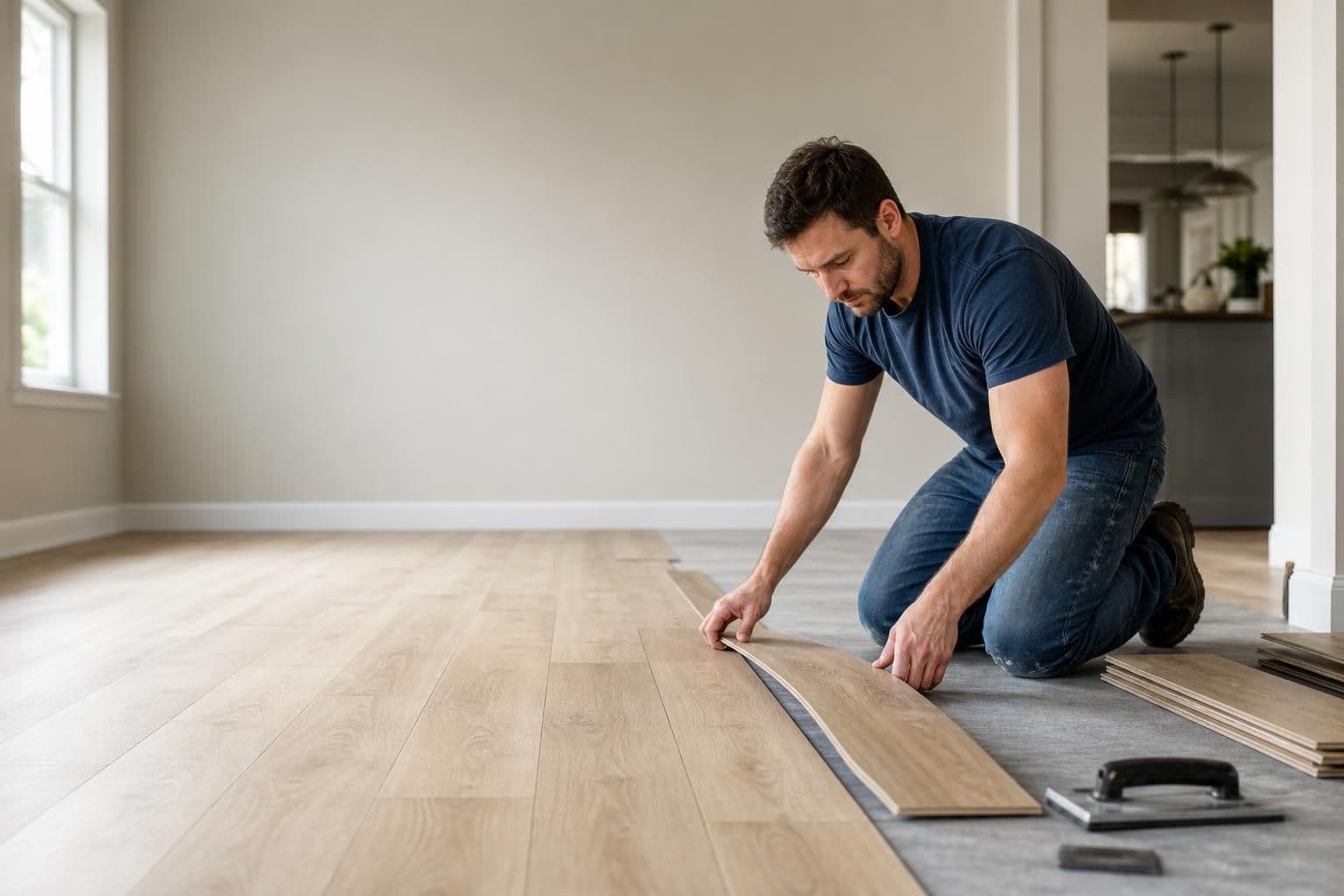
A DIY vinyl plank job on Oahu breaks down into a few line items: the flooring material itself (price scales with wear-layer thickness and plank construction), underlayment (an added cost if it isn't pre-attached to the plank), transition strips, and tools. If you don't already own a flooring cutter, tapping block, and spacers, you'll need to rent or buy them as a one-time cost for the project.
Most first-time installers also underestimate waste. Standard advice is to buy 10% extra material for straight rooms and up to 15% for rooms with angles, closets, or lots of doorways. Skip that buffer and you'll likely be back at the store mid-project, sometimes discovering the dye lot no longer matches.
What Professional Installation Costs
Professional installation cost is driven mainly by labor: how much cutting, fitting, and prep the room requires on top of the material itself. Costs move up for stair nosing, intricate cuts around cabinetry, elevator or loading-dock scheduling in Honolulu high-rises, and subfloor leveling in older homes where the slab isn't flat. A licensed installer also carries liability if something goes wrong, which a DIY job does not.
For a full breakdown of material grades and what drives cost on this island specifically, see the vinyl plank flooring cost guide for Oahu.
Side-by-Side Comparison
| Cost factor | DIY | Professional |
|---|---|---|
| Labor | Your own time, unpaid | Paid labor, scaled to room complexity |
| Material waste | 10–20% overage common | 5–10% overage, planned by installer |
| Tool/equipment cost | One-time purchase or rental | Included in labor |
| Subfloor prep | Often skipped or done incorrectly | Included or quoted separately |
| Redo risk | Higher, especially first attempt | Low, workmanship typically covered |
| Stairs, tight cuts, tear-out | Adds significant time and risk of error | Priced in as added labor |
These are the factors that move cost up or down, not a fixed price — actual cost depends on room shape, subfloor condition, and material grade. The only real number comes from a free quote priced against your actual measurements, which you can request here.
Where DIY Costs Quietly Add Up
Three things push DIY costs higher than people expect:
- Subfloor leveling: Vinyl plank telegraphs imperfections in the subfloor. Concrete slabs in older Oahu homes and condos often need patching compound before planks will lock together cleanly, and that's an extra step most DIY budgets skip.
- Expansion gaps: Vinyl plank expands and contracts with heat and humidity. Installers leave a gap along walls (usually covered by baseboard or quarter round) sized for local conditions; a gap that's too tight can cause buckling within months.
- Return trips for mismatched dye lots: If you underbuy and need more boxes later, the manufacturer's dye lot may have shifted slightly, creating a visible seam between old and new material.
Humidity and salt air are also bigger factors on Oahu than on the mainland, which affects both product choice and installation technique. Our guide on flooring that holds up in humidity and salt air covers material selection in more depth.
When DIY Makes Sense
DIY is a reasonable choice for small, simple rooms — a single bedroom, a laundry nook, a rectangular space with no cabinetry to cut around. Click-lock vinyl plank is designed for exactly this kind of straightforward, tool-light installation, which is part of why it has become a common choice for renters and first-time flooring projects, according to the Consumer Product Safety Commission's flooring guidance and general product literature from major flooring manufacturers.
DIY becomes riskier in kitchens, bathrooms, and any condo where the AOAO board requires specific paperwork — including sound-rating documentation in many buildings — before installation begins. A mistake there can mean redoing work to meet board specs, not just redoing the floor.
When Professional Installation Pays for Itself
Professional installation is usually worth the added cost when:
- The subfloor is uneven, cracked, or previously tiled
- The room has lots of cuts (kitchens, bathrooms, closets, stairs)
- You're in a condo and need documentation for AOAO approval, including sound-rating compliance
- You want a workmanship warranty in case boards separate or buckle later
- The project involves moving furniture, tearing out old flooring, and hauling it away
For whole-home or rental-property projects, the labor cost difference often gets absorbed by faster completion and fewer callbacks. The National Association of Home Builders has noted that flooring is one of the most commonly redone finishes in resale prep, partly because of installation quality issues from the first go-round.
A Quick Way to Decide
Ask three questions before picking up a flooring cutter: Is the room a simple rectangle? Is the subfloor flat and dry? Are you comfortable measuring and cutting to a tight tolerance? If you answered no to any of those, professional installation likely costs less in the long run than a DIY redo.
Frequently Asked Questions
Q: Is vinyl plank flooring easy enough to install yourself?
Click-lock vinyl plank is one of the more DIY-friendly flooring types, especially in small, rectangular rooms with a flat subfloor. It gets harder in kitchens, bathrooms, and rooms with lots of cabinetry or angled cuts.
Q: What determines professional vinyl plank installation cost on Oahu?
Labor complexity is the biggest factor — subfloor leveling, stairs, tight cuts around cabinetry, tear-out and disposal of old flooring, and elevator or loading-dock scheduling in high-rises all add time. Material tier and any AOAO-required specs also play a role. Get a free quote against your exact measurements for an accurate number.
Q: What tools do I need for DIY vinyl plank installation?
At minimum you'll want a flooring cutter or utility knife, a tapping block, spacers for expansion gaps, and a rubber mallet. Budget for a one-time purchase or rental if you don't already own these.
Q: Does DIY installation void any warranty on the flooring material?
Some manufacturers require installation according to their written instructions to keep a product warranty valid, so it's worth checking the specific product's warranty terms before starting. This is separate from any workmanship warranty, which only applies to professional installation.
Q: Can I install vinyl plank myself in a condo on Oahu?
You can, but many Oahu condo associations require submitted flooring specs, including sound-rating (IIC) documentation, for AOAO board approval before work starts, regardless of who installs it. Check your building's requirements first so the paperwork doesn't hold up the project.