Cabinet Refacing on Oahu: What Homeowners Should Know
Key takeaway
Cabinet refacing means keeping your existing cabinet boxes in place and replacing only the doors, drawer fronts, and exposed surfaces — it's a faster, less invasive alternative to tearing out a kitchen and starting over. It works well when the boxes are structurally sound (no water damage, no warping from humidity) and you mainly want a new look. It does not work when boxes are swelling, delaminating, or laid out wrong for how you actually use the kitchen.
Key takeaways
- Refacing only makes sense if the cabinet boxes are dry, square, and free of water or termite damage — have them checked before you commit.
- Oahu's humidity and salt air stress particleboard boxes faster than mainland homes, so older units deserve a close look at the interior, not just the doors.
- Condo owners should confirm whether refacing counts as a cosmetic change or a reviewable alteration under their AOAO rules before ordering materials.
What Refacing Actually Changes
Refacing replaces the parts you see and touch — doors, drawer fronts, end panels, and often the hinges and pulls — while the cabinet box, shelves, and drawer boxes stay put. Contractors typically apply a matching veneer or laminate to any exposed box surfaces so the new doors blend with what's left of the old structure. This is different from a full cabinet replacement, where boxes are removed and rebuilt from scratch, and different from simple repainting, which keeps the original doors too.
The distinction matters for scheduling and disruption. A reface generally keeps your kitchen usable for cooking in stages, since the plumbing, electrical, and countertop don't need to come out. A full replacement usually does require disconnecting the sink, cooktop, and sometimes the countertop, which is one reason homeowners comparing what drives cabinet cost on Oahu find labor scope, not just materials, swings the estimate.
When Refacing Makes Sense — and When It Doesn't
Refacing is a good fit when:
- The boxes are plumb, square, and show no soft spots, swelling, or musty smell.
- You're happy with the current layout — where the sink, stove, and storage sit.
- You want a style update (shaker vs. slab doors, a new finish) without a full remodel timeline.
Replacement is the better call when:
- Boxes show water staining or soft particleboard, common under sinks and near dishwashers in older Oahu homes.
- You want to change the layout — add an island, move appliances, or gain pull-out storage.
- There's evidence of past termite activity, which is a real risk in older single-wall and plantation-era construction across Oahu.
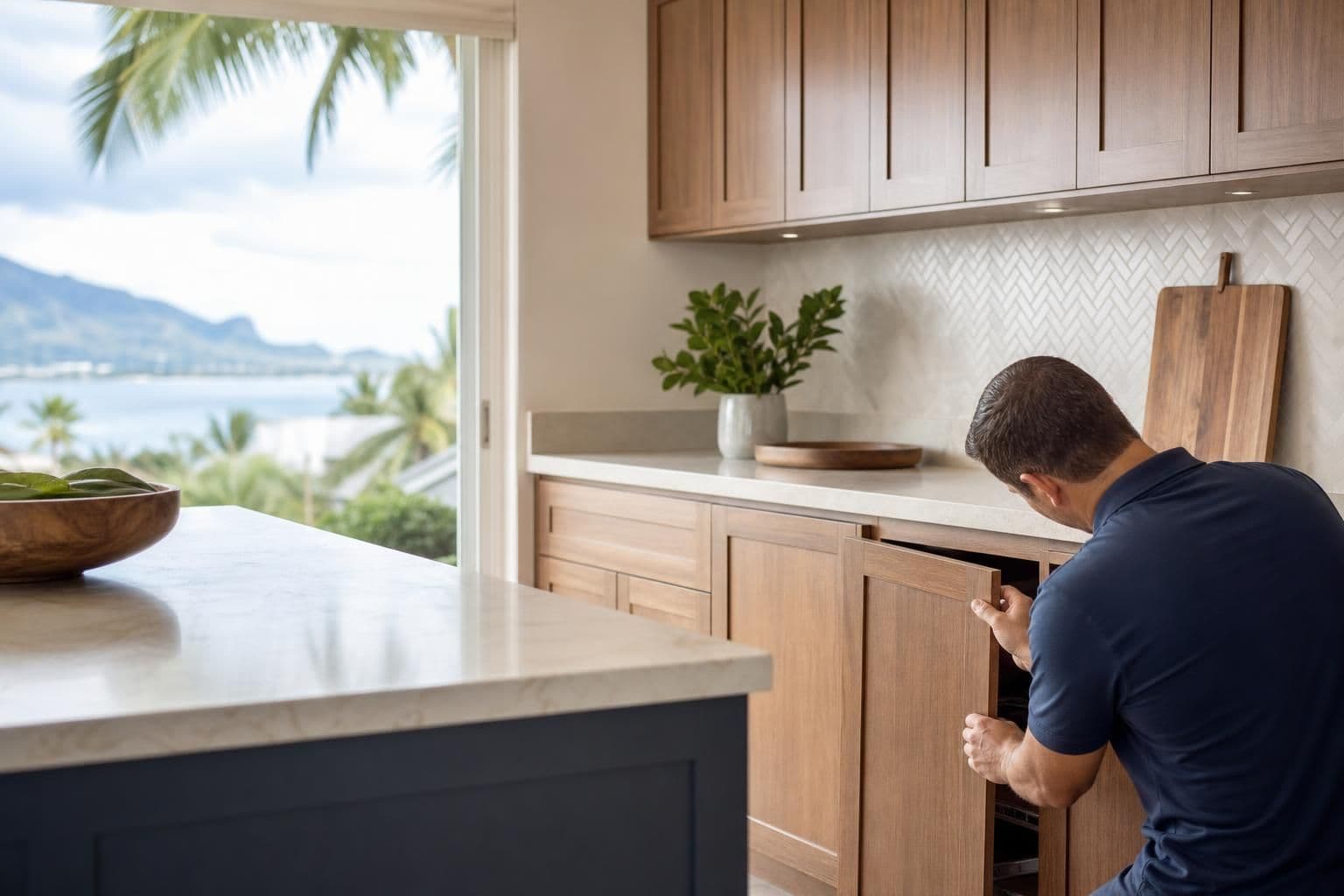
A licensed installer can open a few doors and check the box material and fastener condition in minutes, which is a faster way to decide than guessing from how the kitchen looks on the surface.
Oahu-Specific Factors That Shape the Project
Three local conditions change how a refacing job is scoped here more than on the mainland:
Humidity and salt air. Cabinet boxes built from particleboard or MDF absorb moisture over time, especially in kitchens near open lanais or with windows facing the ocean. The U.S. Environmental Protection Agency sets formaldehyde emission limits for composite wood products under the TSCA Title VI rule, which is worth asking about if you're replacing doors with a different panel material — moisture exposure can also affect how those panels perform over years, not just at installation.
Condo and AOAO approval. Many Oahu condo associations require an alteration request before any interior work, even cosmetic refacing, if it involves attaching new material to shared walls, running new venting, or altering anything visible from common areas. Getting specs written up in advance for board review saves weeks of back-and-forth — a detail covered in more depth in guides on Honolulu condo AOAO rules.
Freight on special-order finishes. Standard door styles and stock finishes are usually readily available through local suppliers. Custom colors, unusual panel profiles, or specialty hardware sourced off-island can add lead time, since they arrive by container rather than local stock. If your timeline is tight, ask your installer which finishes are in local inventory before you fall in love with a special order.
The Refacing Process, Step by Step
- Box inspection. A contractor checks for moisture damage, termite history, and squareness before quoting anything.
- Measuring and material selection. Doors, drawer fronts, and veneer are chosen to match your chosen style — this is also when hardware (hinges, pulls, soft-close mechanisms) gets picked.
- Box surface prep. Exposed box fronts and end panels get veneer or laminate applied so new and old surfaces match.
- Door and hardware installation. New doors and drawer fronts are hung, hinges adjusted, and pulls installed.
- Final adjustment. Doors are checked for alignment and even reveals before the job is called complete.
Because the boxes stay in place, most of this work happens with the kitchen partially functional, which is one of the main appeals over a full gut remodel.
Refacing vs. Full Replacement vs. Custom Cabinets
Refacing sits between a simple cosmetic refresh and a full cabinet rebuild. If you're also considering a layout change — a bigger island, different drawer configuration, or more pull-out storage — that typically means new boxes, which puts you in custom cabinet territory rather than refacing. Homeowners weighing the two often start by browsing kitchen cabinet ideas for Oahu homes to see what layout changes are realistic before deciding whether their existing boxes are worth keeping.
If you're not sure which category your project falls into, a contractor who's walked through hundreds of Oahu kitchens — old plantation-style homes, 1970s high-rises, newer builds in Kapolei and Mililani — can usually tell within a short walkthrough whether refacing will hold up or whether the boxes need to come out. That's a judgment call best made in person against your actual cabinets, not from a general price list, which is why the only reliable number comes from a free quote measured against your real square footage and box condition.
How to Evaluate a Refacing Contractor
Ask these questions before signing anything:
- Do they inspect box condition before quoting, or only measure door openings?
- What warranty applies to the veneer adhesion and hinge hardware specifically?
- Can they provide alteration paperwork formatted for AOAO board review if you're in a condo?
- Do they handle hardware upgrades (soft-close hinges, new pulls) as part of the reface, or is that a separate add-on?
The National Kitchen & Bath Association publishes general planning guidance on cabinet layout and storage standards that's useful background reading if you're also considering layout tweaks alongside refacing. For finding a reputable local company, a broader checklist is covered in how to find the best kitchen cabinet company on Oahu.
Frequently Asked Questions
Q: How long does cabinet refacing take compared to full replacement?
Refacing is generally faster than a full rebuild because the boxes, plumbing, and electrical stay untouched — the main time variables are door and veneer lead time, not demolition. A full replacement usually adds time for disconnecting appliances, removing old boxes, and reinstalling counters.
Q: Can cabinet refacing fix water-damaged boxes?
No — refacing covers the visible surfaces but does nothing for a swollen, soft, or delaminating box underneath. If the boxes show moisture damage, replacement is the safer long-term choice rather than refacing over a weak structure.
Q: Does refacing require AOAO board approval in a condo?
It depends on your association's rules, but many AOAOs require an alteration request for any work that attaches new material to shared walls or changes something visible from common areas, even if it's cosmetic. Check with your board and have specs prepared in advance to avoid delays.
Q: Is cabinet refacing a good option for older Oahu homes?
It can be, as long as the existing boxes have been checked for termite damage and moisture exposure first, since older single-wall construction homes are more prone to both. A contractor can verify box condition in a short inspection before you commit to new doors.
Q: What's the difference between refacing and repainting cabinets?
Repainting keeps your original doors and simply changes the finish, while refacing replaces the doors and drawer fronts entirely with new material, often in a different style. Refacing gives you more flexibility in door style and hardware than repainting the same doors you already have.