What Drives Cabinet Cost on Oahu? A Homeowner's Guide
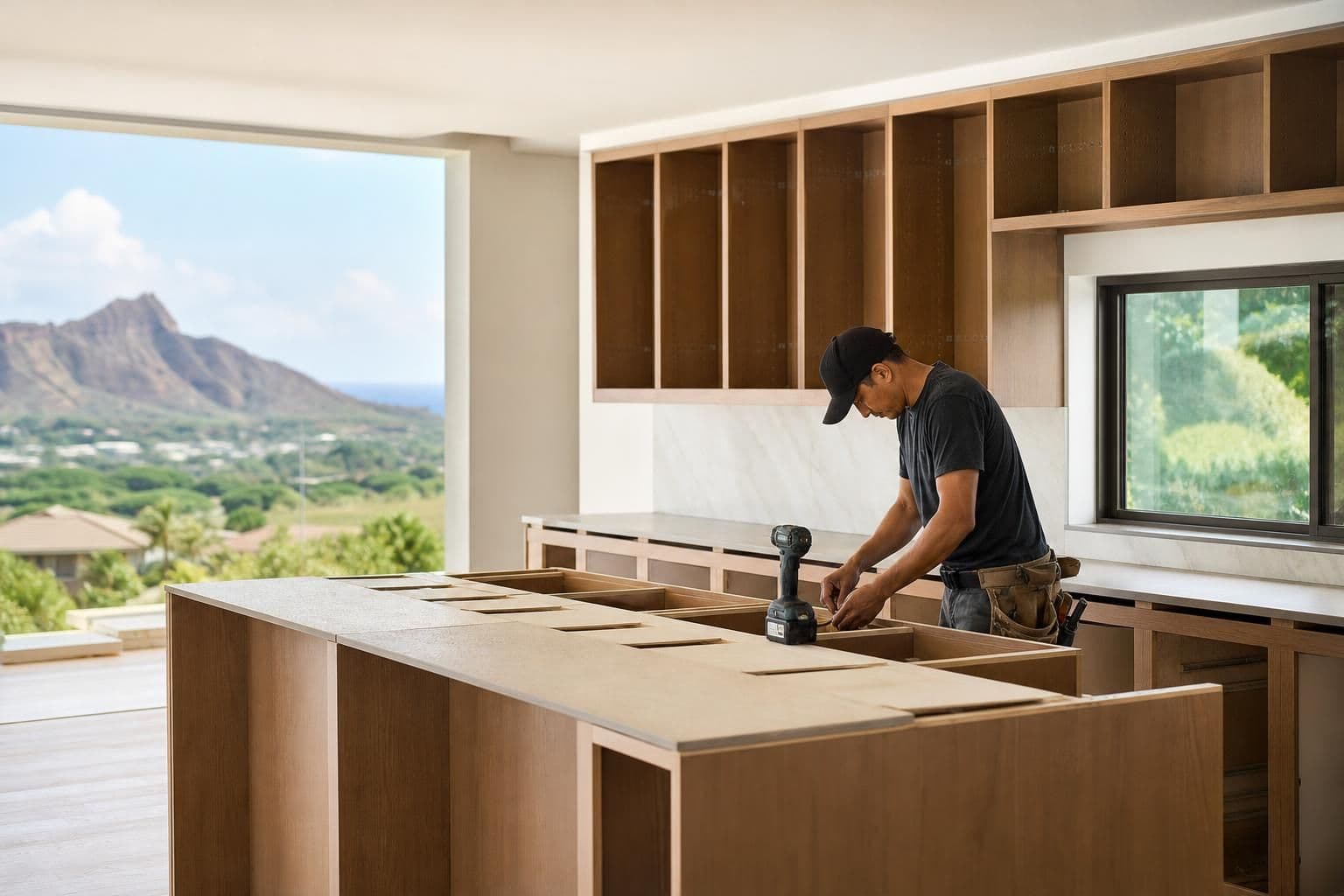
Key takeaway
Cabinet cost on Oahu is driven less by a per-box price tag and more by construction type (stock vs. semi-custom vs. custom), material and finish tier, how much the existing kitchen layout needs to change, and — for condo owners — elevator access, loading-dock scheduling, and AOAO paperwork. Two kitchens with the same square footage can land in very different places once those factors are counted. The only accurate number for a specific project comes from measuring the actual space against the actual plan.
Key takeaways
- Construction type (framed/frameless, box material, finish) moves price more than square footage alone.
- Condo and high-rise projects add elevator reservations, loading-dock windows, and AOAO-approved specs that ground-floor homes don't need.
- Older Oahu homes often need wall, subfloor, or termite-damage repairs before cabinets go in — budget time for that discovery step, not just material.
What Actually Moves Cabinet Pricing on Oahu
Cabinet pricing is built from several independent variables, not one number per linear foot. The main ones:
- Construction type — framed cabinets (face frame plus door) versus frameless/full-access (European-style) boxes. Frameless typically means more usable interior space but different hinge and hardware systems.
- Box material — plywood boxes resist humidity and racking better than particleboard, which matters more in Oahu's coastal air than it would on the mainland.
- Finish — painted, stained, laminate, or thermofoil finishes each have different prep, labor, and touch-up requirements.
- Hardware — soft-close hinges and slides, pull-out trays, and specialty organizers add to the bill item by item.
- Layout changes — moving a sink, relocating outlets, or adding ventilation for a range hood pulls in licensed trades beyond the cabinet installer.
- Linear footage and ceiling height — taller upper cabinets or floor-to-ceiling runs use more material and labor than a standard run.
None of these show up on a generic online calculator, which is why published "per linear foot" ranges rarely match what a real Oahu kitchen ends up costing.
Stock, Semi-Custom, and Custom Cabinets Compared
| Cabinet type | Lead time | Design flexibility | Best fit |
|---|---|---|---|
| Stock | Shortest | Fixed sizes, limited finishes | Rentals, quick turnarounds, standard layouts |
| Semi-custom | Moderate | Size and finish options within a product line | Most owner-occupied kitchens |
| Full custom | Longest | Built to exact dimensions and design | Irregular layouts, condo corners, high-end finishes |
Full custom work generally costs more per box because every piece is built to order, but it's also the only route when a kitchen has an odd soffit, a narrow galley width, or a corner that stock sizing simply won't fill. Homeowners comparing options for their own layout can look at how to choose custom cabinet makers on Oahu before deciding which tier fits the project.
Condo and High-Rise Factors That Add Cost
Honolulu's condo towers add layers that a single-family home on Mililani or Kapolei doesn't deal with. Material has to move through a loading dock and freight elevator on a scheduled window, which the building management books in advance — missing that window can push a delivery back by days. Many AOAOs also require submitted specs before cabinet or flooring work starts, covering everything from material type to noise and vibration during installation. Getting those documents right the first time avoids a rejected submission and a second round of waiting. For a deeper look at what boards typically ask for, see the site's guide on visiting a cabinet showroom in Honolulu, which covers how samples and specs come together before a board sees them.
Older Oahu Homes: Subfloor, Walls, and Termite Conditions
Plantation-era and mid-century homes across Oahu often have out-of-level walls, furred-out plumbing chases, or termite damage in the wall framing behind old cabinetry. Hawaii's climate supports several termite species that are more active and more damaging to untreated wood than in most mainland states, according to the University of Hawaii College of Tropical Agriculture and Human Resources, which studies pest pressure specific to the islands. Removing old cabinets sometimes reveals this damage only after demolition starts, which is why a contractor walk-through before ordering matters more here than it would in a newer build.
Material and Finish Tiers Without a Price Tag
Cabinet finish and countertop choice are usually decided together, since a painted shaker door reads differently next to a quartz slab than it does next to laminate. Builders planning both at once often review quartz countertop options alongside cabinet finish samples so the two don't clash once they're installed side by side. Formaldehyde emissions from composite wood products (used in some lower-cost cabinet boxes) are regulated under the EPA's TSCA Title VI formaldehyde standards, which is worth knowing if indoor air quality is a concern in a tightly sealed condo unit.
Design Choices That Change the Scope
Islands, pantry walls, and floor-to-ceiling uppers all change the linear footage and labor involved, which is a bigger swing factor than most homeowners expect going in. The National Kitchen & Bath Association publishes general planning guidelines on clearances and workflow that are useful for sketching a layout before getting quotes, even though actual pricing is always project-specific. For Oahu-specific layout ideas, the guide on kitchen island ideas for Oahu kitchens covers common configurations that work in typical island floor plans.
What a Free Quote Actually Measures
A cabinet quote done against real measurements — not a generic average — accounts for linear footage, ceiling height, box material, finish, hardware, and any structural or condo requirements specific to the address. Oahu Flooring Quote builds quotes this way, priced for the actual square footage and answered within 24 hours, with one point of contact from the first call through delivery. Condo owners get the paperwork formatted for AOAO board review as part of that same process, and anyone comparing cabinet tiers can start from custom cabinets to see what's available through the supplier's two Honolulu showrooms before requesting numbers.
Frequently Asked Questions
Q: What makes custom cabinets cost more than stock cabinets on Oahu?
Custom cabinets are built to exact dimensions rather than standard sizes, which means more labor and material per box and a longer lead time. They're usually worth it for irregular layouts, condo corners, or soffits that stock sizing can't fill cleanly.
Q: Do condo cabinet projects cost more than single-family home projects?
Condo projects often involve added coordination — booking freight elevators, loading-dock windows, and submitting specs for AOAO board approval — that single-family homes don't need. Those logistics add time and planning rather than material cost, but they do affect the overall project timeline and scope.
Q: Can I get an accurate cabinet cost estimate online without a site visit?
A generic online estimate can't account for wall condition, layout changes, or condo-specific requirements, so it's rarely accurate for a real Oahu kitchen. A quote based on actual measurements and photos of the space gets much closer to a real number.
Q: Does cabinet material affect how well they hold up in Hawaii's climate?
Yes — plywood boxes generally resist humidity and swelling better than particleboard, which matters in coastal and non-air-conditioned homes. Finish type also affects how well doors and drawer fronts hold up to daily moisture exposure.
Q: Should I replace cabinets and countertops at the same time?
Doing both together lets the finish and material choices be compared side by side before installation, which avoids mismatched tones or textures. It also means one coordinated schedule instead of two separate installation windows.