Best Flooring for a Lanai on Oahu: What Actually Holds Up
Key takeaway
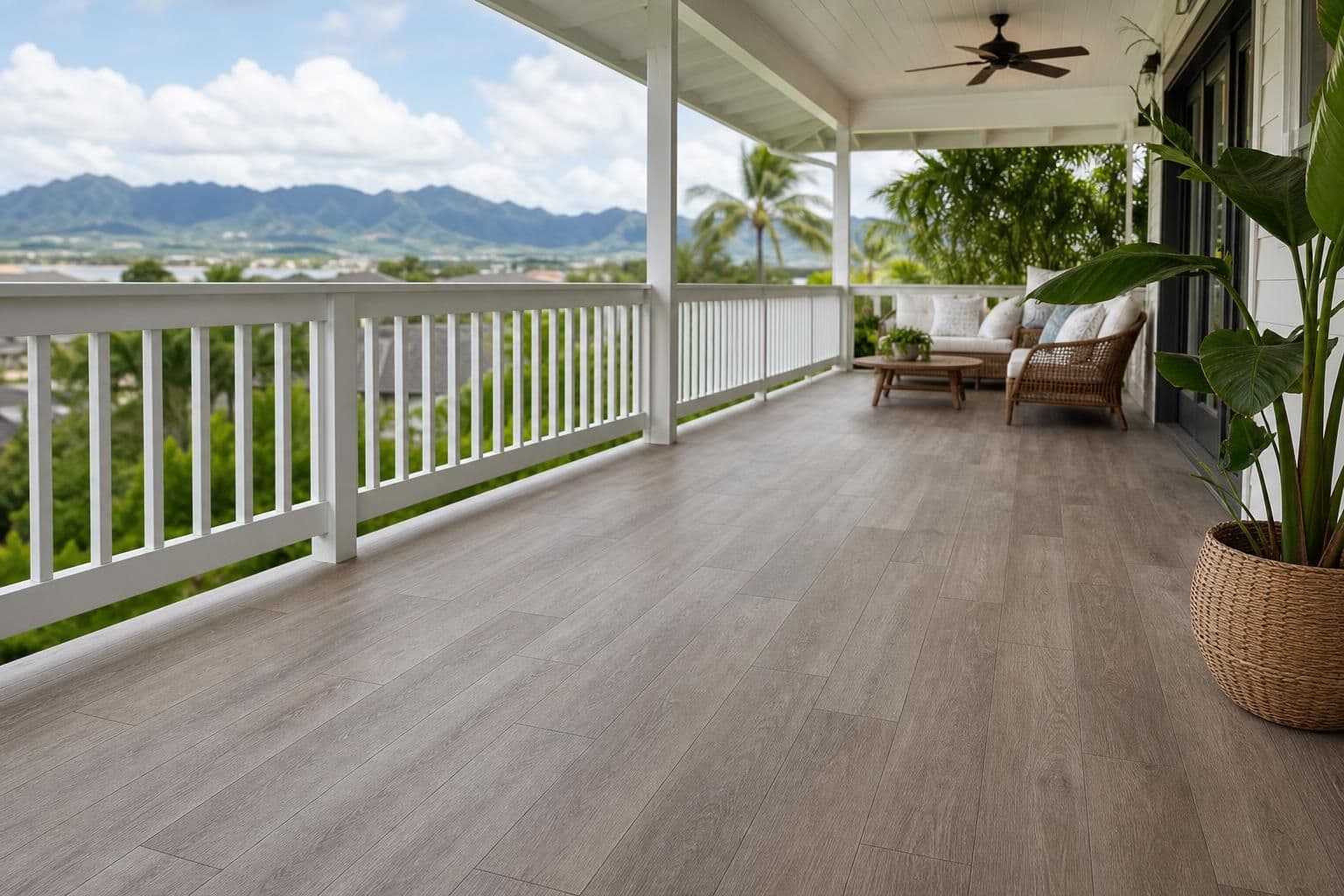
The best flooring for a lanai on Oahu is a slip-rated, moisture-sealed material that can handle standing water, direct UV, and salt-laden air without warping or fading — in most cases that means a waterproof SPC vinyl plank rated for outdoor or semi-outdoor use, textured porcelain tile, or a sealed concrete overlay, depending on whether the lanai is covered, screened, or fully open. Wood-look laminate and interior-grade engineered wood are not built for this and typically fail within a couple of years on an exposed lanai. The right pick depends on how much direct rain and sun the space gets and whether it's part of a condo common-element inspection.
Key takeaways
- Open, rain-exposed lanais need a waterproof, slip-rated surface — not interior-grade vinyl, laminate, or unsealed wood.
- Covered and screened lanais have more flooring options but still need UV-stable material because reflected sun and salt air reach almost every surface on Oahu.
- Condo lanais often count as a limited common element, so flooring changes there usually need AOAO paperwork before installation.
Why lanai flooring fails faster than interior flooring
A lanai isn't a sheltered extension of the living room, even when it's covered. Wind-driven rain, condensation, and salt air reach surfaces that stay dry indoors, and UV exposure breaks down plastics, adhesives, and wood fibers faster than almost anywhere else in the house. The EPA's indoor air quality guidance notes that materials exposed to repeated wet-dry cycling are far more prone to delamination and microbial growth — exactly the failure mode seen on Oahu lanais where flooring was chosen for looks rather than exposure rating.
Salt air is the other variable mainland flooring guides don't account for. Airborne salt accelerates corrosion of metal transition strips and fasteners and can dull or cloud certain finishes over a few seasons, especially within a mile or two of the shoreline — which covers a large share of Oahu's residential lanais.
What actually works, by lanai type
Not every lanai needs the same flooring. An open-air lanai with no roof is a different project than a screened one.
Fully open, rain-exposed lanai This space needs a product built for outdoor water exposure: waterproof SPC vinyl plank rated for outdoor/patio use, textured porcelain paver tile, or a broom-finished and sealed concrete overlay. Standing water and direct sun rule out interior-grade vinyl, laminate, and most engineered wood.
Covered or screened lanai With a roof overhead, water exposure drops significantly, which opens up the field to include higher-end waterproof vinyl plank, natural stone, and some composite decking look-alikes. UV-stable finishes still matter, since Hawaii sun reflects off glass doors and white walls onto "shaded" flooring anyway.
Condo lanai Many AOAOs classify the lanai as a limited common element, which means flooring changes there — not just inside the unit — can require board-approved specs before work starts. Material, underlayment, and sometimes sound-rating documentation all get reviewed.
Comparing the realistic options
| Flooring type | Handles direct rain | UV/fade resistance | Slip resistance (textured finish) | Typical maintenance |
|---|---|---|---|---|
| Waterproof SPC vinyl plank (outdoor-rated) | Yes | Good with UV-stable wear layer | Good | Sweep, occasional mop |
| Textured porcelain paver tile | Yes | Excellent | Good to excellent | Sweep, periodic grout check |
| Natural stone (sealed) | Yes, if properly sealed | Good | Varies by finish | Resealing on a schedule |
| Sealed concrete overlay | Yes | Good | Good with broom/texture finish | Resealing on a schedule |
| Interior-grade vinyl or laminate | No | Poor | Poor when wet | Not recommended outdoors |
The slip-resistance question
Lanai floors get wet from rain, hose-down cleaning, and tracked-in pool or ocean water, so a glossy, smooth finish is a hazard regardless of the material. ASTM International publishes the test standards (ASTM C1028 and related slip-resistance methods) that manufacturers reference when they label a tile or plank as suitable for wet areas — look for that kind of rating on the product spec sheet rather than taking "outdoor" labeling at face value. A textured or matte wear layer on vinyl plank, or a textured paver finish on tile, performs noticeably better barefoot and wet than a polished equivalent.
UV and heat: Oahu's specific challenge
Oahu sits at a latitude with consistently high UV index readings year-round, and the National Weather Service tracks UV index as part of its daily forecast because sun exposure here stays elevated even on cloudy days. Flooring on an uncovered or partially shaded lanai takes that exposure directly, which is why wear-layer quality matters more than it would for the same product installed in a living room. A thin or budget wear layer on vinyl plank can visibly fade or chalk within a year or two of full sun exposure; a thicker, UV-stabilized wear layer is built to resist that.
Subfloor and drainage conditions that change the plan
Older Oahu homes often have lanais poured at a slight slope for drainage, with concrete that has settled unevenly over decades. Before any new flooring goes down, that slab needs to be checked for level and for any cracks that could trap water underneath a sealed vinyl or tile installation. On covered lanais that get converted into semi-interior living space, moving furniture, tearing out old tile, and disposing of debris all add to the scope — the same cost-driving factors that apply to flooring for stairs also apply here: it's the site conditions, not just the material, that shape the final job.
If the lanai is on a high-rise or mid-rise condo, add elevator booking and loading-dock scheduling to that list, since material has to move through the building on a reserved window rather than straight off a truck.
Why a sample beats a photo for this decision
Lanai flooring photographs differently than it feels underfoot in salt air and bright sun. Bringing home a physical sample and leaving it on the lanai for a few days — through a rain shower and a few hours of direct afternoon sun — shows fade resistance and slip texture in a way no photo can. That's also the reasoning behind what to bring to a showroom visit: measurements and photos of the actual lanai help narrow the field before you touch samples.
A free quote priced against the lanai's actual square footage is the only way to get a firm number, since drainage condition, covered-vs-open exposure, and AOAO paperwork all change scope on a case-by-case basis. Waterproof vinyl plank flooring built for outdoor exposure is one of the more common picks for Oahu lanais because it balances water resistance, UV stability, and a lower-maintenance surface compared to natural stone.
Frequently Asked Questions
Q: Can I use regular vinyl plank flooring on a lanai?
Only if it's specifically rated for outdoor or high-moisture exposure. Standard interior-grade vinyl plank isn't built to handle standing water or direct UV and will typically delaminate or fade within a season or two on an open lanai.
Q: Is tile or vinyl plank better for a lanai?
Both can work well; textured porcelain tile tends to hold up slightly better under heavy direct rain and full sun, while outdoor-rated vinyl plank is often lighter, warmer underfoot, and faster to install. The better choice depends on whether the lanai is open or covered and how it's used.
Q: Do I need AOAO approval to change lanai flooring in an Oahu condo?
In many buildings, yes — the lanai is often treated as a limited common element, so flooring changes there usually require board-reviewed specs before installation, separate from work done inside the unit.
Q: How often does lanai flooring need to be resealed or replaced?
That depends heavily on exposure and material; sealed stone and concrete typically need resealing on a recurring schedule, while a quality UV-stable vinyl plank or porcelain tile generally needs little beyond routine cleaning. Full sun and salt air exposure shorten those intervals compared to a shaded, covered lanai.
Q: What's the biggest mistake homeowners make choosing lanai flooring?
Picking a product based on how it looks indoors rather than its moisture and UV rating. A floor that performs perfectly in a living room can fail within a year or two on an exposed lanai if it isn't rated for that environment.