Waterproof Vinyl Plank Flooring for Oahu Beach Houses
Key takeaway
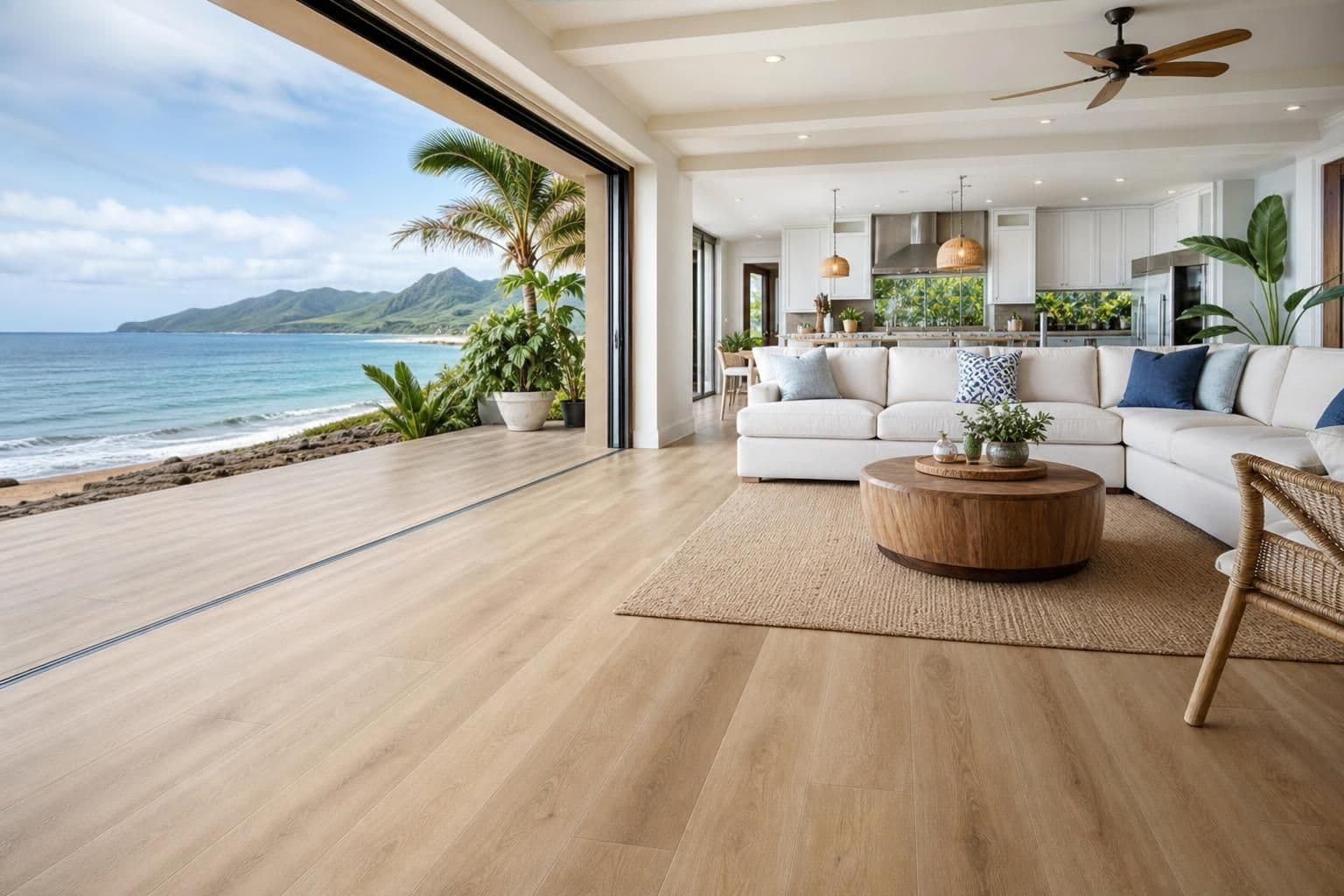
Waterproof vinyl plank is the most practical flooring choice for Oahu beach houses because its rigid core (SPC or WPC) won't swell, delaminate, or grow mold when it gets splashed with saltwater, tracked-in sand, or humid trade-wind air. Unlike laminate or engineered wood, a fully waterproof core keeps performing even if water sits on the surface for hours, which matters in oceanfront homes where sandy feet and open lanai doors are a daily reality. It's not a floor you baby — it's a floor built for the exact conditions a beach house throws at it.
Key takeaways
- Look for a rigid SPC or WPC core labeled "100% waterproof," not just a water-resistant top wear layer.
- Typical Oahu material costs run $3.50–$7 per sq ft for vinyl plank alone, with installed pricing higher — a quote is the only way to get an exact number for your square footage.
- Attached pad/underlayment and a wear layer of 12 mil or more help the floor handle sand grit and salt exposure over years, not just months.
What "waterproof" actually means for vinyl plank
Not all vinyl flooring marketed as "waterproof" is built the same. The core is what matters:
- SPC (stone plastic composite) — a dense, rigid core made mostly of limestone powder and PVC. It's the most dimensionally stable option, resists dents from furniture, and holds up well on concrete slabs common in Oahu homes.
- WPC (wood plastic composite) — a foamed core that's softer underfoot and quieter, still fully waterproof, but slightly less puncture-resistant than SPC.
- Water-resistant laminate — not the same thing. Laminate has a wood-fiber core that can still swell if water sits at a seam for an extended period, even with a "water-resistant" coating.
For a true beach house — salt air blowing through screen doors, wet towels dropped by the entry, the occasional flooded lanai during a storm — SPC with a fully sealed click-lock joint is the safer bet. The U.S. Environmental Protection Agency notes that trapped moisture behind or under flooring is a primary driver of indoor mold growth, which is exactly the failure mode a rigid waterproof core is designed to prevent.
Why humidity and salt air change the equation on Oahu
Standard interior flooring products are engineered for mainland climate ranges, not for a marine environment where relative humidity regularly sits above 60% and salt-laden air corrodes anything with exposed metal. Oahu's humidity swings, plus the sand and grit that get tracked in from the beach, put more mechanical wear on flooring seams and edges than a typical inland home ever sees. If you're comparing material types for a first-floor or oceanfront layout, the deeper cost breakdown in our vinyl plank flooring cost guide walks through how humidity and slab conditions affect both material choice and installed pricing.
Rigid-core vinyl also handles Oahu's temperature swings between air-conditioned interiors and hot, humid exteriors without the expansion and contraction issues that solid hardwood or laminate can develop over time.
Typical Oahu price ranges for waterproof vinyl plank
These are typical ranges seen on Oahu, not a quote — actual pricing depends on square footage, subfloor prep, and whether you're buying material only or having it installed.
- Material only: roughly $3.50–$7 per sq ft, depending on wear layer thickness, texture, and plank size.
- Installed (material + labor): roughly $6–$12 per sq ft, varying with subfloor condition, room layout, and whether old flooring needs removal.
- Underlayment/moisture barrier add-on: often built into attached-pad products, or added separately on concrete slabs near the water.
A licensed installer will factor in slab moisture testing, transitions between rooms, and any baseboard or trim work — all of which move the final number. A free quote priced for your actual square footage is the only way to get an exact figure, and answers typically come back within 24 hours.
What to check before you buy
A few specs matter more than the marketing copy on the box:
- Wear layer thickness — 12 mil is a reasonable minimum for a beach house with sandy foot traffic; 20 mil or higher suits high-traffic rental or commercial use.
- Core type — confirm SPC or WPC in writing, not just "waterproof" on the label.
- Locking system — a tight, reinforced click-lock reduces the chance of water creeping between planks at the seams.
- UV and fade resistance — homes with large sliding doors facing the ocean get more direct sun exposure than a typical inland room.
- Slip resistance rating — relevant for lanai-adjacent flooring or bathrooms where feet are often wet or sandy.
Seeing and touching actual samples side by side makes these differences obvious in a way spec sheets don't — texture, thickness, and finish all feel different in hand. Two Honolulu showrooms carry samples you can touch before committing to a whole-house order.
Condo owners: don't skip the AOAO paperwork
If the beach house is a condo unit rather than a single-family home, most Oahu AOAOs require flooring specs — underlayment sound rating, moisture barrier details, and sometimes an acoustic test — before approving an installation. This is separate from the product's waterproof rating and trips up more owners than the flooring choice itself. Getting the spec sheet formatted the way a board expects up front avoids a rejected application and a second round of paperwork.
Frequently Asked Questions
Q: Is waterproof vinyl plank actually safe for a beach house that floods occasionally?
A fully waterproof SPC or WPC core will not swell or delaminate from standing water, but prolonged flooding can still push moisture underneath the planks if the subfloor isn't sealed. For homes with real flood risk, ask about a moisture barrier underlayment in addition to the waterproof core.
Q: What's the difference between "waterproof" and "water-resistant" vinyl flooring?
Waterproof means the core itself won't absorb or swell from water exposure, even if it sits on the surface for hours. Water-resistant usually means the surface coating repels spills for a limited time, but the core underneath can still be vulnerable if water reaches it.
Q: Does salt air affect vinyl plank flooring differently than regular humidity?
Salt air itself doesn't damage the vinyl core, but it can accelerate corrosion on any exposed metal transition strips, fasteners, or trim near entryways. Choosing corrosion-resistant hardware for transitions matters as much as the flooring choice itself.
Q: How much does waterproof vinyl plank cost installed on Oahu?
Installed pricing typically runs $6–$12 per sq ft depending on subfloor prep and layout, though material-only purchases run $3.50–$7 per sq ft. A quote based on your exact square footage is the only way to get a precise number.
Q: Do AOAO boards have specific requirements for vinyl plank flooring in condos?
Many Oahu AOAOs require documentation on underlayment sound ratings and moisture barriers before approving a flooring installation, separate from whether the product is waterproof. Getting these specs prepared in the format the board expects speeds up approval.