What Causes Vinyl Plank Flooring to Buckle?
Key takeaway
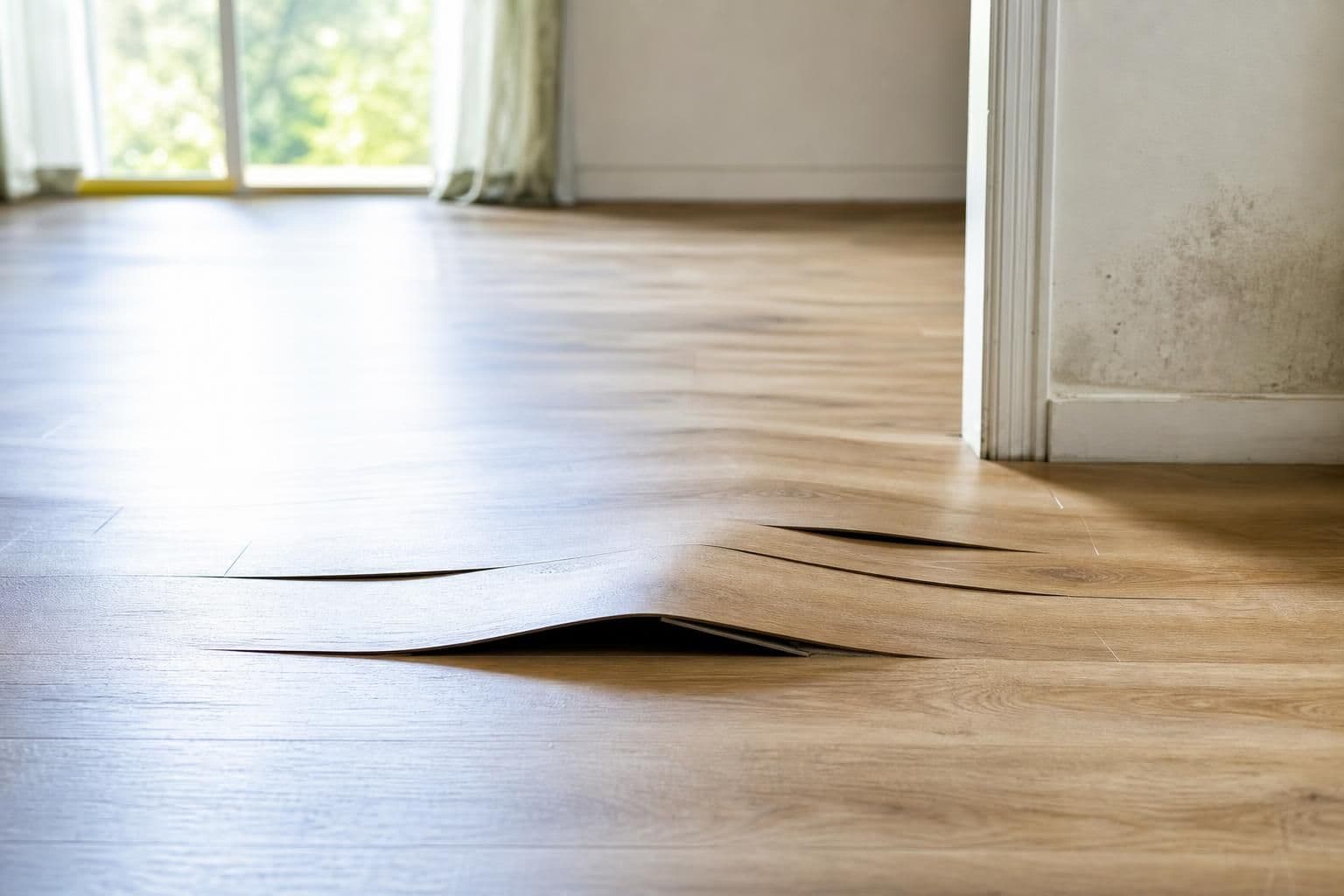
Vinyl plank flooring buckles when the planks expand or shift more than the installation can absorb — usually from trapped moisture underneath, heat buildup on the surface, or planks that were installed without enough room to expand and contract. Once the material pushes against itself with nowhere to go, it tents, ripples, or separates at the seams. The fix depends entirely on which of those three forces is at work, which is why a visual inspection matters more than a generic answer.
Key takeaways
- Buckling is almost always moisture, heat, or an installation gap problem — not a defective product.
- Ripples near exterior walls or sliding doors usually point to sun-driven heat expansion; ripples near a slab or bathroom usually point to moisture.
- Planks that were installed tight against walls or cabinets with no expansion gap will buckle even in a perfectly dry, cool room.
Trapped moisture under the planks
Vinyl plank is water-resistant on the surface, but moisture can still get underneath it through a concrete slab, an old subfloor, or a spill that finds its way through a seam. When that moisture has nowhere to evaporate, it pushes the plank up from below. This is especially common in older Oahu homes built directly on slab, where vapor can migrate upward through concrete that was never sealed with a modern vapor barrier. Ground moisture pressure through concrete is a documented driver of flooring failure, which is why flooring manufacturers and the EPA's guidance on moisture and mold control both treat subfloor moisture testing as a standard pre-installation step, not an optional one.
If you've already had water sit on the floor — a leak, an overflowing tub, a dishwasher line — read what actually happens when vinyl plank flooring gets wet before assuming the buckling will settle on its own.
Heat and direct sun exposure
Vinyl is a plastic product, and plastic expands with heat. A wall of west-facing sliding doors or an unshaded lanai entry can push surface temperatures well above the room's ambient temperature during peak sun hours. Over repeated days, that heat cycle expands the planks slightly each time; if the installation didn't leave room for that expansion, the planks eventually have nowhere to go but up. This pattern shows up as buckling concentrated in a sunbeam-shaped patch rather than across the whole room, which is a useful diagnostic clue — moisture problems tend to spread from a source point, heat problems trace the path of the sun.
Installation without an expansion gap
Vinyl plank needs a small gap around the perimeter of the room — against walls, cabinets, and door thresholds — so the floor has room to move as temperature and humidity shift throughout the day. If installers ran the planks tight to the wall and covered the edge with baseboard, the floor has no relief valve. The first hot week or humid stretch, the planks buckle at the tightest point. This is one of the most common causes of buckling in floors that are otherwise installed correctly in every other respect, and it's also one of the easiest to prevent — it just requires an installer who measures the gap rather than eyeballing it.
Subfloor conditions specific to older Oahu homes
Many Oahu homes, particularly in Honolulu's older neighborhoods, have subfloors with dips, humps, or old adhesive residue from a previous floor. Vinyl plank is rigid enough that it will telegraph those irregularities, and a low spot can trap moisture or flex under foot traffic in a way that accelerates buckling at the seams. Leveling compound or subfloor prep isn't a cosmetic upgrade in these cases — it's what keeps the new floor flat enough to lock together properly. If you're weighing vinyl plank against other options for a home with an older subfloor, the pros and cons guide for Oahu homes covers how subfloor condition factors into that decision.
Humidity swings and acclimation
Vinyl plank should sit in the room where it will be installed for a period before installation, so the material adjusts to the space's actual temperature and humidity rather than whatever conditions it was shipped or stored in. Skipping this step is a common cause of buckling that shows up within the first few weeks, because the planks are still expanding to match the room after installation is already locked in place. Hawaii's year-round humidity makes this step more important than it would be in a drier climate — the National Weather Service's Honolulu climate data shows relative humidity in the Honolulu area regularly sits in a range that gives materials meaningfully more moisture to absorb than a mainland installation would see.
How to tell which cause applies to your floor
A few observations narrow it down before you call anyone:
- Buckling near a slab edge, bathroom, or kitchen appliance — check for a moisture source first.
- Buckling in a sunlit patch that moves with the day — heat expansion is the likely driver.
- Buckling right at the wall line or under baseboard — missing expansion gap.
- Buckling that's spread out and shows soft or uneven spots underfoot — subfloor irregularity.
- Buckling that appeared within the first month, room-wide — acclimation was skipped.
None of these fixes is one-size-fits-all, and none of them can be diagnosed accurately without seeing the floor and the room conditions. If you're maintaining an existing floor and want to avoid triggering any of these issues through cleaning habits, how to clean vinyl plank flooring the right way covers which products and methods keep moisture from working into seams over time.
Can buckled vinyl plank be repaired, or does it need replacing?
Isolated buckling — a few planks near a known moisture source or a missed expansion gap — can sometimes be corrected by removing the affected planks, addressing the underlying cause, and reinstalling. Widespread buckling across a room usually means the moisture or heat exposure has already compromised the adhesive or the locking mechanism along multiple seams, and patch repairs won't hold. A licensed installer can pull a plank to check the subfloor and backing before recommending which path makes sense — this isn't something size or spot-checks from photos can settle reliably. If you're at the point of comparing repair against a full replacement, a free quote priced against your actual square footage is the fastest way to get a straight answer within 24 hours rather than guessing.
Frequently Asked Questions
Q: Can buckled vinyl plank flooring flatten back out on its own?
Sometimes minor heat-driven buckling relaxes once the surface cools and the planks contract back, but moisture-driven buckling rarely self-corrects because the trapped moisture has to fully evaporate first, and by then the locking edges may already be damaged.
Q: Does buckling mean the vinyl plank flooring was low quality?
Not usually — buckling is far more often an installation or moisture issue than a defect in the plank itself, since even premium vinyl plank will buckle without an expansion gap or over a wet subfloor.
Q: Is buckled vinyl plank flooring a sign of a bigger moisture problem in the house?
It can be. Buckling near a slab or exterior wall is worth checking against a plumbing leak or vapor intrusion issue, especially in older homes, rather than treating the floor as an isolated problem.
Q: How long does vinyl plank need to acclimate before installation to avoid buckling?
Manufacturer instructions vary by product, but the general principle is letting planks sit in the actual room, out of packaging, long enough to reach the room's ambient temperature and humidity before installation begins.
Q: Does buckling happen more on concrete slab floors than on wood subfloors?
Slab floors are more prone to moisture-related buckling because concrete can carry vapor upward from the ground, while wood subfloors are more prone to buckling from irregularities like dips or old adhesive residue.