What Affects Waterfall Countertop Cost on Oahu
Key takeaway
A waterfall countertop costs meaningfully more to install than a standard flat-edge quartz counter, because the side panel requires a second cut of slab and a mitered seam that has to line up perfectly. What that adds up to for a specific kitchen depends on the quartz pattern, island size, and how many finished sides the waterfall wraps. A measured quote against the actual layout is the only way to know what a particular island will run.
Key takeaways
- Waterfall quartz costs meaningfully more than a standard flat-edge quartz counter, mainly because of the extra slab panel and the mitered joint.
- The added cost comes from a second slab section and the mitered corner joint, not just the material itself.
- Bold veining patterns take more fabrication time to match across the miter than solid or subtle patterns, which drives the cost up further.
What Makes a Waterfall Countertop Cost More
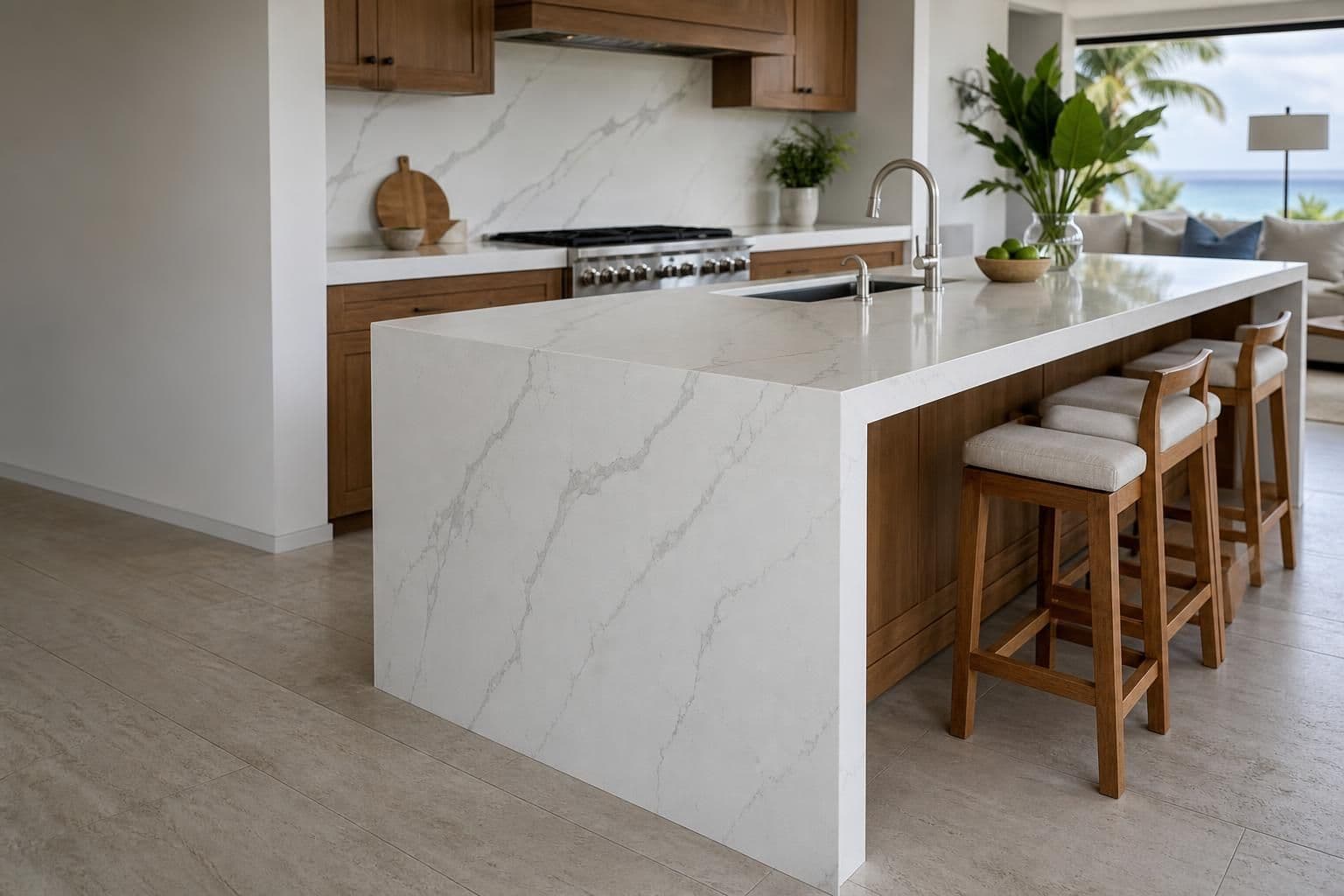
A waterfall countertop extends the counter surface down the side of an island or cabinet run in one continuous visual plane, instead of stopping at a square edge. To do that, a fabricator cuts a second panel from the slab and joins it to the countertop at a 45-degree miter, so the seam disappears and the stone appears to "flow" over the edge.
That miter joint is the labor-intensive part. It has to be cut precisely, polished, and fitted so the pattern lines up across the seam — especially with quartz that has strong veining, since a mismatched miter is the most common complaint homeowners have about waterfall counters. Fabricators price in the extra template time, cutting, and installation labor, on top of the added slab material — which is why two waterfall quotes for similar-looking islands can land far apart.
Comparing Countertop Styles: What Drives the Difference
Rather than a price list, here's how these styles compare on the factors that actually move a quote: durability, moisture tolerance, install complexity, and how long the material takes to source.
| Countertop style | Durability | Moisture tolerance | Install complexity | Lead time |
|---|---|---|---|---|
| Standard flat-edge quartz | High | Excellent (non-porous) | Straightforward — single slab, standard edge | Typically in stock or short order |
| Waterfall on one side only | High | Excellent (non-porous) | Higher — second panel, single mitered seam | Depends on slab availability for pattern match |
| Waterfall wrapping two sides | High | Excellent (non-porous) | Highest — two mitered seams, more slab used | Longer — needs enough slab for both panels |
| Waterfall in bold/exotic veining | High | Excellent (non-porous) | Highest — pattern-matching labor across seams | Longest — exotic slabs often special-order with island freight |
| Standard laminate counter (for comparison) | Lower — vulnerable to chipping and heat | Fair — seams can allow moisture in | Low — no stone fabrication needed | Fast, widely stocked |
Slab size also limits how much waterfall a single piece can cover — most quartz slabs run around 120 x 55 inches, so a tall island or an unusually long waterfall panel may need a seam even beyond the miter, which adds to the fabrication scope.
Where the Square Footage Adds Up
Homeowners often underestimate waterfall square footage because they're only picturing the countertop, not the side panel. A typical kitchen island might have:
- 25–35 sq ft of countertop surface
- 10–15 sq ft of waterfall panel on one side (roughly the height of the island times its depth)
- Extra slab waste from cutting the miter angle, which fabricators generally build into the overall scope rather than itemizing separately
That's why two islands that look similar in photos can scope out very differently — panel height and island depth matter as much as the countertop footprint. If you're planning a full kitchen remodel and want to see how countertop scope fits alongside cabinets and flooring, our kitchen remodel cost guide breaks down how the pieces typically fit together.
Quartz vs. Other Materials for a Waterfall Edge
Quartz is the most common material for waterfall edges on Oahu because it's manufactured to consistent thickness and pattern, which makes matching the miter easier than with natural stone. Granite and marble can also be used, but natural stone slabs vary more from one edge to the next, so pattern-matching a waterfall miter in natural stone generally adds more fabrication time. Butcher block and laminate waterfalls exist but are far less common in kitchens because they don't hold up as well to daily wear at a vertical edge, and can shorten how long the installation lasts before it needs replacing.
For homeowners comparing quartz against other counter materials more broadly, our guide on quartz countertops covers slab options and care beyond just the waterfall edge.
Condo Considerations
Condo owners planning a waterfall island as part of a kitchen renovation should check with their AOAO before ordering material, since plumbing and electrical relocations for a new island layout often require board approval separate from the countertop itself. Elevator reservations and loading-dock scheduling can also add time to a high-rise install, since large slab panels need careful handling on the way up. Getting specs written up correctly the first time avoids delays once material is ordered.
Getting an Accurate Number
Because waterfall scope depends on island height, depth, and how many sides are finished, the only number that means anything is one built from the actual footprint. A free quote priced against your real measurements typically comes back within 24 hours, rather than relying on a rough guess that won't hold up once fabrication starts.
Frequently Asked Questions
Q: Why is a waterfall countertop so much more expensive than a regular countertop?
A waterfall countertop uses a second cut of slab for the side panel and requires a precise mitered joint so the pattern lines up seamlessly, which adds both material and skilled fabrication labor compared to a standard flat-edge counter.
Q: Does quartz or granite cost less for a waterfall edge?
Quartz is usually easier to pattern-match at the miter because it's manufactured with consistent thickness and repeating patterns, while natural granite or marble slabs vary more and can add fabrication time — and with it, cost.
Q: Can a waterfall edge be added to an existing countertop?
Adding a waterfall panel to an existing countertop is possible but often approaches the scope of a full replacement, since it typically requires removing the current edge and installing new slab pieces with a proper miter — it's rarely a simple add-on.
Q: How much extra square footage does a waterfall panel add?
A waterfall panel typically adds 10 to 15 square feet for a standard island, based on the island's height and depth, on top of the countertop surface itself — that extra footage is what most rough estimates miss.
Q: Is a waterfall edge worth it on a small kitchen island?
It depends on the layout — a waterfall edge tends to visually anchor larger islands more than small ones, and on a compact island the added fabrication effort may outweigh the visual effect, which is worth discussing when getting a quote for the specific space.