What Flooring Adds the Most Resale Value on Oahu?
Key takeaway
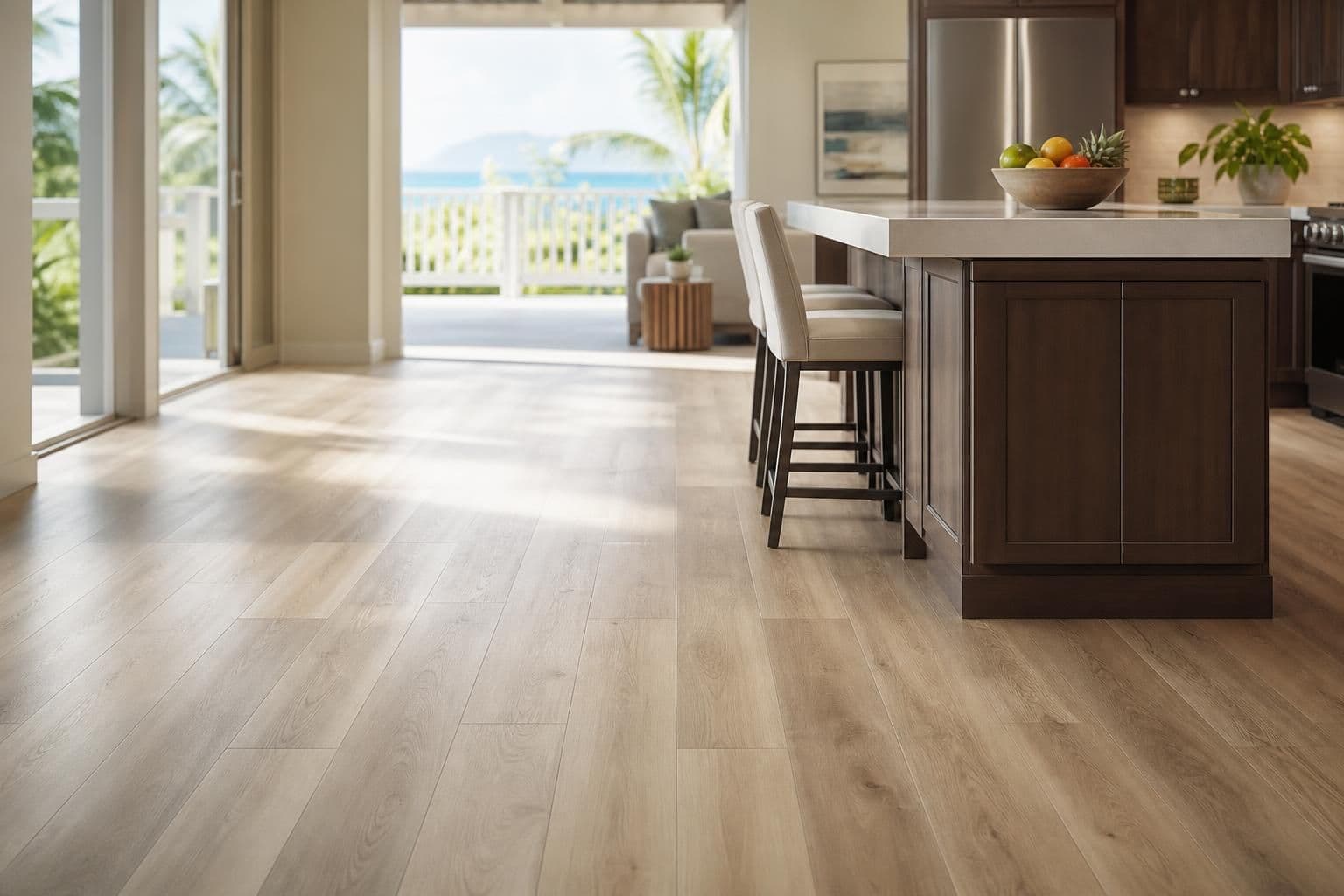
Waterproof luxury vinyl plank (LVP) generally returns the most resale value on Oahu because it survives humidity and salt air better than hardwood or laminate, reads as "updated" to buyers and appraisers, and avoids much of the extra subfloor prep and moisture-barrier work that solid wood often needs over slab and condo subfloors here. Quartz countertops are the next-strongest value add in kitchens and baths, since they're durable and low-maintenance in ways buyers actively screen for. No flooring or countertop material guarantees a fixed return, and what any given upgrade actually costs depends on your subfloor condition, unit access, and finish level rather than the material name alone.
Key takeaways
- Waterproof LVP typically outperforms hardwood for resale on Oahu because it resists humidity, salt air, and condo moisture issues that cause callbacks after closing.
- Buyers and appraisers respond to consistent flooring throughout main living areas more than to a single "premium" material in one room.
- Quartz countertops paired with updated flooring tend to move kitchens and baths from "dated" to "move-in ready" in listing photos, which is where resale value is actually won or lost.
Why flooring choice matters more in Hawaii than on the mainland
Standard mainland advice ("hardwood always wins") doesn't transfer cleanly to Oahu. High humidity, trade-wind salt air, and slab or condo subfloor conditions common in Honolulu and Kailua buildings put real stress on solid hardwood, which expands, contracts, and can cup over time in coastal humidity. The EPA's guidance on indoor moisture and mold explains why materials that trap moisture underneath them — carpet pad, some laminates, solid wood over concrete without a proper vapor barrier — create ongoing problems in humid climates, and buyers' home inspectors on Oahu know to look for exactly this.
That's part of why waterproof vinyl plank has become the default resale-safe choice here: it's dimensionally stable, tolerates humidity swings, and doesn't require the same subfloor prep as solid wood.
What drives flooring and countertop costs on Oahu
What any of these materials ends up costing swings more than most homeowners expect, and the swing comes from a short list of real factors: subfloor leveling in older homes (many Oahu houses and condos need moisture testing or self-leveling compound before new flooring goes down), elevator booking and loading-dock limits in Honolulu high-rises, AOAO sound-rating requirements that can force an underlayment upgrade, the material tier you choose within a category, whether stairs or extensive furniture-moving are involved, and tear-out and disposal of the existing floor. Special-order material also carries island freight, which adds both cost and lead time that a mainland price chart won't reflect.
Rather than a number that changes with every project, here's how the common resale-relevant materials compare on the factors that actually move price:
| Material | Durability in Oahu conditions | Moisture tolerance | Install complexity | Typical lead time |
|---|---|---|---|---|
| Waterproof vinyl plank (LVP) | High; resists humidity and salt air | Excellent; safe over most subfloors | Low to moderate; minimal subfloor prep | Usually in stock |
| Engineered wood | Moderate; better suited to interior rooms away from direct humidity | Fair; needs stable interior conditions | Moderate | Often in stock; some finishes are special-order |
| Solid hardwood | Lower in coastal or humid units; can cup or gap | Poor; sensitive to moisture swings | Higher; often needs acclimation time and a vapor barrier | Frequently special-order |
| Ceramic or porcelain tile | High | Excellent | Higher; substrate prep and layout time add labor | Usually in stock; some patterns are special-order |
| Quartz countertops | High | Excellent; no sealing required | Moderate to high; templating, fabrication, cutouts | Depends on slab availability and fabrication schedule |
For a closer look at how those factors play out project to project, see this vinyl plank flooring cost guide.
The only way to get a real number for your project is a free quote measured against your actual layout — request a free quote and get a figure back based on your square footage, subfloor, and access conditions rather than a general estimate.
What actually moves resale value: consistency over luxury
Appraisers and real estate agents consistently note that mismatched flooring — vinyl in the kitchen, carpet in the hallway, tile in the bath, and old parquet in the bedrooms — reads as a patchwork of deferred maintenance, even if each material is fine on its own. The National Association of Realtors' Remodeling Impact reports have repeatedly found that flooring replacement ranks among the top interior projects for recovering cost at resale, largely because it's one of the first things buyers notice walking in the door.
For Oahu sellers specifically, that means:
- Running the same flooring material through connected living spaces (living room, dining, kitchen, hallway) reads better than upgrading one "hero" room.
- Replacing worn or dated flooring almost always outperforms leaving it and dropping the asking price, because buyers discount visually for flooring they assume they'll have to redo.
- In kitchens, updated countertops paired with fresh flooring do more for listing photos and walkthroughs than either change alone.
Condo owners: resale value has a paperwork step
If you're in a condo, resale value isn't just about the material — it's also about whether the flooring was installed with proper documentation. Many Oahu AOAOs require sound-transmission specs and installer sign-off before flooring goes in, and buyers' agents increasingly ask for that paperwork during due diligence on a resale. A flooring job installed without AOAO-compliant specs can become a disclosure issue at sale time, even if the floor itself looks great. If you're weighing options in a high-rise or garden-style unit, it's worth reading through condo flooring approval requirements before you commit to a material, since some flooring types simply won't clear certain buildings' rules regardless of how good they look.
Where quartz countertops fit into the resale picture
In kitchens and baths, countertops are judged almost as harshly as flooring in a walkthrough. Quartz has become the default "safe" choice for resale because it doesn't need sealing, resists the etching that granite and marble can show from acidic spills, and comes in consistent slab patterns that photograph well for listings. If you're deciding between countertop materials for a pre-sale kitchen refresh, it helps to understand what drives quartz cost up or down before comparing bids — slab grade, edge detail, and cutout count move the outcome more than most buyers expect.
Custom cabinets: a smaller but real factor
Cabinets rarely make or break a sale on their own, but dated cabinet boxes next to new flooring and countertops create the same "patchwork" impression mentioned earlier. Refacing or replacing cabinet fronts — without necessarily doing a full custom cabinet build — is often enough to bring a kitchen back into visual alignment with new flooring and countertops for a pre-sale refresh.
A quick decision framework
- Selling within a year, budget-limited: prioritize consistent waterproof LVP through main living areas before touching countertops or cabinets.
- Selling within a year, kitchen is the weak point: pair updated flooring with quartz countertops; skip a full cabinet replacement unless boxes are structurally failing.
- Long-term hold, not selling soon: choose flooring for climate performance and daily livability first, resale value second — humidity resistance and condo compliance matter more than any resale bump.
Frequently Asked Questions
Q: Does hardwood flooring add more resale value than vinyl plank on Oahu?
Not typically. Solid hardwood can look impressive, but Oahu's humidity and salt air make it more prone to cupping and long-term maintenance issues than waterproof vinyl plank, which appraisers and buyers now generally accept as an equivalent or preferable choice in coastal climates.
Q: Is it worth replacing flooring right before selling a condo on Oahu?
Often yes, but only if the new flooring meets your building's AOAO specs, since buyers' agents may request that documentation during due diligence. Flooring installed without proper sign-off can create a disclosure problem even if it looks new.
Q: Do quartz countertops really pay off at resale?
Quartz tends to perform well because it needs no sealing and resists the etching and staining that granite or marble can show, which matters to buyers evaluating a kitchen at a walkthrough. It won't guarantee a fixed return, but it removes a common buyer objection.
Q: What's the biggest flooring mistake for resale value?
Mixing several different flooring materials across connected rooms. Buyers tend to read that as a sign of piecemeal, deferred maintenance rather than intentional design, even when each material is in good condition.
Q: How do I get an exact cost estimate instead of a general range?
Subfloor condition, unit access, and finish level all change what a project actually costs, so general comparisons are only a starting point. A free quote measured against your actual square footage and layout is what turns that into a real number.